
This Week in Voltage
The oil market just handed degrowth advocates their favorite talking point — and buried their actual argument at the same time.
Reports emerged this week that the U.S. and Iran are nearing a peace agreement, sending crude prices sliding after weeks of elevated tension. Brent had been trading at its highest levels since March 2022 — driven by supply disruptions from halted marine traffic through the Strait of Hormuz since the conflict began in February. The price relief is real. But here's what the degrowth crowd won't tell you: the lesson from this episode isn't that we should use less energy. It's that we need to produce more of it, from more sources, in more places, so that no single chokepoint can hold civilization hostage.
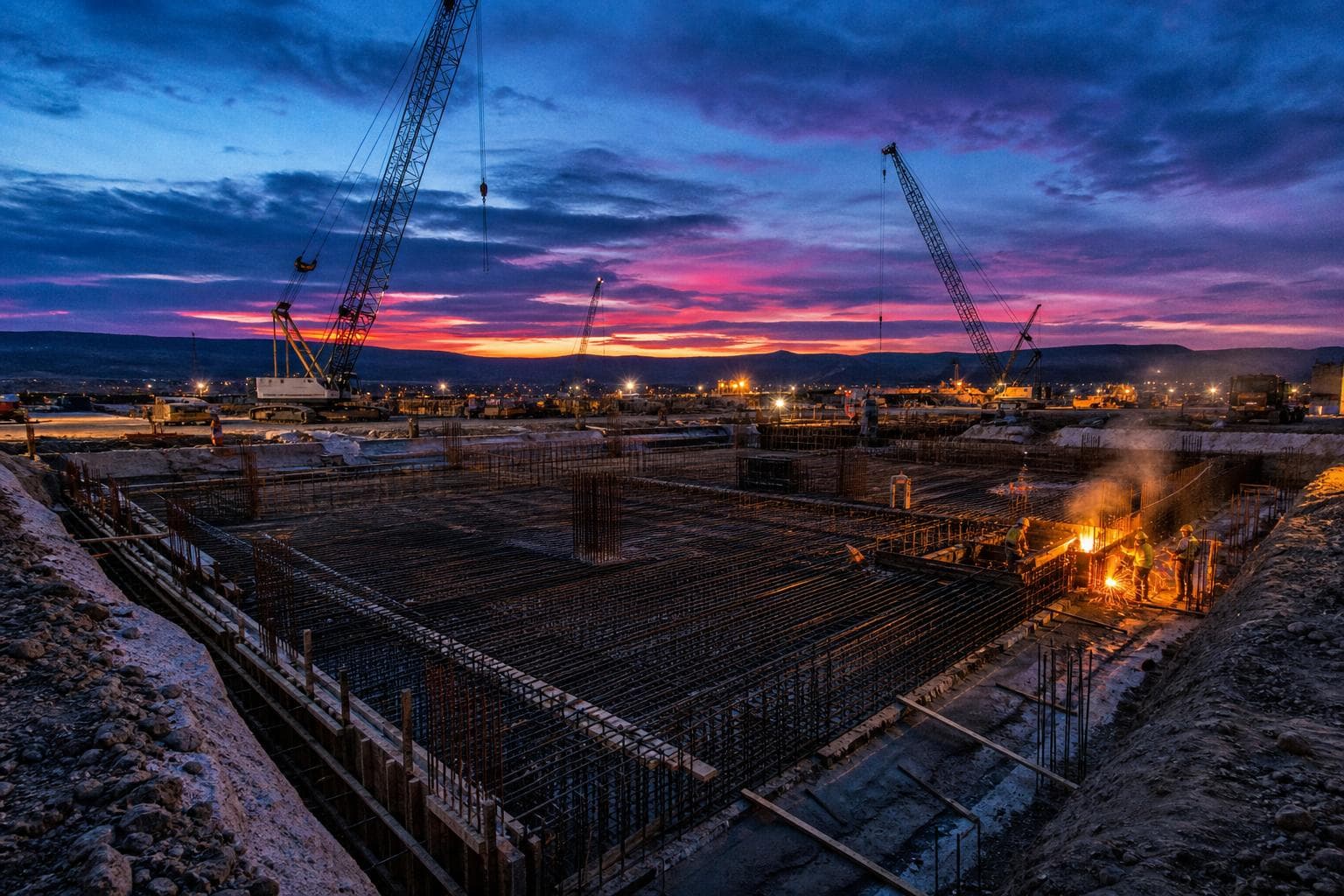
Meanwhile, in Kemmerer, Wyoming, the future was being poured in concrete. The Nuclear Regulatory Commission gave TerraPower final approval to begin construction in March, capping five years of safety demonstrations and site selection. This is only the fourth nuclear reactor to break ground in the U.S. this century — and one of the first in a new generation of advanced designs. TerraPower CEO Chris Levesque notes that communities are now competing to host nuclear plants. The NIMBY era may be ending. The abundance era may be beginning.
These two stories — oil volatility and nuclear construction — are not separate news items. They are the same argument, playing out in real time.
Deep Charge: The Degrowth Trap Is a Civilizational Choice, Not an Environmental One
Let's be precise about what degrowth actually proposes, because its advocates rarely are. At its core, degrowth argues that rich economies should deliberately shrink their energy consumption — and by extension, their economic output — to reduce environmental pressure. It sounds reasonable until you ask: shrink to what? And for whom?
The answer, when you follow the logic, is deeply uncomfortable. Because the people who need energy abundance most are not the ones already swimming in it.
The Demand Signal Is Already Telling Us the Answer
The International Energy Agency projects that U.S. data centers alone will need roughly 130% more energy by 2030 — driven primarily by AI workloads. That's not a rounding error. That's a doubling-plus of one sector's electricity appetite in four years. And AI isn't a luxury. It's becoming the substrate for drug discovery, materials science, logistics optimization, climate modeling, and agricultural yield improvement.
Jensen Huang put it bluntly at Davos: the United States may lead in AI models and chips, but China is spinning up power generation faster. If energy is the core of the competitive inner loop, that gap matters. Degrowth, in this context, isn't a principled environmental stance. It's unilateral disarmament.
The physical reality is stark. Meta's El Paso AI data center is targeting roughly 1 gigawatt of capacity — a single facility with the power footprint of a mid-sized city. That's not an outlier. It's the template. AI workloads require dense, continuous, high-reliability power, and the hyperscale campuses being built right now resemble large industrial facilities in their demand profiles. You cannot power this future with conservation. You cannot power it with efficiency gains alone. You need more electrons, full stop.
The Geopolitical Argument Degrowth Refuses to Make
Here's the thing about the Hormuz episode that should haunt every degrowth advocate: supply disruptions don't hurt the wealthy first. They hurt the poor first.
When Brent spikes toward $119 per barrel — the adverse scenario modeled by the European Central Bank for Q2 2026 — the pain cascades unevenly. European households face energy bills that consume a larger share of income. Developing economies that import oil face currency pressure and inflation. Agricultural supply chains that run on diesel get squeezed. The people with the least buffer absorb the most shock.
Degrowth, in practice, locks in that vulnerability. If the answer to energy price volatility is "use less," then the implicit policy is: the poor should use less, because the rich have already optimized. That's not environmentalism. That's austerity with better branding.
The actual answer to Hormuz-style disruptions is diversification and abundance: more nuclear, more domestic renewables, more grid resilience, more firm generation that doesn't depend on tanker routes through contested straits. The TerraPower plant in Kemmerer isn't just a climate story. It's a national security story. It's a poverty story. It's a "never again" story about what happens when civilization's energy supply runs through a single geographic chokepoint.
The Infrastructure Argument Degrowth Can't Win
Solutions to the AI power problem exist — renewable energy, battery development, gas, nuclear, and grid expansion — but they all face political and practical roadblocks. The industry is lobbying hard to accelerate them. Degrowth advocates are, in many cases, lobbying against them.
This is the contradiction that never gets examined. The same political coalition that worries about AI's environmental footprint often opposes the nuclear plants, transmission lines, and grid expansions that would make AI's energy supply cleaner and more resilient. They want less consumption without building the infrastructure that would make consumption less damaging. That's not a policy. That's a wish.
The infrastructure reality is unforgiving. Power availability has become the binding constraint on AI deployment — not chips, not fiber, not cooling. Developers are now working backward from power: where can we get enough reliable electricity, fast enough, under what operating conditions? Regions with firm generation and transmission headroom are gaining strategic importance. Regions without them are falling behind.
Degrowth doesn't solve this problem. It just decides that falling behind is acceptable — or worse, virtuous.
What TerraPower Actually Represents
The Kemmerer plant deserves more attention than it's getting, because it's a direct rebuttal to the degrowth frame. This is a Bill Gates-backed company building an advanced sodium-cooled reactor in a former coal town, with the blessing of the NRC, the enthusiasm of local communities, and purchase agreements from Meta for additional reactors. If the plant is online by 2031 as planned, TerraPower says it will generate enough electricity to power nearly half a million homes.
That's abundance. That's what it looks like when you build toward something instead of retreating from it.
The DOE's Reactor Pilot Program is pushing to have at least three advanced nuclear reactor concepts reach criticality — with a stated target tied to July 4th as a symbolic milestone. Nuclear is moving from the edges of infrastructure planning into the center of it, driven not by ideology but by the hard math of AI demand, grid resilience requirements, and the failure of intermittent sources to provide the firm power that hyperscale computing requires.
The degrowth movement has no answer to this math. It has aesthetics, not arithmetic.
By the Numbers
- 130% — Projected increase in U.S. data center energy demand by 2030, per the IEA, driven by AI workloads
- ~1 GW — Capacity target for Meta's El Paso AI data center, with investment exceeding $10 billion
- $119/barrel — Oil price peak in the ECB's adverse scenario for Q2 2026, modeling a sharp energy shock
- 2031 — TerraPower's target online date for the Kemmerer, Wyoming reactor, which would power roughly 500,000 homes
- 4th — Where the TerraPower plant ranks among nuclear reactors built in the U.S. this century
What We're Fighting For
The degrowth debate isn't really about energy. It's about what kind of civilization we want to be.
One path says: we've used enough, we should use less, the future is about doing more with less. It sounds wise. It is, in practice, a counsel of managed decline — dressed up in the language of sustainability but pointing toward a world where the next billion people don't get the energy access that made the last billion prosperous.
The other path says: the problem isn't that we use too much energy, it's that we don't produce enough of it cleanly, reliably, and cheaply. Build the nuclear plants. Extend the transmission lines. Permit the grid expansions. Make electricity so abundant and so clean that the question of "how much should we use" becomes as quaint as asking how much math we should do.
Watch the NRC's licensing pipeline for the next wave of advanced reactor applications — that's where the degrowth debate will actually be decided, not in academic journals or think-tank white papers. Watch whether the DOE's Reactor Pilot Program hits its criticality milestones. Watch whether Meta's El Paso campus comes online on schedule in 2028 and what it does to regional grid planning in the Southwest.
The future belongs to civilizations that build. Every kilowatt-hour we add to the grid is a vote for the world where the next TerraPower plant isn't news — it's Tuesday.
This is what we're fighting for.


