


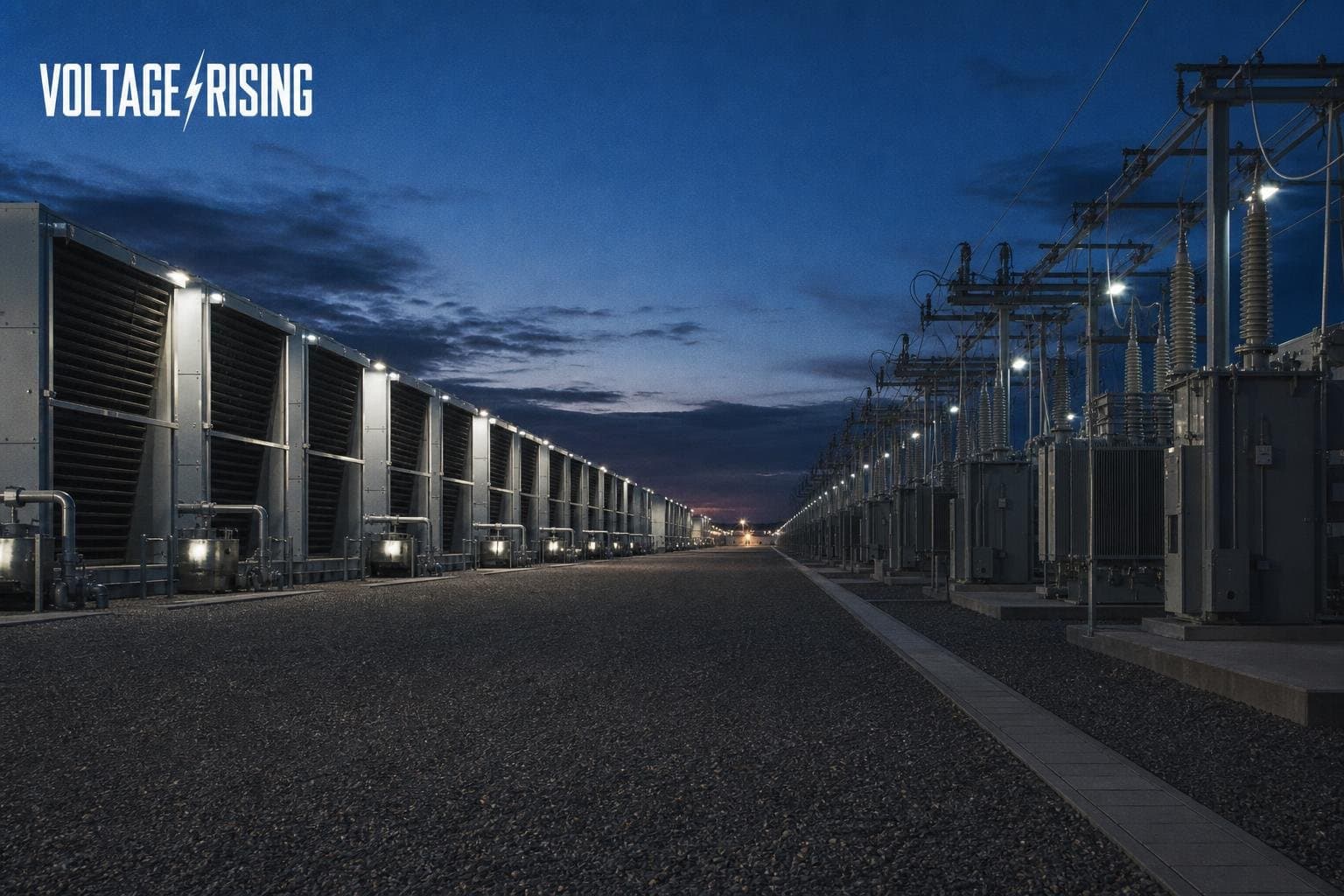

The EIA's June Short-Term Energy Outlook contains a number that deserves more attention than it's getting: commercial electricity demand is projected to surpass residential demand in 2026 for the first time on record. Not "approaching." Not "closing the gap." Overtaking. The EIA projects 1,547 billion kWh for commercial customers versus 1,512 billion kWh for residential — a structural inversion driven almost entirely by AI data centers and crypto mining.
This is what civilizational acceleration looks like in a spreadsheet. Total U.S. power consumption hit a record 4,195 billion kWh in 2025, and the EIA projects it climbs to 4,271 billion kWh in 2026 and 4,397 billion kWh in 2027. That's not a blip. That's a new demand regime.
The Grid Is Scrambling to Keep Up — and Regulators Know It
The supply side is in full sprint mode. FERC approved PJM's "expedited interconnection track" on June 9, allowing up to 10 fast-track reviews annually for projects of at least 250 MW that can come online within three years. The process expires at end of 2027 — a two-year emergency measure dressed up in regulatory language. When FERC creates time-limited fast-track pathways, that's not confidence. That's triage.
Meanwhile, the nuclear buildout is accelerating on the supply side. The DOE's Reactor Pilot Program has 11 projects moving through a new fast-track authorization pathway, with three securing Final Documented Safety Analyses as of May 2026, targeting at least three reactor designs reaching criticality by July 4, 2026. And the competition isn't waiting: China is preparing a $295 billion, five-year plan to build a nationwide network of AI data centers, drafted by the National Development and Reform Commission. That's not a market signal. That's a civilizational bet.
The through-line here is simple: AI is rewriting the demand curve faster than any grid operator planned for, and every institution — FERC, DOE, Beijing — is now running to catch up. The EIA's Hormuz analysis adds one more variable: with Brent averaging $105/bbl in June and July and Middle Eastern producers cutting output by over 11 million bpd, the economic pressure to electrify everything — faster — only intensifies.
The commercial sector just became the biggest electricity customer in American history. Watch whether the 4,397 billion kWh projection for 2027 holds, or whether AI deployment outpaces even the EIA's already-aggressive forecast.