


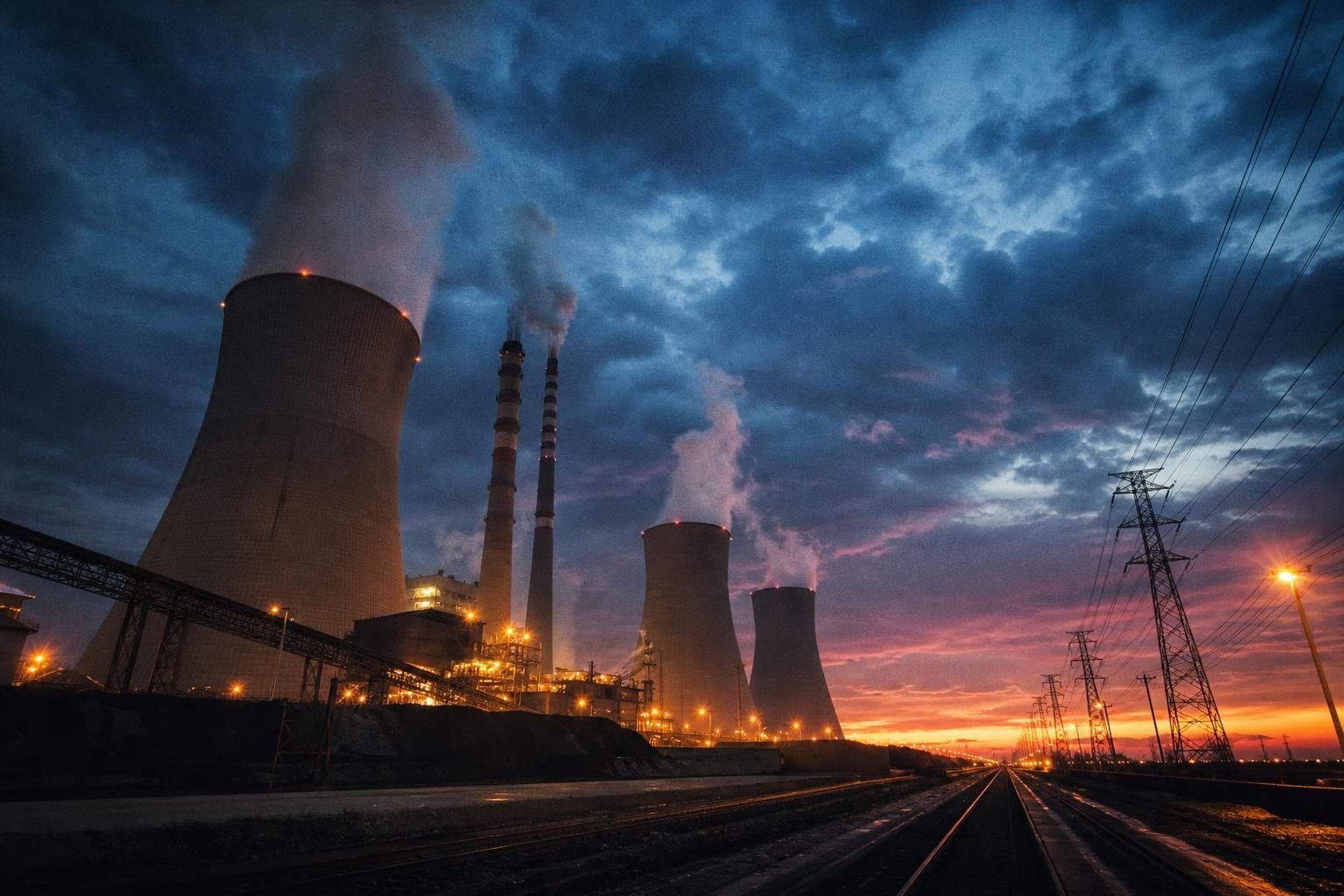

India just told more than 100 coal plants to stop planning their wind-down and start running flat out. On September 25, the federal power ministry ordered captive coal-fired stations with at least 50 megawatts of capacity to operate at maximum output from October 1 through year-end, invoking emergency provisions of the Electricity Act because it expects demand to keep climbing through the fourth quarter, per Reuters. Nearly 40% of those plants are already running on critically low fuel stock. The order covers 112 facilities tied to Vedanta, Tata Steel, Hindalco, JSW Steel, and other industrial giants, and it extends a separate emergency directive keeping Tata Power's imported-coal plant in Mundra at full tilt through December 31, per the same Reuters report.
This is the clearest, best-documented version right now of a pattern that shows up everywhere demand growth outruns new capacity: the plants you were supposed to be closing become the plants keeping the lights on.
The US Version Is Real, but Thinner Than You'd Like
The American storyline — utilities holding coal retirements open specifically to serve AI load — gets cited constantly, and the underlying mechanism is plausible given what's happening on the demand side. Reporting from DW points to utilities delaying retirement decisions on roughly 15 coal-fired plants nationwide as data center buildout accelerates, drawing on an earlier study that found more than half of US data centers already run on fossil generation. I'd treat that specific count as directionally useful rather than load-bearing — it's a secondary citation of older research, not a fresh utility filing or EIA release, and the publication date isn't clear. What's not in dispute is the pressure driving the behavior: the EIA's own numbers show total US net generation up 1.7% year-over-year in July 2026, with ERCOT setting a new all-time peak demand record of 91.1 gigawatts on July 22 during a heat wave, per the EIA's Electricity Monthly Update. Interestingly, that same EIA release shows national coal consumption down 6.0% and coal stockpiles down 8.0% month over month — a reminder that the broader US fleet is still shrinking even as individual plants get held open in AI-adjacent corridors. Retirement delays, where they're happening, are surgical, not systemic.
Announced Gigawatts Aren't Running Gigawatts
The regulatory fight over PowerHouse Hillwood's Joliet, Illinois data center campus is the sharper illustration of why coal keeps getting a stay of execution near load centers under AI pressure. FERC ruled on September 22 that Commonwealth Edison cannot cancel its transmission security agreement covering the 1.8 gigawatt, $20 billion campus — a project still tied up in a parallel federal court dispute over a $1 letter of credit that one commissioner called "an embarrassing legal fiction," per tftc.io. That 1.8 gigawatts is announced capacity contingent on winning a contract fight, not power flowing today. Every gigawatt of AI load that gets stranded in permitting or litigation is a gigawatt utilities have to cover with whatever's already interconnected — which, in a lot of PJM and ERCOT territory, still means coal.
Where the Money Is Actually Pointing
Investors are reading the same tea leaves. Bloomberg's survey of climate-focused fund managers ahead of Climate Week found rooftop solar, battery storage, and European utilities drawing renewed interest specifically because power demand is surging faster than clean buildout can absorb it, according to five managers collectively overseeing about $7.5 billion, per Bloomberg. That's not a bet that coal disappears on schedule — it's a bet that the gap between demand and clean capacity stays open long enough to be investable. The Verge's ongoing tracker of data center backlash cases, including a moratorium in Hernando County, Florida and Amazon's abandoned Calvert Cliffs campus, shows the other side of that gap: communities increasingly unwilling to host the infrastructure that would close it faster, per The Verge.
None of this is an argument for keeping coal running longer than necessary. It's an argument that the fastest way to actually retire it on schedule is building the replacement capacity faster than anyone is currently permitting it — nuclear, gas with real interconnection, storage at scale. India's emergency order and Joliet's contract fight are two data points on the same curve. Watch the Northern District of Illinois ruling on the Joliet letter-of-credit dispute and India's December 31 Mundra directive expiration — both are near-term tests of whether "temporary" emergency generation stays temporary once the load it's covering doesn't go away.