


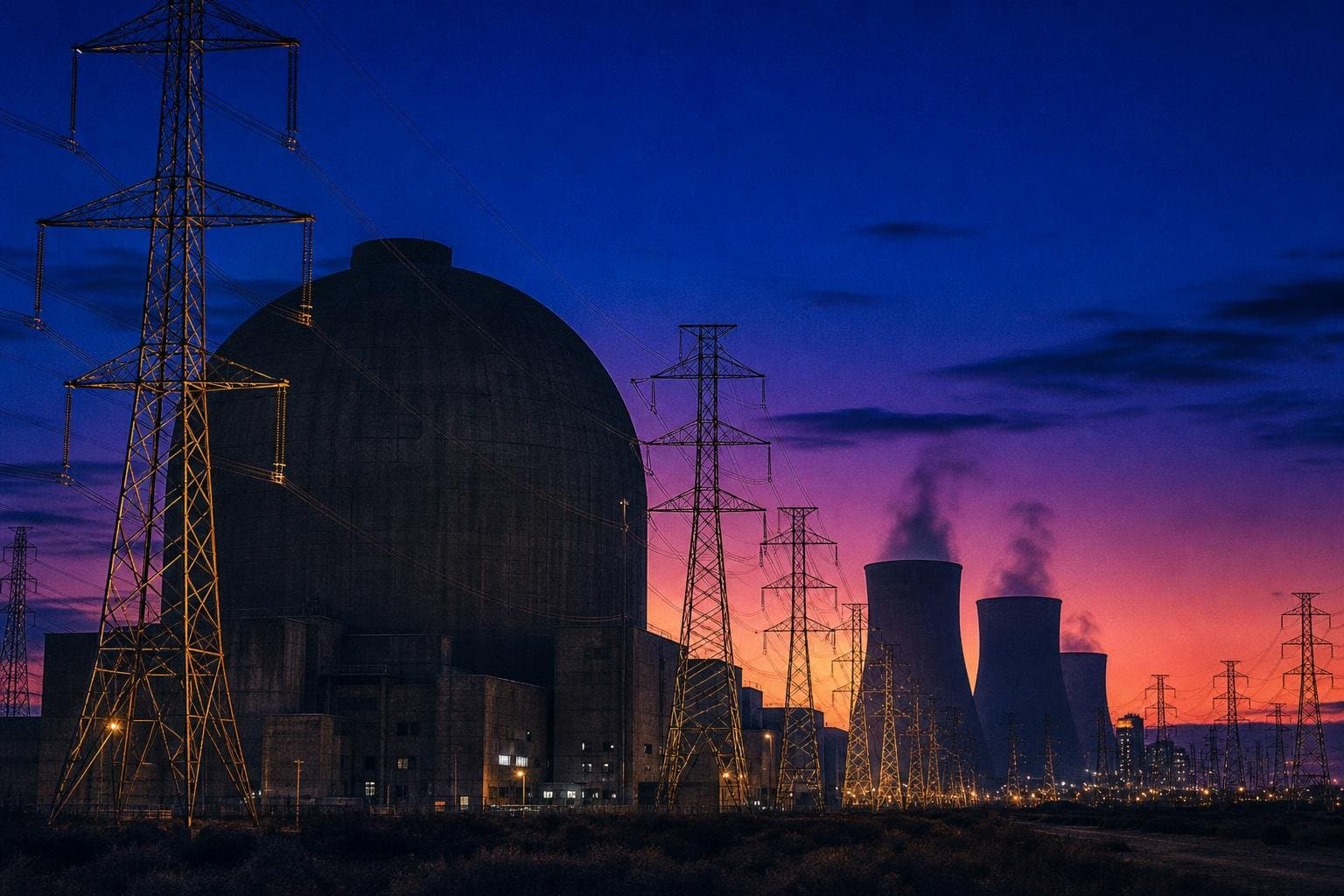

The civilizational scoreboard updated again last Friday. China's State Council approved eight new nuclear generating units across four provinces — Zhejiang, Guangdong, Liaoning, and Shandong — with total investment estimated at more than 170 billion yuan ($25 billion). Eight reactors. One cabinet meeting. Done.
This is the pace of a civilization that has decided electricity abundance is non-negotiable. China already leads the world in installed nuclear capacity, with 125 gigawatts operational as of April 2026, 60 units in commercial operation and 36 under construction. Last year they approved 10 new units. This year, eight more. The compounding is the point.
The Contrast Is Damning
While Beijing was signing off on gigawatts, the Danube was reminding Europe what energy fragility looks like. Romania was forced to shut down both of its nuclear reactors at Cernavoda — the first time low water levels have ever knocked both offline simultaneously — after the river hit decades-low levels. Those two 706-megawatt reactors account for roughly a fifth of Romania's power production. Gone, because of a drought. Peak demand that week was estimated at 7.3 GW against domestic production of up to 4.3 GW before the second shutdown. The gap gets filled by imports and price spikes.
That's what a thin grid looks like under climate stress. Romania didn't build enough redundancy. Europe broadly hasn't. And China, watching all of this, keeps approving reactors.
Meanwhile in the U.S., the most notable nuclear headline of the week was NextEra and Brookfield announcing a $100 billion data center campus in Paducah, Kentucky — anchored by a 2-gigawatt natural gas plant and up to 2.6 gigawatts of battery storage. Private capital doing what the grid hasn't. That's progress, but it's also a workaround, not a strategy.
China's State Council doesn't hold multi-year public comment periods before approving a reactor. That's a real tradeoff — and not one to dismiss lightly. But the energy abundance math is unforgiving: the civilizations that build generation capacity at scale will have the compute, the industry, and the optionality that the ones still debating process won't. Eight react