


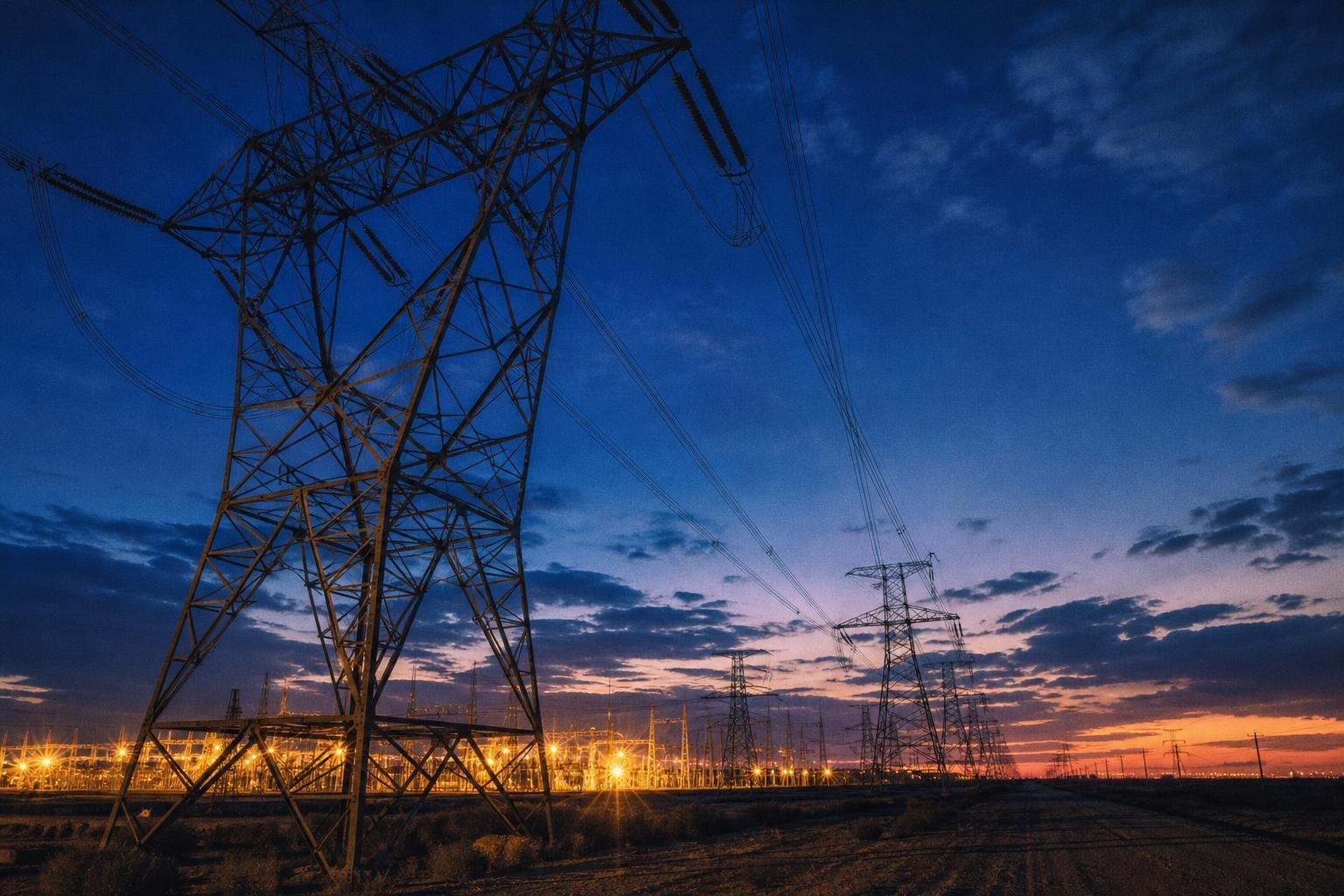

Everyone's watching chip export controls. They should be watching wires.
China generated 10.6 trillion kilowatt-hours of electricity in 2025 — roughly a third of global output and 2.4 times what the US produced — and added generating capacity last year equivalent to more than three times France's entire installed base, according to The Straits Times. Under its 15th Five-Year Plan covering 2026-2030, Beijing is targeting another 1,500 gigawatts of new capacity — more than the EU's entire installed base — with two-thirds of that growth coming from renewables. That's not a rounding error. That's a civilization deciding electrons are the scarce resource that matters and building accordingly.
The Wires Are the Bottleneck, Not the Turbines
Here's the part that should alarm anyone tracking the AI buildout: China hasn't just out-built the US on generation. It's out-built on transmission too, and by a margin that makes the generation gap look modest. Over the past 15 years, China constructed 6 to 7 times more high-capacity transmission than the United States, with Europe building 7 to 8 times more, according to a Grid Strategies report cited by Energy Central. The US has more than 10,000 miles of 500kV+ lines scheduled to come online by 2034, with MISO, ERCOT, CAISO, and SPP all running regional efforts — but "scheduled by 2034" is the key phrase. That's eight years out, and the IEA estimates transmission builds in advanced economies already take four to eight years once permitting clears, while wait times for critical grid components have doubled over the past three years, per The Straits Times.
Beijing's response to its own version of this problem is instructive. China has built wind and solar farms faster than it can wire them up — curtailment in the renewable-rich west is a real cost of stranded generation, according to Energy Intelligence. The fix isn't a white paper. It's a record grid budget exceeding 5 trillion yuan (roughly $750 billion) for 2026-2030, about 80% above the prior five-year period's 2.8 trillion yuan, according to figures from China's National Energy Administration relayed by Energy Intelligence. When China hits a bottleneck, it throws state capital at the bottleneck immediately. That's the muscle memory of a state that treats electricity as a civilizational input rather than a market commodity to be optimized at the margin.
Floating Turbines as Proof of Concept, Not Proof of Scale
The engineering flex gets real attention too. Ming Yang Smart Energy's OceanX platform, floating 70km off China's southern coast, pairs two turbines on a V-shaped frame tall as a 73-story building and already generates the most power of any floating wind platform on record, per the China Classification Society as reported by The Straits Times. The company plans an even larger 50MW twin-turbine platform — triple OceanX's capacity — as soon as 2027. I want to be precise here: that's announced capacity on a company roadmap, not operating generation, and floating offshore wind projects worldwide have a long history of slipping timelines. One platform surviving three Category 5 typhoons is a genuine engineering milestone. It is not evidence that China's 1,500 GW five-year target will land on schedule or at the renewable share projected. Treat the number as directional ambition, not delivered megawatts.
Why the Gap Compounds Instead of Closing
This is where the AI race actually gets decided. Compute scales however fast chips allow. Power scales however fast interconnects, transformers, and high-voltage lines allow — and that's the slower variable by years, not months. The US has real momentum: 10,000-plus miles of major transmission in the pipeline is not nothing, and FERC-level coordination efforts are finally being discussed as the Energy Central piece notes. But "could soon speed up" is a hope, not a delivered fact. China is already executing at a run rate the US transmission system has never matched in fifteen years of trying.
The lesson isn't that America should mimic China's state-directed capital allocation wholesale — different system, different constraints. The lesson is that the bottleneck conversation in US energy policy needs to stop centering on reactors and turbines and start centering on steel-in-the-ground transmission capacity, because that's the input nobody can conjure in eighteen months regardless of how much capital shows up. Watch whether the 500kV+ line buildout actually clears permitting ahead of 2034, and watch the next NEA budget disclosure to see if China's $750 billion figure turns into executed contracts rather than planning-stage allocation. The side that turns megawatts into miles of copper first wins the decade that follows.