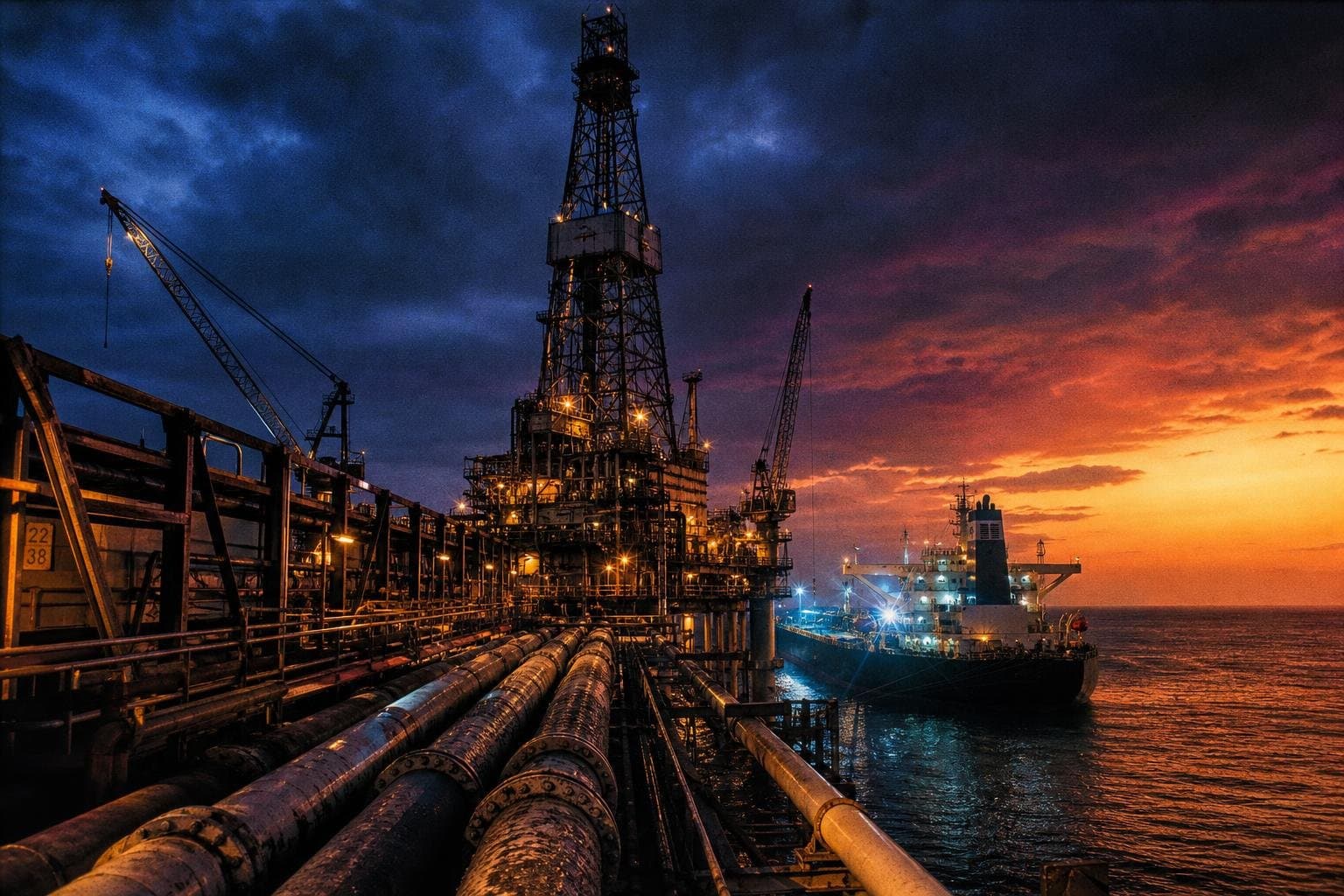

A nearly $40-per-barrel price range in a single month. That's not volatility — that's a civilization running on a fuel it cannot control.
According to the IEA's August 2026 Oil Market Report, benchmark crude traded in an "exceptionally wide range of almost $40/bbl" in July alone, driven by geopolitical developments and tightening crude markets. North Sea Dated — the Brent benchmark — rose $25.67 per barrel over the month to close at $96.80, before pulling back to around $92 at the time of the IEA's writing. As of this weekend, Bloomberg reported Brent trading below $89, after gaining 6% the prior week, with WTI near $82 — fresh fighting in Lebanon and continued Hormuz vessel attacks keeping the market on edge.
This is what fossil fuel dependency looks like at civilizational scale: a single chokepoint, a single conflict, and the entire global energy financing picture rewrites itself in real time.
The Supply Picture Is Still Broken — and Getting Worse
Let's be precise about what's actually happening in the physical market, because the numbers are staggering.
The IEA reports that global oil supply rose 2.4 mb/d in July to 101.5 mb/d — but that figure still sits 6.3 mb/d below year-ago levels, with 8.3 mb/d of Gulf output shut in. Renewed hostilities and maritime disruptions in July and early August then knocked projected Q3 supply down by another 1.7 mb/d compared to the prior month's estimate. The IEA now projects global oil supply will decline by 4.3 mb/d on average across all of 2026.
On the demand side, the IEA revised its 2026 demand contraction to 1.6 mb/d — 510,000 barrels per day worse than its previous estimate — as elevated fuel prices suppress consumption. Reuters reported that OPEC simultaneously cut its own 2026 demand growth forecast to 580,000 bpd, while U.S. commercial crude inventories posted their largest weekly build since January 2023 — up 17.4 million barrels to 424.4 million barrels in the week ended August 7.
Demand destruction and supply disruption, simultaneously. The market is being pulled apart.
The only thing keeping prices from going vertical again is a shadow logistics operation. Bloomberg reported that Middle Eastern producers are running covert shipments at full tilt — ferrying crude through the Strait of Hormuz undetected, transferring barrels to tankers in the Gulf of Oman, despite ongoing vessel attacks. This is the actual price stabilization mechanism right now: a clandestine tanker operation threading through an active war zone. That's the floor under global energy markets. Sleep well.
What This Means for the Electricity Transition
Here's the civilizational argument that this moment makes unavoidable.
Every solar panel, every nuclear reactor, every grid-scale battery installation is a unit of energy that cannot be held hostage by a conflict in the Persian Gulf. Every gigawatt-hour of electricity generated domestically — from uranium, from wind, from solar — is a gigawatt-hour that doesn't depend on covert tanker routes through a strait where ships are being attacked right now.
The EIA, per Forbes's analysis of its current forecasts, now projects Brent averaging $82 for 2026 and $65 for 2027, assuming the conflict continues to unwind. That's the optimistic scenario. The scenario where Lebanon escalation pulls Iran back into active confrontation, where Hormuz vessel attacks intensify, where the covert tanker operation gets disrupted — that scenario has a very different price path. The IEA's global inventory figure tells you how thin the buffer is: total observed oil stocks are down 410 million barrels since the start of the war.
The energy transition financing argument runs both directions here. Yes, volatile oil prices create uncertainty for project financing — capital markets hate uncertainty, and a $40 swing in a month makes long-duration infrastructure investment harder to underwrite. That's real. But the more powerful argument is the opposite: every month of this chaos is a month that makes the case for electricity abundance more viscerally than any policy paper ever could. When your civilization's energy supply depends on covert tanker operations in an active war zone, the "risk premium" for electrification isn't a cost — it's the cheapest insurance policy in history.
The Acceleration Case, Made by the Market Itself
The IEA projects global oil demand returning to growth in Q4 2026 and expanding by 2.4 mb/d in 2027 — assuming the conflict resolves. That assumption is doing a lot of work right now, with Bloomberg reporting that US-Iran negotiations appear "at a standstill" and Lebanon seeing its deadliest fighting in months.
Watch the Q3 IEA Oil Market Report in September — if supply recovery continues to underperform and the demand contraction deepens, the financing case for accelerating grid buildout and nuclear construction becomes not just compelling but urgent. The grid that can't be blockaded is the grid worth building. Every week this drags on, that argument gets louder.
The future is electric. The Persian Gulf is making the case for us.


