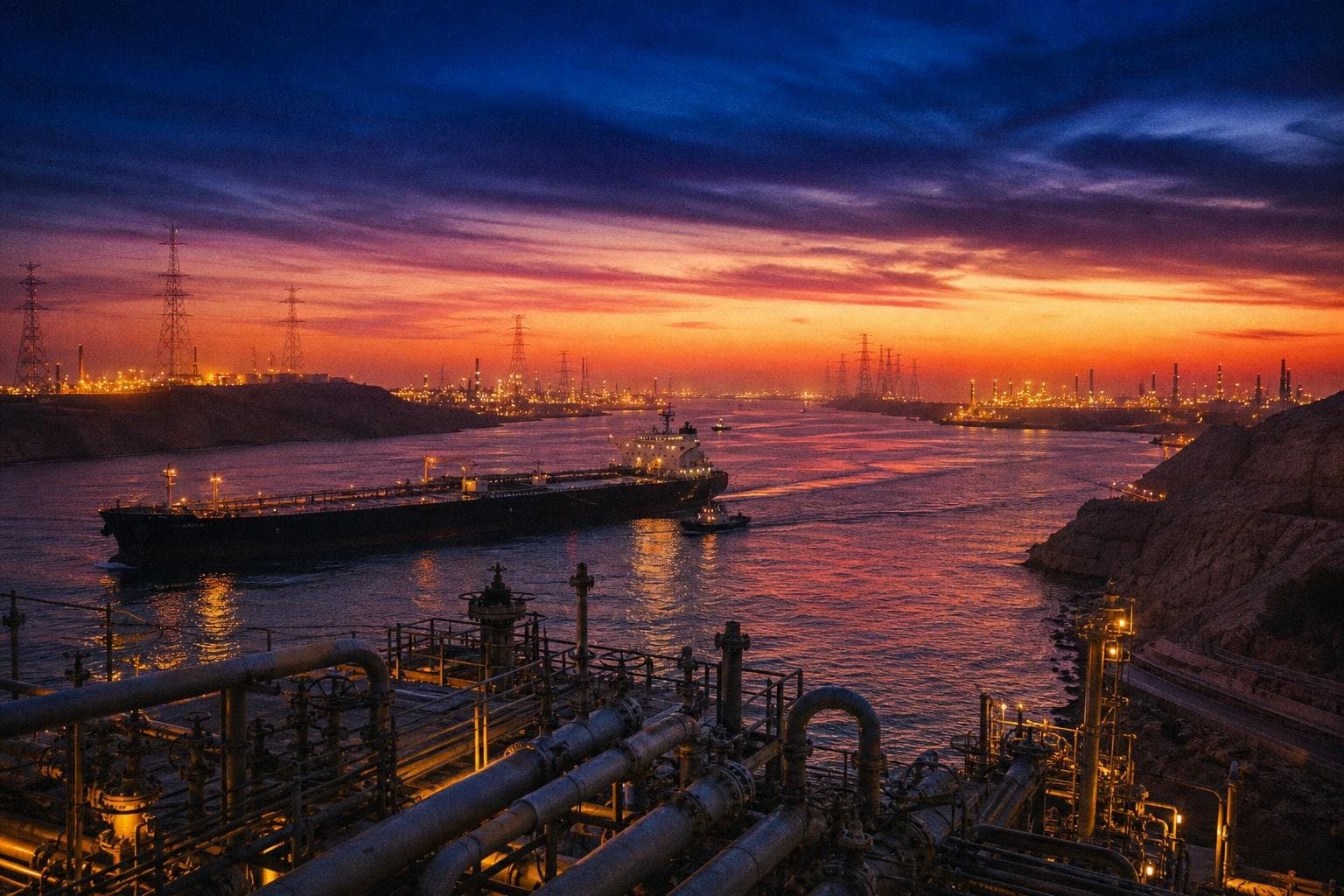

Brent crude crossed $100 a barrel on September 9th. Not briefly — it settled at $101.21, its highest close since late May, after Iran attacked 10 ships near the Strait of Hormuz and the U.S. Navy sank five Iranian oil tankers in the largest single-day exchange of the six-month war. By Thursday, Brent was holding above $101 and WTI was at $96.55, with analysts at ING describing "no credible path to de-escalation" in the Persian Gulf.
This is what civilizational dependency looks like. A narrow waterway between Iran and Oman — the Strait of Hormuz, which before this war carried roughly a fifth of global oil and gas supplies — is now the single most consequential chokepoint in the global economy. Every data center, every EV charging station, every AI training run that still depends on a fossil fuel supply chain that routes through that strait is exposed. And the exposure is getting worse.
The Strait Is Already Breaking the Demand Signal
The IEA's September 2026 Oil Market Report is worth reading slowly. Global oil production fell by 1.6 million barrels per day month-over-month to 100.1 mb/d in August, with more than 10 mb/d of Gulf supply disrupted. World oil demand is now forecast to decline by 2.5 mb/d in 2026 — 940,000 barrels per day steeper than the IEA projected just last month — as the impasse between the U.S. and Iran delays any normalization of flows. Losses are concentrated in middle distillates and petrochemical feedstocks, especially in Asia.
That demand destruction is not a policy victory. It's an economy choking on its own fuel costs. Bank of America analysts noted this week that "the biggest impact of the conflict has been on petroleum products rather than crude oil itself" — diesel has hit record highs, surpassing its previous peak by more than 55% since the war began, and is now approaching $6 a gallon nationally. Diesel powers farms, trucking, and trains. This is not an abstraction. This is the cost of building civilization on a fuel that has to pass through someone else's war zone.
Commodities analysts are now warning Brent could reach $120 to $150 if the stalemate continues or infrastructure damage escalates. Bank of America puts the upper bound at $150 in a scenario involving major damage to energy facilities. That number should be tattooed on the forehead of every energy minister who has spent the last decade arguing that fossil fuel infrastructure is the "reliable" choice.
AI's Electricity Demand Is Accelerating Into This Headwind
Here's the civilizational collision: at the exact moment that oil market volatility is exposing the fragility of fossil-dependent energy systems, electricity demand is surging to record levels — driven precisely by the AI buildout that everyone agrees is the defining infrastructure investment of this decade.
The EIA's September 2026 Short-Term Energy Outlook projects U.S. power consumption rising from a record 4,195 billion kWh in 2025 to 4,270 billion kWh in 2026 and 4,349 billion kWh in 2027. Data centers dedicated to AI and cryptocurrency are the primary demand driver. The EIA specifically called out the West South Central region — Texas and its neighbors — as accounting for the largest share of electricity sales growth in the forecast, even accounting for the pause in new data center grid connections ERCOT imposed earlier this year.
This is what we're fighting for: an electricity system that can absorb this demand without routing it through a geopolitical chokepoint. Natural gas still supplies 40% of U.S. power generation — flat in the EIA's forecast through 2027 — and Henry Hub prices move with global LNG markets that are themselves sensitive to Persian Gulf disruption. Every percentage point of generation that shifts from gas to nuclear, solar, or wind is a percentage point of AI infrastructure that becomes immune to whatever happens in the Strait of Hormuz.
Renewables are projected to grow from 24% of U.S. generation in 2025 to 27% in 2027. Nuclear holds at 18%. That trajectory is real progress — but it is not fast enough for a world where Brent can add $3.29 in a single session because two navies exchanged fire over a shipping lane.
The Acceleration Argument Has Never Been Stronger
Bloomberg's markets coverage framed the Brent move through its effect on equities and Fed rate expectations — stocks fell for a third straight day, ten-year Treasury yields hit their highest since 2023, and markets began pricing in rate hikes to contain the inflationary pressure from energy costs. That's the financial system's way of saying that oil volatility is now a macro constraint on everything else, including the capital markets that fund grid buildout and nuclear construction.
Every week that Brent stays above $100 is a week that makes the case for electrification more viscerally than any policy paper ever could. The question for builders and investors is whether the urgency translates into construction timelines or just into op-eds.
Watch the EIA's October STEO for any revision to the natural gas generation share — if gas demand for power rises as LNG exports tighten, that's the signal that the grid is moving in the wrong direction under pressure. And watch FERC's interconnection queue data for whether the pace of renewable and nuclear approvals is accelerating to match the demand signal the AI boom is sending. The market is screaming for energy independence. The infrastructure has to answer.


