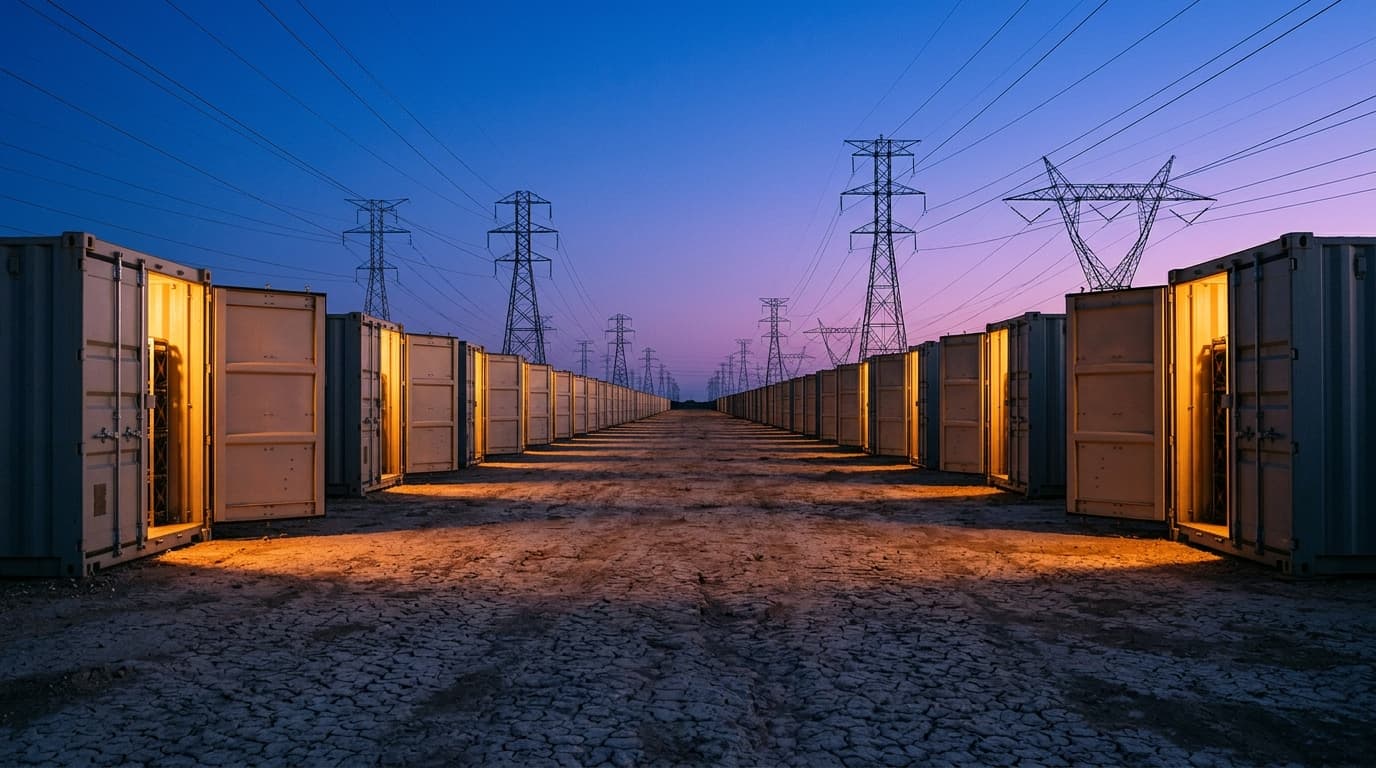

There's a thought experiment worth running: what if the most controversial electricity consumer of the past decade turns out to be the one that forced the grid to grow up?
Bitcoin mining has spent years as the villain in every energy conversation — the punchline in climate debates, the target of state-level moratoriums, the thing environmentalists point to when they want a concrete example of "wasteful" computation. But viewed through the lens of infrastructure reality rather than moral panic, the picture looks different. Bitcoin miners are large, price-sensitive, geographically flexible loads that can be switched off in seconds. That combination of properties is genuinely rare and genuinely valuable. The grid needs more of it, not less.
This week's data makes the stakes concrete. Let's get into it.
This Week in Voltage: The Grid Is Being Asked to Do the Impossible
ERCOT filed its newest long-term load forecast last week, and the number is staggering: peak electricity demand surpassing 367 gigawatts by 2032 — more than four times the current all-time peak of 85,508 MW recorded in August 2023. The majority of that projected load comes from large sites drawing at least 75 MW each, dominated by data centers but also including cryptocurrency mining, industrial operations, and oil and gas processes.
ERCOT's own CEO Pablo Vegas immediately flagged that the forecast is "higher than expected future load growth," and the agency's general counsel raised concerns about using it as a planning baseline. So we have a grid operator simultaneously publishing a demand projection and distancing itself from it — which tells you something about how genuinely uncertain this moment is.
Meanwhile, MISO — the grid operator covering much of the Midwest — expects 8 to 14 GW of data centers to come online in 2026–2027 alone, with total load jumping 35% by 2035. And the federal government is trying to keep pace: a new U.S. initiative announced this week will provide low-cost financing to increase existing nuclear plant output by 5 GW by 2029, explicitly targeting the data center and manufacturing demand surge.
FERC, for its part, plans to act in June on interconnection reforms specifically designed to handle large-load customers like data centers. The regulatory machinery is finally moving — but the demand is already here.
Into this environment, Bitcoin mining walks in and gets blamed for the chaos. The actual story is more interesting.
Deep Charge: The Flexible Load Nobody Wants to Admit They Need
Here's what the Congressional Research Service's April 2026 report on cryptocurrency mining and the electricity sector actually says, buried beneath the obligatory concern-framing: "Some see an opportunity to leverage cryptocurrency mining facilities as a way to manage growth in electricity demand and to moderate wholesale power prices during times of peak demand or low generator availability."
That sentence deserves to be read twice. The CRS — not a Bitcoin advocacy group — is acknowledging that mining facilities can function as demand management tools. This is the insight that the conservation-first crowd consistently misses, and it matters enormously for how we think about grid architecture.
The core property that makes Bitcoin mining valuable to grid operators is interruptibility at scale. A large mining facility drawing 200 MW can, in principle, drop that load to near-zero within minutes when the grid signals stress. No other industrial load of comparable size offers that flexibility without significant process disruption. Aluminum smelters can't do it. Data centers processing financial transactions can't do it. Manufacturing lines can't do it. Bitcoin miners can, because the "product" — validated blockchain transactions — is temporally flexible in a way that almost no other industrial output is.
This isn't theoretical. The CRS report notes that some states have already moved to offer miners reduced electricity rates and opportunities to participate in electric load reduction programs — essentially paying miners to be interruptible. That's a market signal. When grid operators start paying you to exist and be flexible, you're providing a service, not just consuming a resource.
The rate dynamics cut both ways, and the CRS is honest about this: when localized mining demand exceeds available generation capacity, utilities may raise rates to recover capital investment costs. But when a utility can accommodate the demand, increased sales can actually lead to rate reductions. The outcome depends on whether the infrastructure investment follows the demand signal — which is exactly the argument for building more generation, not for suppressing the demand.
Bitcoin Mining Forces the Infrastructure Conversation Nobody Wanted to Have
Here's the civilizational argument: every major energy demand catalyst in history has faced the same political resistance before it forced the infrastructure buildout that made the next era possible. Air conditioning was "wasteful." The interstate highway system was "extravagant." Data centers in the 1990s were "energy hogs." Each time, the demand signal won — and the infrastructure that followed served far more than the original use case.
Bitcoin mining is doing something similar right now, and it's doing it in places that desperately need the signal. Miners are geographically flexible in a way that AI data centers are not — they don't need fiber density, proximity to financial centers, or specific climate conditions. They go where power is cheap, which often means where generation capacity is stranded or underutilized. Stranded wind in West Texas. Underutilized hydro in the Pacific Northwest. Flared natural gas at oil fields that would otherwise burn it into the atmosphere for nothing.
That last case is worth dwelling on. The CRS report notes that blockchain technologies could present opportunities for the electricity sector by facilitating transactions on a smart grid — but the more immediate opportunity is simpler: miners consuming gas that would otherwise be flared are converting waste into computation. The alternative isn't "no emissions." The alternative is flaring, which produces emissions with zero productive output. Mining at least produces a transaction ledger and a demand signal that can attract pipeline investment.
The ERCOT forecast — even discounted by ERCOT's own leadership — tells you that Texas is going to need to build a lot of generation capacity over the next decade. The question is whether that capacity gets built proactively, ahead of demand, or reactively, after blackouts and price spikes force the issue. Bitcoin miners, by showing up early and creating localized demand signals, are doing the unglamorous work of forcing that conversation before the crisis arrives.
By the Numbers
- 367 GW: ERCOT's projected peak demand by 2032, per its latest long-term load forecast — more than 4x the August 2023 all-time peak of 85,508 MW
- 8–14 GW: Data center capacity MISO expects to come online in 2026–2027 across its footprint
- 5 GW: Additional nuclear output the U.S. government is targeting by 2029 through low-cost financing for existing plants
- 1,050 TWh: One estimate for global data center energy consumption approaching by 2026, per Brookings — which would rank data centers as the fifth-largest national energy consumer globally
- June 2026: FERC's target date for acting on large-load interconnection reforms — the regulatory decision that will shape how fast new demand can actually connect to the grid
What We're Fighting For
The conservation-first critique of Bitcoin mining assumes that electricity is a fixed resource to be rationed rather than an expandable resource to be grown. Every kilowatt-hour a miner consumes is, in that worldview, a kilowatt-hour stolen from something more deserving. But that framing is exactly backward. The miner consuming power in a stranded-generation zone is creating the economic justification for the transmission line that eventually connects that zone to the broader grid. The miner participating in demand-response programs is teaching the grid how to handle flexible industrial loads at scale — a capability that becomes more valuable, not less, as renewable penetration increases and the grid needs more dispatchable flexibility.
The ERCOT forecast, even heavily discounted, describes a Texas that needs to roughly double or triple its generation capacity over the next decade. The MISO forecast describes a Midwest in the same position. The federal government is scrambling to finance nuclear uprates. FERC is racing to reform interconnection rules before the queue collapses under its own weight.
In that environment, the argument against Bitcoin mining as an energy demand catalyst is an argument for a smaller, slower, more timid grid. I'd rather have the stress test. I'd rather have the demand signal that forces the infrastructure conversation before the crisis, not after. I'd rather have a grid that learns to handle 200 MW of interruptible industrial load in West Texas than one that never had to.
Watch the June FERC interconnection decision closely. If the reforms pass, large flexible loads — including miners — get a cleaner path to the grid. If they stall, the bottleneck tightens and the demand signal gets louder anyway. Either way, the electricity is coming. The only question is whether we build fast enough to meet it.
The future is electric. Build the grid to prove it.


