
This Week in Voltage
The TerraPower construction site in Kemmerer, Wyoming is becoming the most photographed dirt pile in American energy. And for good reason. NPR reported this week that the Nuclear Regulatory Commission gave TerraPower final construction approval in March — capping five years of safety demonstrations — and that the plant, if it comes online by 2031, would generate enough electricity to power nearly half a million homes. CEO Chris Levesque put it plainly: "There is an energy crisis, it's concerning." The IEA projects U.S. data centers will need roughly 130% more energy by 2030. TerraPower is one answer to that equation.
But nuclear is a long game. The reactor in Kemmerer won't flip a switch until 2031 at the earliest. Meanwhile, the grid needs solutions that can deploy in months, not years. That's where something quieter — and faster — is already reshaping the equation.
Deep Charge: The Battery Inflection Point Nobody Announced
There was no press conference. No ribbon-cutting. But sometime in the last 18 months, battery storage crossed from "promising technology" to "grid infrastructure." The evidence is stacking up fast.
According to the LA Times, average battery costs dropped roughly 75% between 2018 and 2025, and analysts at BloombergNEF expect another 25% decline through 2035. That's not incremental improvement — that's a technology in freefall toward commodity pricing. And when a technology gets cheap enough, it stops being optional.
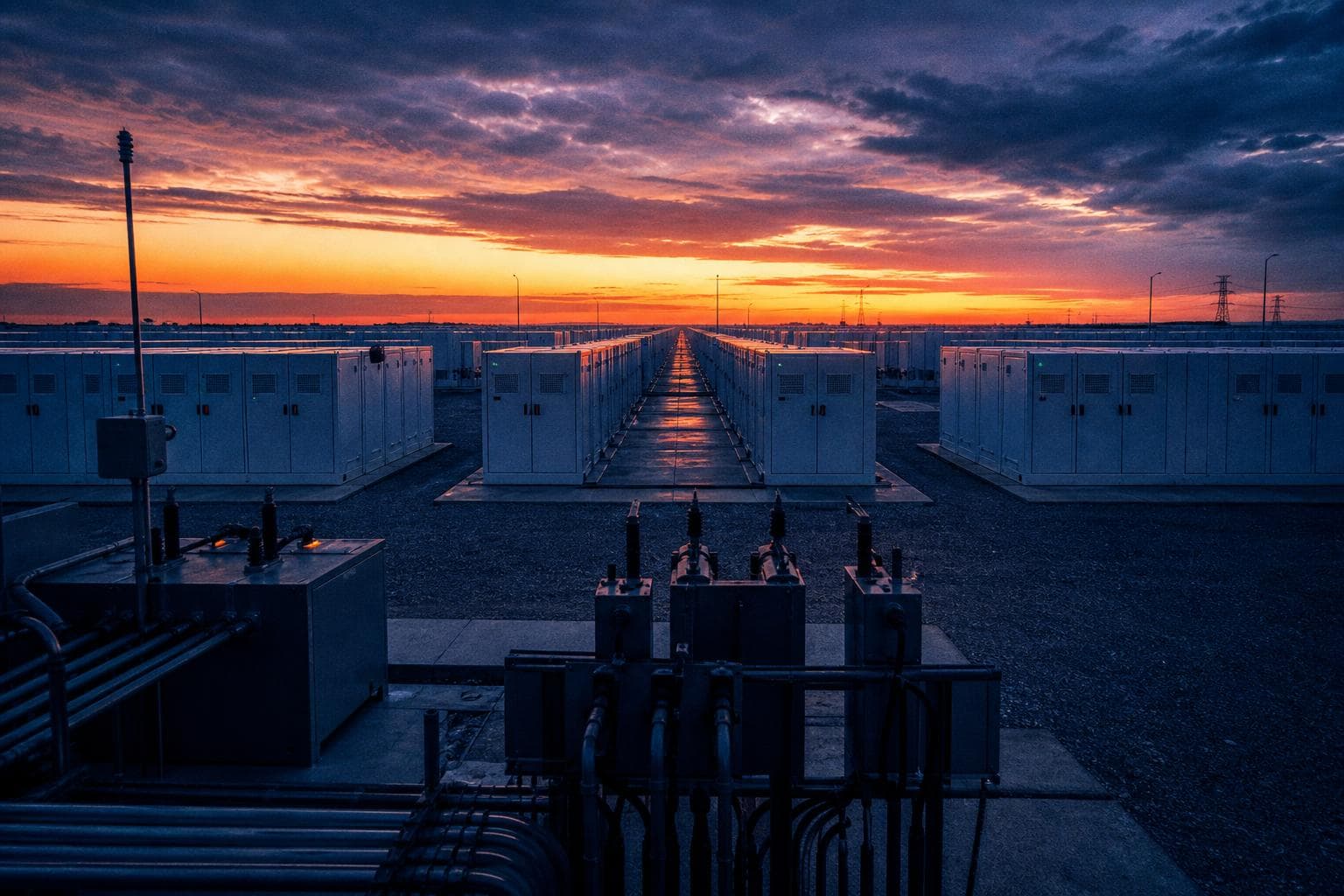
The proof is in the deployments. In inner Mongolia, three massive battery installations recently came online with a combined capacity of 7.4 gigawatt-hours. In Australia — the world's largest battery market per capita — the partially operational Waratah Super Battery in New South Wales discharged more power onto the main grid during evening peak hours than gas-fired plants. That's not a pilot program. That's displacement.
The IEA's head of power sector analysis, Brent Wanner, said it directly: "We've now crossed into a point where anytime anyone is looking at investing in the power system, batteries are one of the most attractive options."
The geopolitical tailwind is real too. Middle East tensions have lifted fossil fuel costs and accelerated the search for alternatives. In Vietnam, a developer is already seeking to replace a planned LNG-to-power project with renewables paired with storage — citing the fuel cost surge. War is doing what carbon pricing couldn't: making the economics of storage undeniable.
The dominant chemistry driving this is lithium-iron phosphate. The IEA's Global Energy Review 2026 reports that LFP batteries now account for around 90% of grid storage deployments — cheaper than rival chemistries and better suited to the frequent charge-discharge cycles that grid applications demand.
The remaining frontier is duration. Most grid batteries today handle four to six hours of discharge — enough to smooth the evening solar cliff, not enough to carry a grid through a cloudy week. The DOE's Long-Duration Energy Storage program defines the target as systems capable of delivering electricity for 10 or more hours, and explicitly acknowledges that today's storage technologies are "not sufficiently scaled or affordable enough" for that role. That's the honest assessment. The commercial deployments are real; the 24/7 claim is still a work in progress.
But here's the thing: you don't need to solve 10-day storage to transform the grid. You need to solve the evening peak, the overnight gap, the six-hour renewable drought. And that problem is increasingly solved. The 24/7 grid isn't a single breakthrough — it's a stack of incremental deployments that collectively make fossil fuel peakers redundant. We're watching that stack get built in real time.
By the Numbers
- ~75% — drop in average battery storage costs from 2018 to 2025, per BloombergNEF
- ~25% — additional cost decline projected through 2035
- ~90% — share of grid battery deployments using LFP chemistry, per IEA Global Energy Review 2026
- 7.4 GWh — combined capacity of three new battery installations in inner Mongolia
- 130% — projected increase in U.S. data center energy demand by 2030, per IEA
- 2031 — earliest expected online date for TerraPower's Kemmerer reactor
What We're Fighting For
The knock on renewable energy has always been the same: the sun sets, the wind dies, and you're back to burning something. That argument is getting harder to make. Not because it's wrong in principle, but because the economics of storage are systematically dismantling it, one gigawatt-hour at a time.
The civilizational bet here is straightforward: if storage costs keep falling on the trajectory BNEF projects, and if long-duration technologies close the remaining gap, then renewable energy stops being an intermittent resource and becomes a baseload one. That's not a small thing. That's the unlock that makes energy abundance structurally achievable — not just in favorable geographies, but everywhere.
Watch Australia. Watch the Waratah Super Battery's full commissioning in 2026. Watch whether Vietnam's LNG-to-storage pivot gets approved. These are the leading indicators of whether the 24/7 grid is arriving on schedule — or whether long-duration storage needs to move faster than the funding currently allows.
The future is electric. The batteries are almost ready.


