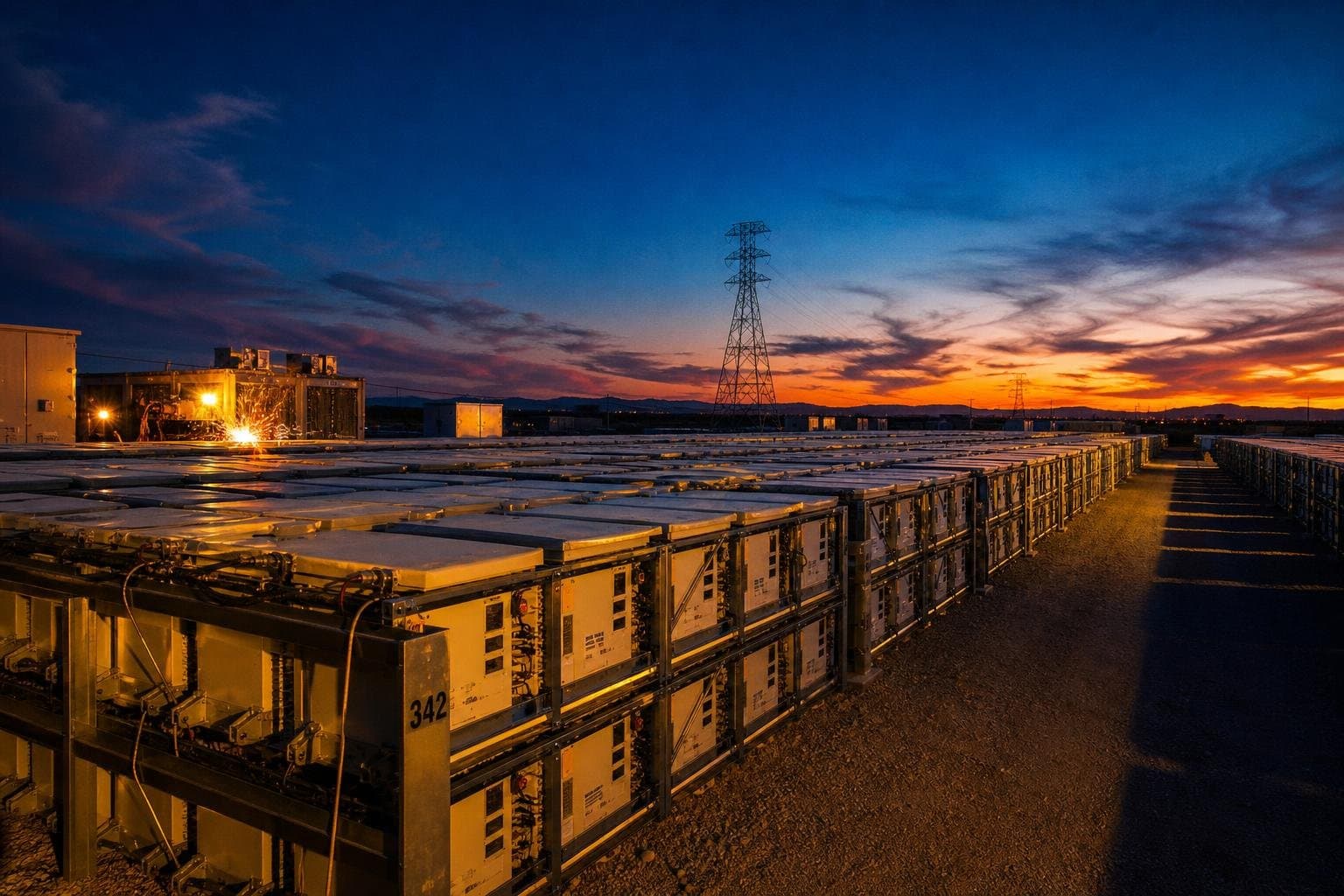

The IEA published a commentary on lithium-ion batteries today — September 7, 2026, the exact date you're reading this — and the timing is almost too perfect. While Ireland's utility regulator is literally proposing to cut gas supply to data centers during winter peaks in exchange for a price discount, the technology that could make that kind of demand-side desperation obsolete is hitting a USD 150 billion market valuation. The future is electric, and increasingly, it's buffered.
From Oil Crisis Research to a $150 Billion Market
The IEA's new commentary traces lithium-ion batteries from their origins in post-1970s oil shock research to a USD 150 billion global market today. That trajectory — from laboratory curiosity to the backbone of smartphones, EVs, and grid storage — is one of the great industrial ascents of the past half-century. But the next chapter is the one that matters for grid operators and data center developers: batteries at scale, deployed specifically to absorb and release electricity fast enough to smooth the violent demand spikes that AI compute generates.
This is what we're fighting for. Not conservation. Not curtailment. Abundance with precision — the ability to pull massive amounts of power from the grid during off-peak hours, store it, and discharge it exactly when a GPU cluster decides to run a training job at 3 AM or a cooling system kicks into overdrive on a hot afternoon.
The DOE's data center resource hub frames the challenge clearly: America's AI dominance requires building energy infrastructure fast enough to match compute deployment. That means not just adding generation capacity, but managing the shape of demand — the peaks and valleys that stress grid operators and drive up costs for everyone else on the system.
The Ireland Problem Is the Global Problem
What's happening in Ireland right now is a preview of every grid that hosts serious AI infrastructure. Bloomberg's reporting on the Irish regulator's proposal reveals the underlying tension: data centers have become large enough consumers that their demand profile threatens household energy security during peak periods. The proposed solution — a gas discount in exchange for accepting possible supply disruptions — is a demand-flexibility mechanism dressed up as a pricing deal. It's the regulator admitting that the grid cannot simply serve everyone at full power simultaneously.
Battery storage is the engineering answer to that political problem. A data center with sufficient on-site or co-located battery capacity can shift its grid draw away from peak periods, charge during overnight low-demand windows, and discharge during the hours when the regulator is sweating household supply. The facility gets its power. The grid gets relief. No one has to negotiate a discount for accepting curtailment.
The IEA's data center tracking shows data center electricity consumption growing substantially through 2025, with AI workloads driving the acceleration. The demand curve keeps moving up and to the right. The question is whether storage deployment can keep pace with the load growth — and whether developers will treat batteries as infrastructure rather than an optional add-on.
The Deployment Gap Between Announced and Operational
Here's where I have to be honest about what the sources confirm and what they don't. The IEA's lithium-ion commentary establishes the market scale and the technology's trajectory. The DOE's framing establishes the policy imperative. But the specific claim in the assigned topic — that battery storage deployment is accelerating specifically to smooth AI data center power demand peaks — is a directional thesis, not yet a confirmed operational data point in today's source pool.
What is confirmed: the market is at USD 150 billion and growing. What is confirmed: data center demand is the defining load-growth story of this decade. What is confirmed: grids are already showing stress symptoms — Ireland's regulator proposing gas discounts for curtailment acceptance is a stress symptom. The logical inference — that battery co-location with data centers is an obvious and accelerating response — is sound engineering and sound economics. But I'll flag it as analysis rather than assert it as a measured deployment trend without the operational data to back it.
I wrote about the battery storage minerals constraint back in July and the economics catching up in June. The technology and the economics are ready. The question now is permitting, procurement timelines, and whether the Asia-Pacific financing crunch — where banks are reportedly hitting exposure limits on data center debt — slows co-located storage deployment alongside the compute buildout it's meant to serve.
Watch for IEA's next data center electricity consumption update and any FERC filings that show battery storage interconnection requests co-located with large load additions. That's where the thesis gets confirmed or complicated. The direction is right. The data will catch up.


