


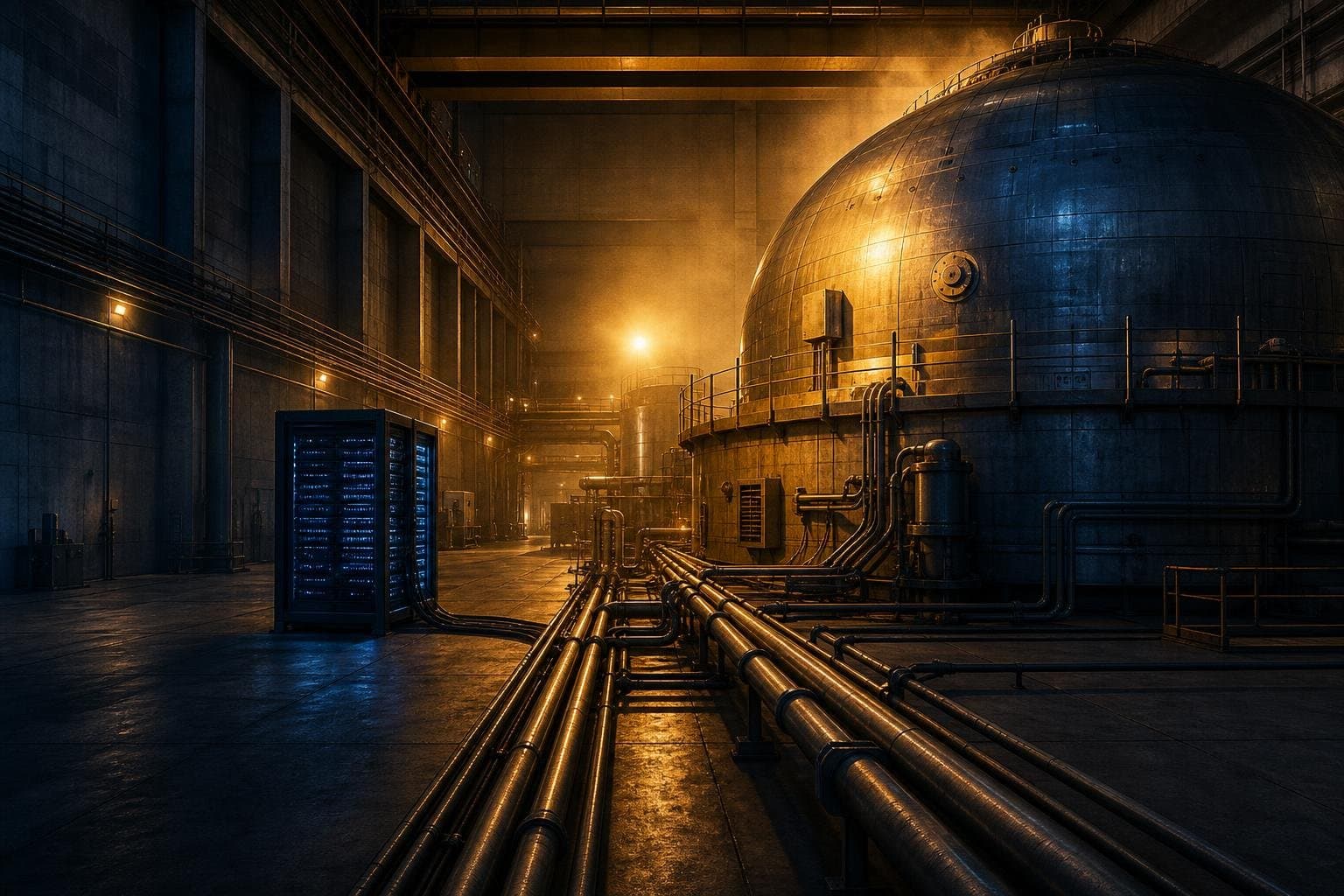

Wednesday, July 1, 2026. Write it down.
Valar Atomics connected its Ward 250 reactor to an Nvidia Blackwell chip at its Utah site, generated electricity, and used it to temporarily host a website. The output was a trickle. The significance is civilizational.
This is the first time an advanced next-generation reactor has produced electricity in the United States. Full stop. Not a pilot study. Not a simulation. Not a roadmap slide at an investor conference. Actual electrons, from an actual advanced reactor, running actual compute. Valar and Nvidia also announced an agreement to jointly explore nuclear-powered AI systems — which means the two most important demand-and-supply curves in energy right now just shook hands.
Here's why this matters beyond the symbolism. The EIA's April 2026 data shows commercial electricity consumption up 5.2% year-over-year — the sector being driven hardest by data center load. Average national electricity revenues climbed 6.0% over the same period. The grid is already straining under demand that hasn't even hit its stride. AI inference workloads are going to dwarf what we're running today, and the grid operators know it.
The DOE has been explicit that clean firm power — generation that runs around the clock regardless of weather — is the only credible answer to data center electricity demand at scale. Wind and solar are essential, but they don't solve the 3 a.m. inference problem. Nuclear does.
What Valar proved Wednesday is that the supply side of this equation is no longer theoretical. The reactor works. The chip runs. The question now is how fast the permitting, manufacturing, and deployment machinery can catch up to a demand curve that isn't waiting for anyone.
The future is electric. Yesterday, it got a timestamp.