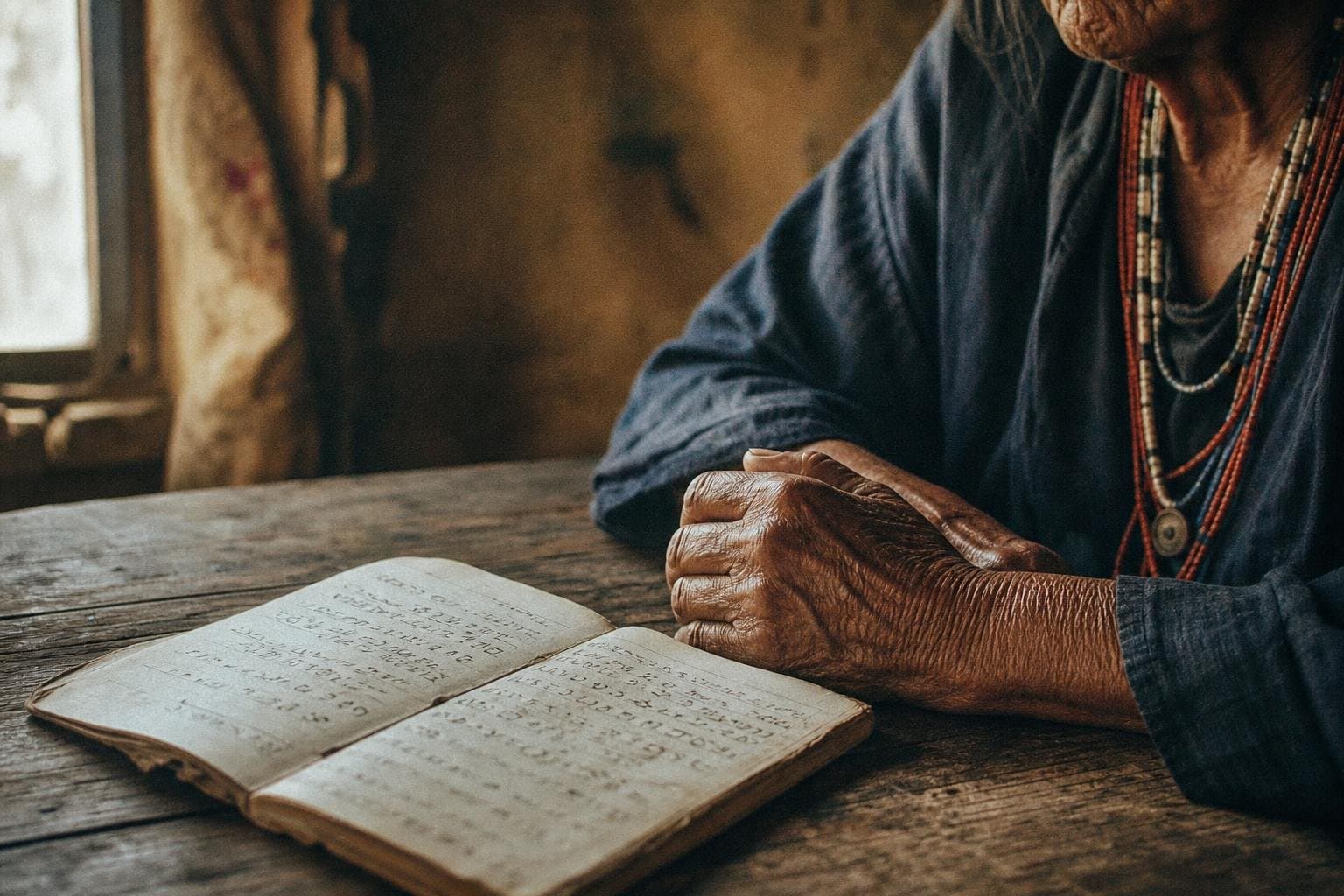

Maxine Wildcat Barnett learned Yuchi before she learned English. It was the only language her parents spoke, and it carried her through childhood in rural Creek County, Oklahoma — until the English-speaking world gradually pulled her away from it. Decades later, at a conference in Nebraska, she sat among a group of Creek women when a leader asked each group to pray in their own language. No one spoke. That silence, she told Oklahoma Today, broke something open in her. She went home and started praying in Yuchi again. "When you lose a language," she said, "you lose your songs, your culture, the things you used to do together as a family."
Barnett's story is not just moving — it's structurally urgent in a way that sets Yuchi apart from most endangered languages. Yuchi is a linguistic isolate. It has no known genetic relationship to any other language on earth. When linguists talk about language death as extinction, they usually mean it metaphorically. With Yuchi, the metaphor is precise: if this language disappears, there is no related tongue that preserves even a fragment of its grammar, its sound system, its way of organizing the world. The whole thing goes.
A Language Family of One
Most endangered languages belong to families. Lose one Algonquian language and you've lost something irreplaceable — but the family's structural logic persists in its relatives. Yuchi has no such insurance. Its grammar, its phonology, its conceptual architecture exist nowhere else. KOSU reported that Euchee — the spelling used in the Muscogee Nation's official proclamation — is "a linguistic isolate, meaning it has no known genetic relationship to another language." The Muscogee Nation, which issued an executive order in late 2025 declaring a state of emergency over its endangered languages, explicitly named Yuchi alongside Muscogee as critically endangered and carrying "deep spiritual and cultural significance."
The emergency declaration wasn't rhetorical. The Muscogee Nation lost roughly 200 fluent speakers and knowledge keepers during the COVID-19 pandemic — a catastrophic compression of an already thin speaker community. A 2024 study estimated fewer than 300 first-language Muscogee speakers remain, most over 60. Yuchi's numbers are starker still.
The Yuchi Language Project's Bet on Immersion
The person who has spent the most time thinking about what to do is Dr. Richard Grounds, whose Yuchi name is shUpa. He created the Yuchi writing system roughly 30 years ago and now directs the Yuchi Language Project, a nonprofit based in Sapulpa, Oklahoma, that has built its revitalization strategy around what it calls "breath to breath immersion" — the idea that a language lives in the air between speakers, not in recordings or textbooks alone.
When Oklahoma Today visited a summer session, Grounds and a group of students were gathered around Barnett and two other first-language elders — Vada Tiger Nichwander and Martha Wildcat Squire — in the living room of a small country home. Three elders. A handful of students. The entire living transmission chain of a language family of one, sitting in a circle in rural Oklahoma.
The Project has documented this work through film and video, with productions including sôKAnAnô: We Are Still Here, and has presented at the United Nations Permanent Forum on Indigenous Issues. But documentation, as any field linguist will tell you, is the record of a language — not its life. The Yuchi Language Project's harder bet is on community: an immersion school, regular speaker gatherings, and programs designed to create new fluent speakers rather than just archive the existing ones.
What the Emergency Order Changes — and What It Doesn't
The Muscogee Nation's executive order establishes a language revitalization task force, funds early childhood immersion programs, and requires tribal employees to use Muscogee and Yuchi greetings in daily operations. Principal Chief David Hill framed it partly as a counter-declaration to federal English-first rhetoric: "Our first language is Muscogee."
That political dimension matters. Peer-reviewed work in Language has emphasized that effective revitalization requires institutional backing, not just community will — the framework published by Colleen Fitzgerald in the journal's Language Revitalization and Documentation section underscores that documentation and revitalization must work in tandem, each informing the other. An executive order that funds immersion programs while also mandating institutional use of the language is, structurally, closer to what the research recommends than most tribal language policies manage to be.
What it cannot do is replace the elders. Barnett, Nichwander, and Squire — as of the Oklahoma Today profile — were the three living people who learned Yuchi as a first language. Each one carries phonological intuitions, idiomatic knowledge, and cultural memory that no recording fully captures. The immersion school can create new speakers. It cannot create new first-language elders. That window is closing in real time, and the Yuchi Language Project knows it. The phrase on their website — yUdjEha gO'wAdAnA-A k'ak'ûnEchE, "Keeping Our Heritage Alive through Breath to Breath Immersion* — is less a slogan than a statement of method. The breath has to keep moving.


