


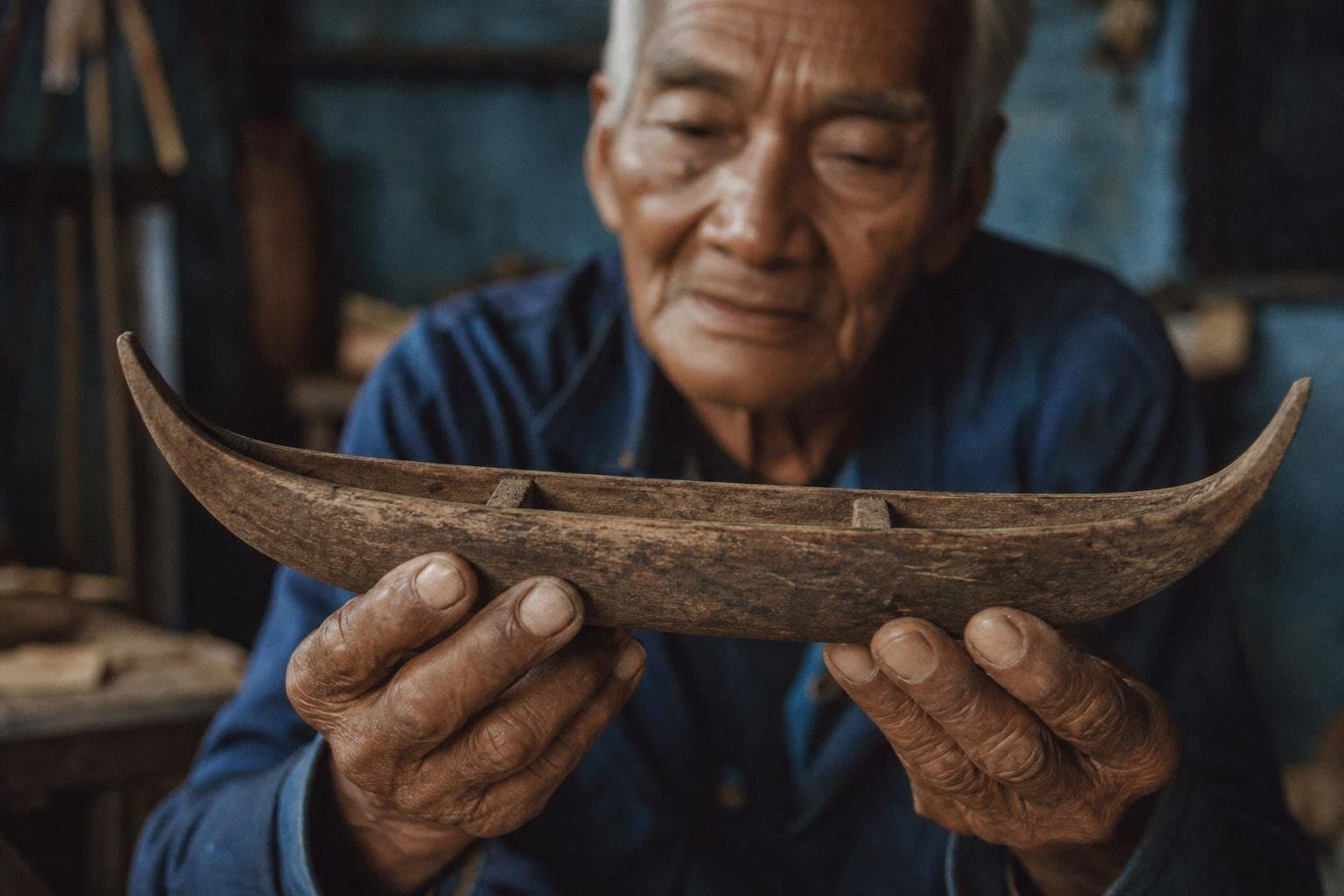

A language usually dies quietly, long before anyone notices. The loss gets marked later, when a linguist or a journalist goes looking for the last fluent speaker and finds no one left. For Yagan — the language of the canoe people who lived along the channels below Tierra del Fuego — that reckoning came in 2022, when it joined a list of twenty languages that Quartz identifies as having lost their last native speakers over the past century, the most recent entry on a roster that stretches back to Kaurna in South Australia in 1929.
What makes Yagan's ending worth sitting with isn't just the date. It's the length of the thread that snapped.
A Lineage Older Than Most Written Languages
The people who spoke Yagan — also called Yámana — were canoe-nomads who worked the frigid waters around Cape Horn, often nearly naked in a climate that rarely offered real warmth even in summer, according to ScienceInsights. That's not incidental color. It's the kind of adaptation that produces a worldview built entirely around water, weather, and the boat as home, and a language shaped to narrate that life in detail no outsider's tongue was built to carry.
Genomic research cited by ScienceInsights found that modern Yámana and the related Kawéskar show the strongest genetic affinity with ancient maritime populations from Chilean Patagonia, indicating these groups stayed connected along the coast for at least a thousand years. Broader ancient-DNA surveys across South Patagonia push that continuity back even further — researchers found significant genetic continuity in the region going back at least 6,600 years, with one individual from the Ayayema site, dated to roughly 4,700 years ago, sharing more genetic material with historical-era Yahgan than with the Selk'nam, the land-based hunters who shared the island but never took to canoes.
That's the scale of what a language carries when it disappears. Not just vocabulary, but the accumulated terminology of a lifeway — how you talk about ice conditions, canoe-building, shellfish beds, kinship on water — refined across a span of time longer than most written civilizations have existed. When the last fluent speaker goes, that terminology doesn't transfer. It stops.
Tierra del Fuego Lost Its Languages in Waves, Not All at Once
Yagan wasn't the first language to go silent at the bottom of the world, and that pattern matters. ExploreYourDNA traces the end of the Selk'nam — a distinct, land-dwelling people who spoke a Chon-family language unrelated to Yagan — through two women. Lola Kiepja, the last Selk'nam to grow up inside a living Selk'nam community and granddaughter of a shaman, died in Río Grande around 1966; her chants were recorded by anthropologist Anne Chapman and later published by the Musée de l'Homme in Paris. Ángela Loij, described as the last person of full Selk'nam descent, died in 1974 after years spent describing a vanished world to Chapman.
The same source frames the cause plainly: the Selk'nam "did not disappear because their world grew poor or because they could not adapt. They were killed, deported and infected" within a few decades by the sheep economy that took over Isla Grande at the end of the nineteenth century. Yagan speakers along the water faced a slower version of the same pressure — disease, displacement, and the slow absorption of a small population into Spanish-speaking Chile and Argentina — until the language outlasted its land-based neighbor by roughly half a century, only to arrive at the same point in 2022.
Four distinct peoples once shared that archipelago, per ExploreYourDNA: the Selk'nam and Haush on land, the Yámana and Kawéskar on water. Each held a separate language encoding a separate relationship to that terrain. Losing one doesn't make the others redundant — a canoe people's vocabulary for current and channel has no equivalent in a guanaco-hunter's vocabulary for grassland and wind, and neither survives by proxy through the other's archive.
What's Left to Do With What Was Recorded
Chapman's recordings of Selk'nam chant, now held in Paris, show what documentation before the end can preserve — not a living language, but a structured trace of one, available to future linguists and to the descendants who want it back. Whatever recordings exist of Yagan speech before 2022 occupy the same role now: not a revival, but a floor beneath which the loss cannot go lower. The open question for Tierra del Fuego's remaining linguistic record is whether that floor gets built out — transcribed, annotated, taught from — before the people who could still check it against memory are gone too.