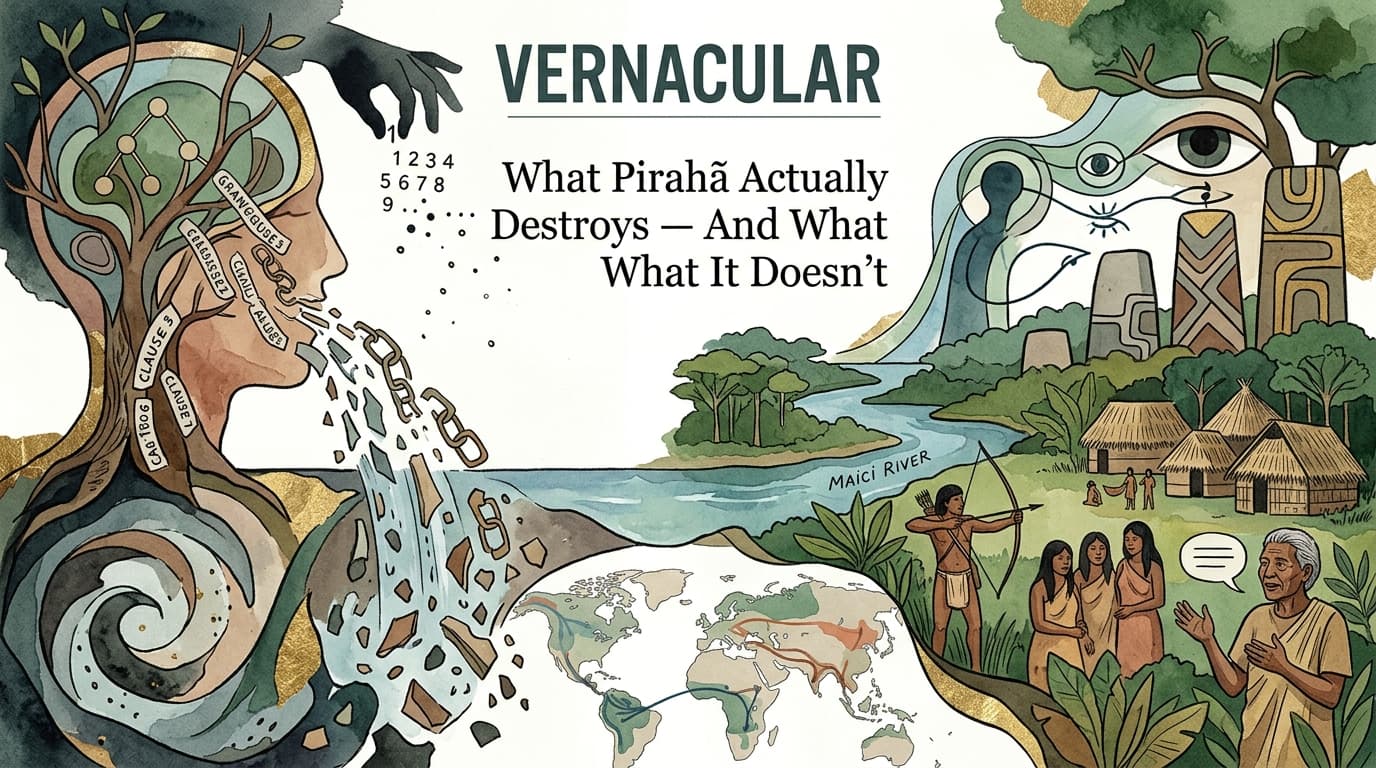

The most contested language in linguistics isn't just about numbers. It's about whether grammar can wall off entire categories of thought.
There is a moment in fieldwork that every linguist recognizes — the moment when a language stops being a system to analyze and starts being a different architecture of mind. For Daniel Everett, that moment came somewhere along the Maici River in the Brazilian Amazon, working with a community of roughly three to four hundred people whose language had been resisting missionary translation efforts for decades. The Pirahã had refused to convert. They had also, it turned out, refused to count.
What Everett eventually argued — and what has since generated one of the most acrimonious debates in modern linguistics — is that the Pirahã language lacks not just number words, but the recursive grammatical structures that most linguists had assumed were universal to all human language. No embedding of clauses within clauses. No creation myths. No color terms beyond rough approximations of light and dark. A tense system organized not around past, present, and future but around whether the speaker has direct evidence for what they're saying. A language, in other words, that seems to encode a fundamentally different relationship to time, quantity, and narrative than any other documented tongue.
The claims are extraordinary. The evidence is genuinely contested. And the stakes — for linguistics, for cognitive science, for what we think we know about the relationship between language and thought — are about as high as they get.
Section I: The Setup — A Language That Shouldn't Exist (According to the Textbooks)
To understand why Pirahã became a flashpoint, you need to understand what it was supposed to be impossible for a language to lack.
For most of the second half of the twentieth century, the dominant framework in linguistics was built on the premise of universals — features shared by all human languages that reflect the underlying architecture of the human mind. Noam Chomsky's theory of Universal Grammar proposed that all languages share a core recursive structure: the ability to embed sentences within sentences, to generate infinite meaning from finite elements. This wasn't just a claim about grammar. It was a claim about human cognition — that certain structural capacities are innate, species-wide, and therefore present in every language spoken by every community on earth.
Pirahã, as Everett described it, violated this premise directly. According to research covered by ScienceDaily, the language lacks number words — not just words for large numbers, but words for any precise quantity. The Pirahã have terms that translate roughly as "a small amount" and "a larger amount," but nothing that functions as a counting system. When researchers tested community members on basic quantitative tasks — matching quantities, tracking small sets of objects — performance was significantly impaired compared to populations with number language. The cognitive gap wasn't about intelligence. It was about the absence of the linguistic scaffolding that most humans use to hold quantities stable in working memory.
Wikipedia's documentation of the Pirahã people captures the split that this finding produced among researchers: Peter Gordon of Columbia University argued that the Pirahã are effectively incapable of learning numeracy, while Everett himself took the more nuanced position that they are cognitively capable of counting but have no cultural motivation to do so, and therefore no linguistic infrastructure for it. That distinction matters enormously. Gordon's reading supports a strong version of linguistic relativity — the idea that the language you speak constrains what you can think. Everett's reading is subtler: the language reflects a cultural choice, a deliberate orientation toward immediate experience over abstraction, and the cognitive effects follow from that choice rather than from some hard neurological limit.
The number question, though, is almost the least radical of Pirahã's reported features. The language is also described as lacking grammatical tense in the conventional sense, instead encoding evidentiality — the source and reliability of information — as its primary temporal-epistemic category. Speakers mark whether they witnessed something directly, heard about it, or are inferring it. What they don't mark, at least not in the way Indo-European languages do, is when it happened in any absolute sense. The past is not a grammatical category so much as a domain of reported experience.
And then there's the recursion question — the one that put Everett in direct conflict with Chomsky and the MIT linguistics establishment. Everett argued that Pirahã lacks the kind of embedded clausal structure that Chomsky had proposed as a universal. You cannot, in Pirahã, say the equivalent of "the man who lives by the river told me that his brother saw the fish." You have to say it in separate, unembedded propositions. If this is true, it's not just a quirk of Pirahã grammar. It's a direct challenge to the universalist foundation of modern linguistics.
I want to be careful here, because this is where the popular science accounts tend to overreach. The claims about Pirahã are genuinely contested among professional linguists, and the debate has not been resolved. What's documented is that the language presents features that are, at minimum, extremely unusual — and that those features cluster around a coherent cultural principle that Everett calls the "immediacy of experience" constraint: Pirahã culture, he argues, restricts communication to direct personal experience or things witnessed by someone still alive. This would explain the absence of creation myths (no one alive witnessed creation), the absence of a counting system (counting abstracts away from immediate experience), and the evidential rather than temporal organization of the grammar.
Whether that cultural principle caused the linguistic features, or whether the linguistic features reinforce the cultural principle, or whether the whole account is partially wrong — that's the argument that has been running for twenty years.
Section II: The Mechanism — How a Language Encodes a Worldview
Set aside the recursion debate for a moment and focus on what's less contested: the evidentiality system, the number question, and what they reveal about how Pirahã organizes knowledge.
Evidentiality is not unique to Pirahã. Many languages grammatically encode the source of information — Turkish, Bulgarian, and a number of Tibetan languages all have evidential systems. What makes Pirahã's system notable is its apparent centrality to the entire grammar, and the way it seems to function as a filter on what can be talked about at all. If you cannot ground a claim in direct experience — yours or someone living who witnessed it — the language, as Everett describes it, provides no comfortable grammatical home for that claim.
Think about what this excludes. Creation narratives require speaking about events no living person witnessed. Genealogies extending more than two or three generations require the same. Abstract planning for events far in the future requires treating unwitnessed future states as real objects of discourse. Number systems, at their most abstract, require treating quantity as a property that exists independently of any particular witnessed instance — the number seven is the same whether you're counting fish or days or enemies, and that abstraction is precisely what the immediacy constraint resists.
This is not the same as saying the Pirahã cannot think about the future, or cannot remember the past. It's saying that their language encodes a particular epistemic stance toward claims about reality: show your evidence, or don't make the claim. The grammar is, in a sense, a built-in citation system — one that privileges sensory witness over inherited narrative.
The cognitive effects of the number gap are the most empirically documented aspect of this. The ScienceDaily report on Peter Gordon's research describes tasks in which Pirahã participants had difficulty matching quantities even when the objects were visible in front of them — not because they couldn't perceive the difference between three and four objects, but because without number words to anchor the quantities, maintaining precise numerical equivalence across a short delay was genuinely harder. This is the Sapir-Whorf hypothesis in its most concrete, testable form: not that language makes certain thoughts impossible, but that language provides cognitive tools that make certain operations easier, and the absence of those tools has measurable effects.
The parallel that comes to mind — and that linguists working in this area frequently invoke — is spatial language. Languages differ dramatically in how they encode spatial relationships: some use absolute directions (north, south, east, west) even for small-scale space, while others use relative directions (left, right, in front of). Speakers of absolute-direction languages show measurably better dead-reckoning navigation abilities, because their language has trained them to constantly track their orientation relative to cardinal directions. The language doesn't make relative-direction speakers incapable of navigating; it just means they haven't been building that particular cognitive habit through every spatial conversation of their lives.
Pirahã's number gap works similarly. The community isn't cognitively blocked from quantity. They're not building the habit of precise numerical tracking, because their language — and the cultural values it encodes — has never required it.
What's harder to assess, and where I think the popular accounts go most wrong, is the color term question. Pirahã is sometimes described as lacking color terms entirely, which is an overstatement. What it appears to lack is a rich, conventionalized color vocabulary — the kind of system where "blue" and "green" are categorically distinct in a way that speakers agree on. The language seems to use descriptive phrases and approximate terms rather than a fixed color lexicon. This is unusual but not unique; several languages have been documented with minimal basic color vocabularies, and the research on whether this affects color perception and categorization is genuinely complex. The Berlin and Kay framework for color universals — which proposed that languages acquire color terms in a predictable order — has been substantially revised in the decades since it was proposed, and Pirahã sits at the extreme end of a real cross-linguistic continuum rather than being simply anomalous.
Section III: The Tension — What the Debate Is Actually About
The Pirahã controversy is, on its surface, an empirical dispute: does the language have recursion or not? Do the cognitive effects of number-word absence hold up under controlled testing? Are Everett's transcriptions and analyses accurate?
But underneath the empirical dispute is a deeper argument about what linguistics is for — and what it means to say that a language encodes a worldview.
The Chomskyan response to Everett has been, roughly, that even if Pirahã lacks surface-level recursive structures, this doesn't falsify Universal Grammar, because UG is a claim about underlying competence, not surface performance. The language might express recursive meaning through other means. The absence of embedded clauses in the corpus doesn't prove the capacity for recursion is absent from the minds of speakers. This is a philosophically coherent position, but it has a certain unfalsifiability problem: if no surface evidence could ever count against UG, what kind of theory is it?
Everett's position has its own vulnerabilities. His account of Pirahã culture — the immediacy of experience constraint, the absence of creation myths, the resistance to conversion — is based on decades of fieldwork, but fieldwork conducted by a single researcher who was, for much of that time, also a missionary. The relationship between observer and observed in that context is complicated. Other linguists who have worked with Pirahã have disputed aspects of his analysis, though the community's geographic isolation and the difficulty of the language have limited the number of independent researchers who can evaluate the claims firsthand.
Wikipedia's account of the Pirahã people notes that the debate over numeracy specifically involves a genuine disagreement between Gordon and Everett not just about the facts but about their interpretation — with Gordon arguing for a stronger cognitive constraint and Everett arguing for a cultural-motivational explanation. This isn't a case where one side has the data and the other is in denial. It's a case where the same data supports genuinely different theoretical frameworks, and where the choice between frameworks reflects deeper commitments about the relationship between language, culture, and cognition.
What I find most interesting about this debate — and what gets lost in the popular coverage, which tends to treat Pirahã as either a miracle or a hoax — is that both sides are actually arguing for something important. The Chomskyan universalists are right that we should be cautious about claims that a language lacks a capacity that every other documented language has. Extraordinary claims require extraordinary evidence, and the history of linguistics includes cases where researchers projected their own cultural assumptions onto communities they were studying. The linguistic relativists are right that the cognitive effects of number language are real and measurable, and that dismissing them as mere surface variation misses something genuine about how language shapes habitual thought.
The Pirahã case is valuable precisely because it sits at the intersection of these two legitimate concerns. It's a language that, if Everett's account is even partially correct, demonstrates that the range of human linguistic variation is wider than the universalist framework predicted — while also demonstrating that cultural values and linguistic structure are intertwined in ways that can't be cleanly separated.
There's also a preservation dimension here that the academic debate tends to obscure. The Pirahã community is small — estimates have generally placed it in the low hundreds — and the language has no writing system, no substantial body of recorded literature, and a history of contact with outsiders that has been, to put it gently, not always in the community's interest. Whatever the truth of the recursion debate, Pirahã encodes a set of epistemic practices — the evidentiality system, the grounding in immediate experience, the specific ways the community has organized knowledge about the natural world of the Maici River basin — that exist nowhere else. The loss of that would be an extinction event regardless of whether it falsifies Universal Grammar.
Section IV: The Signal — What Pirahã Tells Us About Language and Mind
The Pirahã debate has been running long enough that it's tempting to treat it as a settled controversy — a case study in academic overreach that the field has moved past. That reading would be wrong.
The questions Pirahã raises about the relationship between linguistic structure and cognitive habit are more alive than ever, partly because the tools for investigating them have improved dramatically. Neuroimaging studies of language processing, cross-linguistic studies of spatial cognition, and increasingly sophisticated documentation of evidentiality systems across the world's languages have all generated findings that are relevant to the Pirahã debate — even when they don't address it directly.
The broader pattern that emerges from this research is one that I'd characterize as weak but real linguistic relativity: language doesn't wall off categories of thought, but it does shape which cognitive operations become habitual, automatic, and effortless. Number language makes precise quantity tracking easier. Absolute spatial language makes dead-reckoning easier. Grammatical evidentiality — the requirement to mark your information source — may make epistemic vigilance easier, the habit of asking "how do I know this?" more automatic.
If that's right, then Pirahã's evidentiality system isn't just a grammatical curiosity. It's a built-in epistemological practice — a language that requires its speakers to constantly mark the difference between what they've witnessed and what they've been told. In an era when the manipulation of second-hand information is among the central problems of public life, there's something almost utopian about a grammar that makes that distinction mandatory.
The comparison with the Amondawa, another Amazonian community documented by researchers, is instructive here. As reported by News18, the Amondawa organize life by natural cycles and mark life transitions through name changes rather than numerical age — a system that, like Pirahã's, grounds temporal experience in lived events rather than abstract coordinates. [A study on


