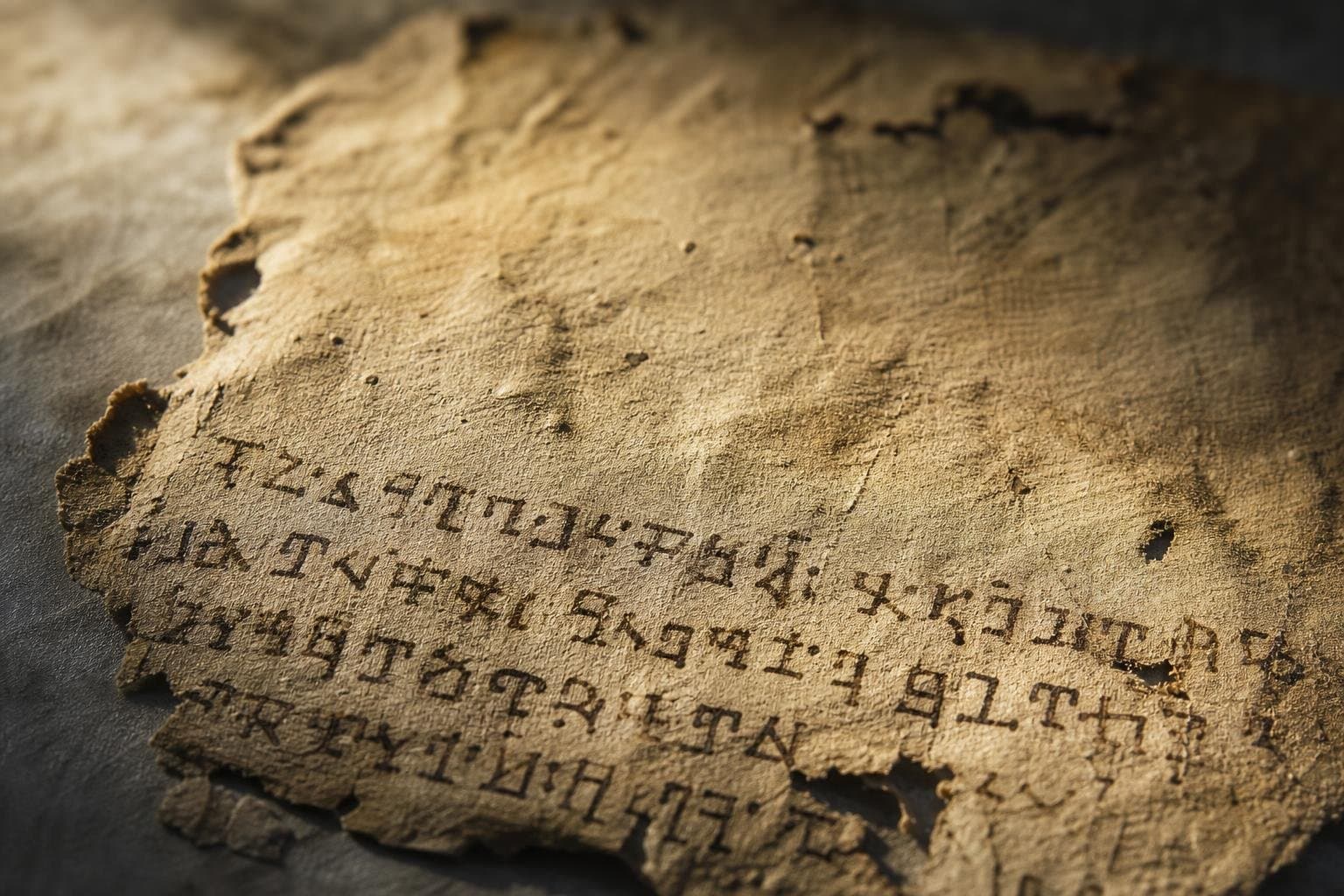

A language dies. Centuries pass. Then, at the turn of the twentieth century, expedition teams digging through the sands of the Tarim Basin in what is now western China pull out manuscripts — thousands of them — written in a script nobody recognizes, in a language nobody expected to find there. The language turns out to be Indo-European. Not distantly, not ambiguously: unmistakably, structurally Indo-European. And yet it sits geographically closer to Chinese than to Greek, Sanskrit, or Latin.
That paradox is Tocharian, and it has been quietly rewriting what we think we know about the earliest movements of the Indo-European world.
The Texts That Shouldn't Be There
Tocharian survives in two closely related varieties, conventionally called A and B. According to scholarship on the Turfan Study Group's century of research, Tocharian B — with roughly 10,000 documents — was likely first spoken in Kucha and eventually developed into a classical literary language before dying out. Tocharian A, associated with Agni (Turfan), exists only as a classical language, specifically a liturgical one, preserved in some 2,000 documents. Neither variety was anyone's everyday spoken tongue by the time the manuscripts were written; both were vehicles for Buddhist transmission across the Silk Road.
The name "Tocharian" itself is an accident of philology. As the Turfan volume documents, the scholar F. W. K. Müller proposed the name in 1907 based on a colophon in an Old Turkish text called the Maitrisimit — a connection that later proved linguistically questionable, but the label stuck. The people who actually spoke these languages may have called themselves something else entirely.
What the texts reveal, once linguists could read them, is a branch of Indo-European that split off extraordinarily early — before the innovations that would later unite the western branches (Greek, Latin, Celtic, Germanic) into recognizable family resemblances. Tocharian preserves archaic features that had already disappeared elsewhere by the time written records begin.
The Migration Problem Tocharian Forces
Here is what makes Tocharian so consequential for understanding Indo-European origins: its geographic position is the inverse of what you'd expect from a language this archaic.
The prevailing Kurgan hypothesis places the Proto-Indo-European homeland on the Pontic-Caspian steppe, with the language spoken roughly between 4500 and 2500 BCE. From there, daughter branches spread outward. The western branches — Greek, Italic, Celtic — are geographically close to that homeland. Tocharian ended up thousands of kilometers to the east, in the Tarim Basin. Yet linguistically, it branched off earlier than most of those western languages.
This is the puzzle: the most geographically distant branch is among the most linguistically conservative. The resolution, supported by recent scholarship on Tocharian's pre-Buddhist origins, is that the Tocharian-speaking populations left the Yamnaya cultural sphere before the major westward expansions, moving east across the steppe over centuries beginning around 3000 BCE. They were, in a sense, the first wave — gone before the later migrations that would carry Indo-European into Europe and South Asia.
That eastward journey left linguistic fingerprints. Recent analysis of Tocharian's contact history identifies two major encounter zones along the way: first with populations associated with the Bactria-Margiana Archaeological Complex (BMAC), and later with Iranian-speaking groups — not proto-Indo-Iranian speakers, but specific Iranian varieties, with proposed connections to Kushan and languages related to Ossetic. The Iranian loans in Tocharian can be dated and stratified, which means they function almost like geological strata: each layer of borrowing marks a moment of contact, a place on the map, a century on the timeline.
What the Loans Actually Tell Us
Linguistic borrowing is one of the most reliable tools historical linguists have, precisely because it's so hard to fake. A community doesn't borrow a word for iron unless it encountered iron through another culture. Scholarship on Tocharian's Iranian contact layer finds that the Tocharians acquired their word for iron from Khotanese — not from their earlier Iranian contacts, but from a later encounter, after they had already settled into the Tarim. The sequencing matters: it tells us that the Tocharians were in the Tarim before the Iron Age reached them there, which anchors their migration chronology in ways that purely internal linguistic reconstruction cannot.
This is the method that makes Tocharian so valuable beyond its own story. As science writer Laura Spinney has described the broader field, geneticists, archaeologists, and linguists are now working together to reconstruct prehistoric migrations — and each discipline provides constraints that the others cannot. Tocharian sits at the intersection of all three: its texts are physical artifacts with datable scripts, its vocabulary encodes contact history, and the populations who spoke it left genetic traces in ancient DNA from Tarim Basin burials.
The manuscripts pulled from the desert a century ago were always more than Buddhist liturgy. They were a message from the first Indo-Europeans to go east — written in a language that, by the time anyone could read it, had already been dead for a thousand years.


