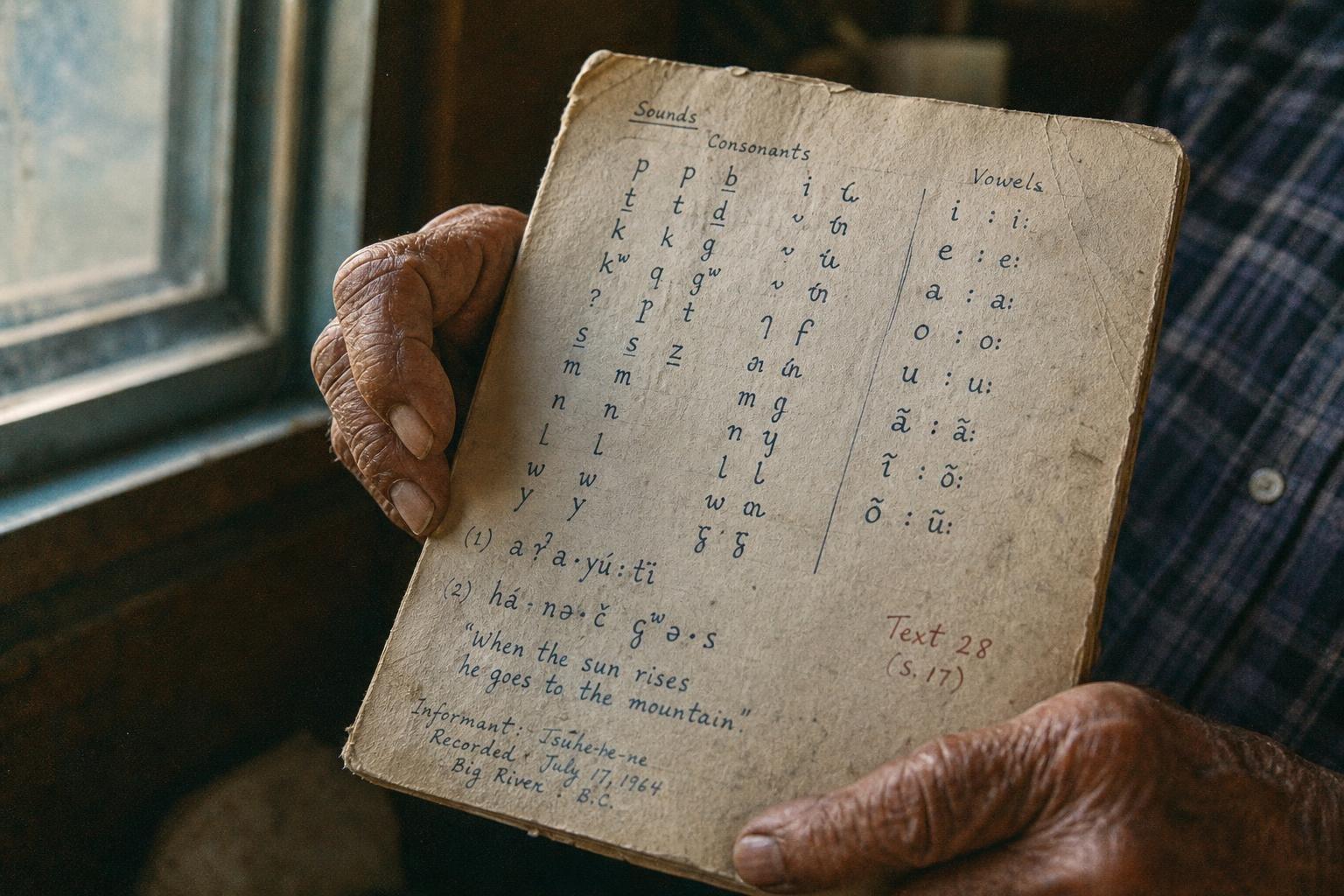

On October 7, 1992, a farmer died in a village near Istanbul, and a phonological system that had existed for centuries went with him. Tevfik Esenç, raised partly by grandparents who still spoke the old language, grew up in the village of Hacıosman near Manyas, among Circassian communities who had resettled there after leaving the Black Sea coast, per Circassian App. In his later years he spent decades sitting with linguists — most consequentially the French scholar Georges Dumézil, who worked with him across four decades and, in an almost unheard-of courtesy for a field consultant of that era, credited him as co-author on publication after publication, according to AbkhazWorld. Esenç wasn't just answering questions. He understood what he was preserving, and he made sure enough of it survived him that linguists today can describe Ubykh with real precision.
That precision is the strange comfort in this story. We know almost exactly what was lost. Knowing precisely what's gone is not the same as having it.
A Phonology That Inverted the Usual Ratio
Most languages balance consonants and vowels somewhere within reach of each other. Ubykh didn't. It carried roughly 84 consonants against as few as two or three vowels depending on the analysis, four of those consonants appearing only in loanwords — a ratio so lopsided that it once topped the Guinness Book of Records for largest consonant inventory of any language, a title now held by the click-language !Xóõ, leaving Ubykh the record-holder among languages without clicks, per Circassian App. Among those consonants were twenty uvular sounds and twenty-nine pure fricatives, concentrations that don't show up together in nearly any other documented language.
This wasn't an isolated oddity. It was a family trait, and the family itself has deep roots on the ground where Ubykh was once spoken — Circassian peoples trace their ancestry in the northwest Caucasus back to the fourth millennium BCE, along the Black Sea coast that later became the staging ground for the 1864 exile, per Circassian Web. Ubykh belonged to the Northwest Caucasian family, alongside Adyghe, Kabardian, Abkhaz, and Abaza — languages that share no demonstrated relationship to any other family on Earth and that all lean the same phonological direction, per AbkhazWorld. Abkhaz itself contrasts 58 consonant phonemes in its literary Abzhywa dialect, climbing to 67 in the Bzyp dialect, set against just two phonemic vowels, per the Abkhaz phonology breakdown on Wikipedia. Kabardian compresses whole sentences' worth of meaning into a single verb through a stack of thirteen prefix positions, per AbkhazWorld. Ubykh sat at the extreme end of a family that treats the consonant, not the vowel, as the primary unit of phonological information — the opposite of how English or French organizes sound.
What that means for a speaker's ear is worth sitting with. Where English distinguishes words mainly by changing vowels — bit, bet, bat, but — Ubykh distinguished meaning almost entirely in the consonant, with the vowel reduced to little more than a hinge between consonantal gestures. It's a sound system built on a completely different theory of where information belongs in speech.
The Record Survives. The Family Doesn't Get a Pass.
Ubykh arrived in Anatolia with the refugee columns of 1864, carried by the Ubykh people who left the Black Sea coast near present-day Sochi at the end of the Caucasian War, and it lasted 128 years in exile before it died in the village of Hacı Osman in Balıkesir province, per CircassianWorld. Every Northwest Caucasian language — not just the extinct one — now appears in the UNESCO Atlas of the World's Languages in Danger, the same source notes. Abkhaz, Abaza, Adyghe, and Kabardian all sit beneath Russian in their home republics, and a 2018 amendment to Russian federal education law, which made study of a republic's own language a matter of parental choice rather than requirement, landed on all four at once.
Ubykh's extinction fits a pattern that's been documented for a century now. Michael Krauss warned in a 1992 paper in the journal Language that as much as 90% of the world's languages could die or be doomed by the century's end, and the twenty extinct languages catalogued from the past hundred years — from Kaurna in South Australia to Yahgan at the tip of South America — all follow the same mechanism: a dominant language takes over under economic or state pressure, children stop learning the old one at home, and within two or three generations it survives in a single elder, per Quartz. The United Nations has since declared 2022 to 2032 the International Decade of Indigenous Languages, the same piece notes — recognition that arrived three decades after Esenç's death, and three decades too late to add a second voice to his.
What Ubykh leaves is a complete, precisely documented record of a phonological extreme, and a reminder that documentation and survival are different achievements. The record is safe. The question worth watching now is whether the related languages still spoken — Abkhaz under its 2007 language law with deadlines deferred more than once, Circassian under Russia's 2018 amendment — get a different ending than the one Esenç's language got.


