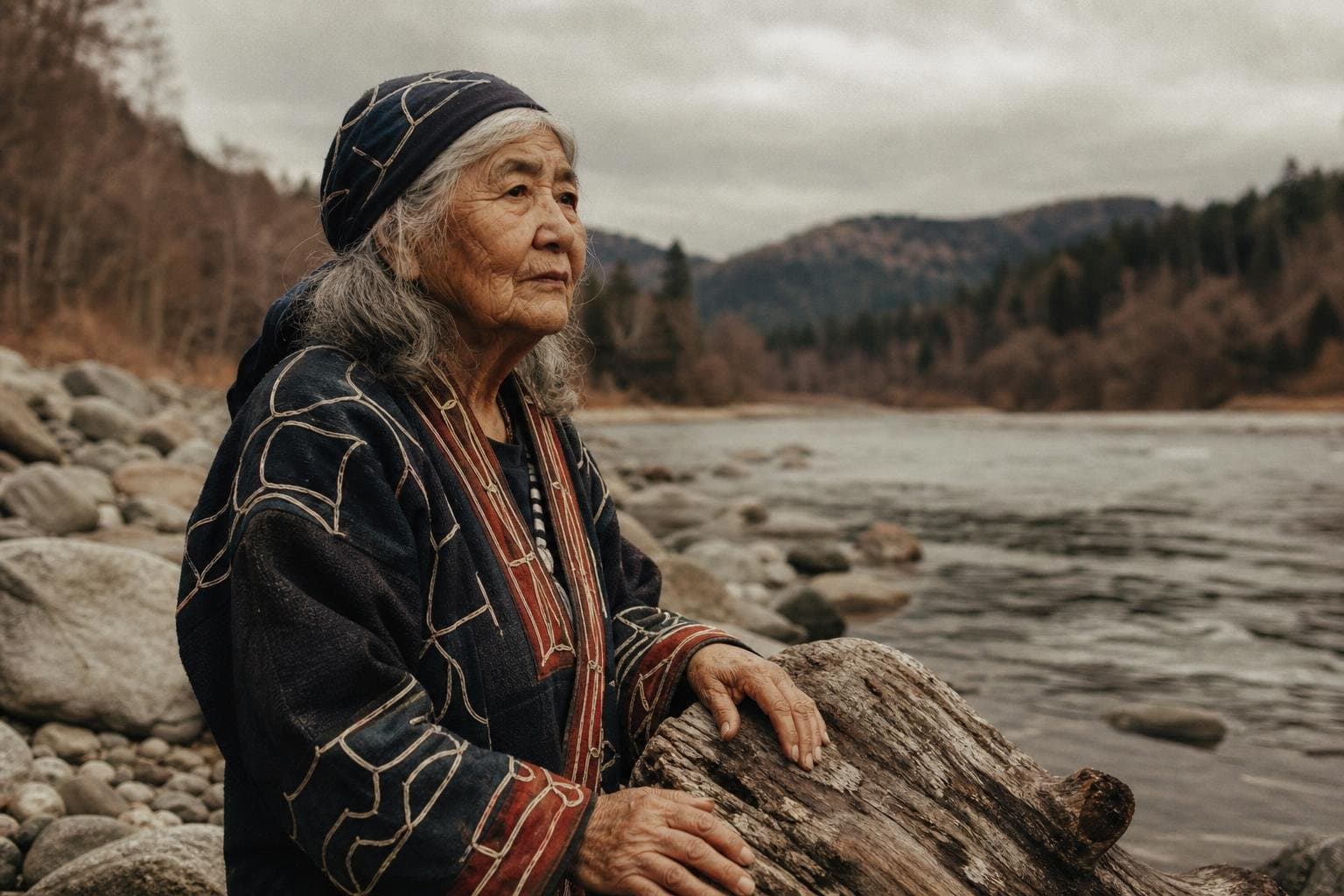

In Hokkaido, roughly 80% of river names still carry Ainu words, according to UNESCO's documentation of the Toya-Usu Geopark region. The mountains speak Ainu. The water speaks Ainu. The people, for the most part, no longer do.
That gap — between a landscape saturated with a language and a community largely severed from it — is the central wound of Ainu revitalization. And understanding how that wound was made turns out to be essential to understanding why healing it is so difficult.
How Scholarship Became a Tool of Erasure
When I wrote about the Ainu revival in June (/p/the-ainu-revival-has-a-policy-problem-and-the-policy-knows-it), I focused on the gap between Japan's 2019 legal recognition of the Ainu as indigenous people and the thin implementation that followed. But a chapter published this month in Beyond the Untranslatable cuts deeper into the origins of that gap — into the moment when Ainu language documentation itself became an instrument of dispossession.
The chapter, by Katsuya Hirano and Daniel Abbe, examines Kyosuke Kindaichi, the founder of Ainu linguistic studies, and his relationship with his Ainu assistant, Yukie Chiri. Their argument is precise and uncomfortable: that the translation practices of Japanese linguists in the colonial period functioned as a mode of domination. By rendering Ainu oral traditions into Japanese — framing them as artifacts of a vanishing race — scholars simultaneously preserved and entombed the language. The act of documentation encoded a verdict: these people are disappearing, and we are here to record the fact.
Chiri herself is a figure worth sitting with. An Ainu woman who became essential to Kindaichi's work, she died at twenty-nineteen, having spent her short life translating her own culture for an institution that viewed that culture as already past tense. The violence Hirano and Abbe identify is not crude. It operates through the grammar of liberal humanism — the claim to be saving what is being destroyed.
This history matters now because it shapes what community-led revitalization has to push against. The Ainu aren't just recovering a language; they're recovering it from a tradition of documentation that framed recovery as impossible.
What Survival Actually Looks Like
The 2019 Ainu Policy Promotion Act was the first Japanese law to formally identify the Ainu as indigenous people — a legal milestone that came after more than a century of assimilation policies, including the 1899 Hokkaido Former Aborigines Protection Act, which seized Ainu land and pushed children into Japanese-language schools. The 2019 law created government subsidies for community development and cultural initiatives, with the Ainu Association of Hokkaido playing a central role in shaping its provisions.
But legal recognition and linguistic vitality are different things. A Quartz survey of endangered languages notes that Ainu has almost no children learning it — which linguists consider the clearest predictor of extinction, regardless of how many adults nominally identify with the community. Self-identification and fluency are not the same. The Hokkaido prefectural surveys that estimate 25,000 to 30,000 Ainu in Japan measure heritage, not speakers.
What does exist — and what the Toya-Usu documentation captures — is something harder to quantify than speaker counts. Yosiyuki Uji, chairman of the Toyoura Ainu Association, describes how stories, place names, and environmental knowledge have traveled through generations in dialogue with the landscape itself. He speaks of Ainu kimochi — the feeling of being Ainu, of belonging — as the connective tissue that has survived even when the language hasn't. That's not nothing. But it's also not a language.
The Repatriation Signal
In May 2025, the University of Edinburgh formally returned the remains of three Ainu ancestors to Japan. The remains are now held at the Upopoy National Ainu Museum and Park in Shiraoi, the modern cultural center dedicated to Ainu history and preservation. Masaru Okawa, Executive Director of the Hokkaido Ainu Association, said at the ceremony: "We believe our ancestors are pleased to return home."
Repatriation and language revival are not the same project, but they move along the same axis: the question of who controls Ainu culture and Ainu futures. For over a century, that control resided with Japanese state institutions and foreign academics. The slow return of that authority — through legal recognition, through the repatriation of remains, through community-led documentation — creates the conditions in which a language might be reclaimed rather than merely archived.
The Ainu case keeps teaching the same lesson from different angles. A language cannot be revived by institutions that view it as a relic. It can only be revived by communities that insist it belongs to the living. The river names are still there. The question is whether the people who gave them will reclaim the right to speak them.


