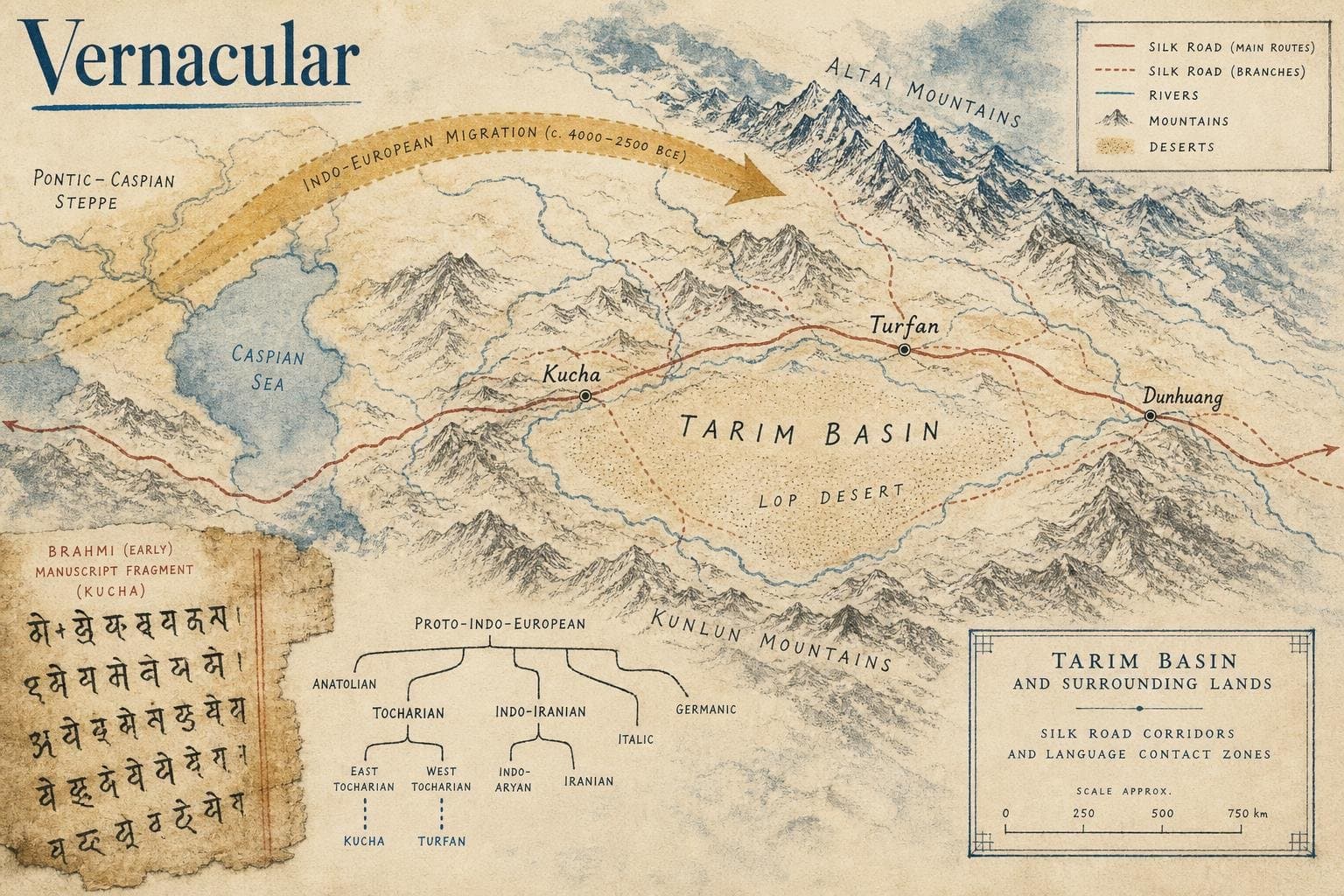

Somewhere in the Tarim Basin — the vast desert depression in what is now western China — scribes were copying Buddhist texts in a language that had no business being there. The script ran across the page in careful lines. The vocabulary was Indo-European. The geography was wrong by several thousand kilometers.
This is the central puzzle of the Tocharian languages: not just that they died, but that they existed where they did in the first place.
An Impossible Address
The Tocharian manuscripts that survive — written in Tocharian A and Tocharian B, two closely related but mutually unintelligible languages — date to roughly the fifth through eighth centuries CE. They were found along the northern rim of the Tarim Basin and the Lop Desert, recovered from sites that had been sealed by sand for centuries. Their subject matter ranges from Buddhist liturgy to administrative records, suggesting a community with both religious and bureaucratic lives conducted in these languages.
What makes their location so disorienting is what the languages themselves reveal about their origins. Proto-Tocharian — the reconstructed ancestor of both attested languages — shows features that place it among the earliest branches to split from Proto-Indo-European, likely before the centum-satem division that had long been used to organize the Indo-European family tree. When linguists first recognized this in the early twentieth century, it overturned a tidy east-west model of how Indo-European had spread. A language with archaic western features had no business turning up on the threshold of ancient China.
The likely explanation traces back to the Afanasievo culture, which emerged in the Altai Mountains and Minusinsk Basin around 3300–2500 BCE. This culture represents the earliest archaeologically attested eastward dispersal of steppe populations — the people who would eventually become the Tocharians appear to have split off from the Proto-Indo-European community very early and moved east, long before the Silk Road formalized the connections between these regions. They arrived in the Tarim Basin carrying a language already ancient by the time the manuscripts were written.
What the Vowels Remember
The linguistic archaeology of Tocharian is, in some ways, more revealing than the physical archaeology. Proto-Tocharian shows radical changes in its vowel system from Proto-Indo-European — length distinctions collapsed, pairs of long and short vowels became distinct in quality instead, and many PIE vowel contrasts survive in Tocharian only through traces of palatalization on preceding consonants. The vowel system is, as one researcher put it, "fraught with difficulty," generating persistent disagreements among specialists.
Recent work published in Indo-European Linguistics has examined interconnected vowel shifts within Tocharian, including the phonetically expected raising of low or mid-low vowels in nasal environments — the kind of granular sound change that accumulates over centuries and leaves its fingerprints in the written record long after the speakers are gone. This is the detective work of historical linguistics: reconstructing not just what words meant, but how mouths moved to produce them, and how those movements drifted across generations.
There's also the question of what other languages left marks on Tocharian. Scholarly work from Leiden University has examined the possibility of Uralic substrate influence — the idea that Tocharian speakers, moving through or settling near Samoyed-speaking populations, absorbed features that weren't inherited from Proto-Indo-European. Substrate influence is one of the most contested areas in historical linguistics, but the question itself tells you something important: the Tocharians were not isolated. They moved through a world of other languages, and those languages left traces.
The Context the Manuscripts Can't Provide
What the Tocharian texts don't give us is what the Central Asian linguistic record more broadly makes painfully clear: written language and spoken language are not the same thing. A recent study by historian Rachel Mairs, examining Persian and Greek administrative texts from Bactria, Sogdiana, and neighboring regions, found that imperial languages dominated the written record while local populations continued speaking their own languages at home. The language you wrote was often not the language you spoke.
This matters for Tocharian because the surviving corpus is almost entirely religious and administrative — exactly the registers most likely to be conservative, formalized, and disconnected from everyday speech. Tocharian A appears to have functioned primarily as a Buddhist liturgical language by the time it was written down, while Tocharian B was more actively spoken across a wider area. We are reading, in other words, the formal face of a community whose informal life is largely lost.
The Tocharians were eventually absorbed into neighboring Saka populations and then disappeared amid Turkic expansions — not through catastrophe, but through the slower erasure of assimilation. Their languages left no descendants. What remains is a corpus of manuscripts, a reconstructed sound system full of unresolved debates, and the persistent strangeness of finding an archaic Indo-European language at the far eastern edge of the ancient world.
That strangeness is the point. The Tocharian languages exist as evidence that the early spread of Indo-European was stranger, earlier, and more geographically ambitious than any tidy model can contain. Every vowel shift reconstructed, every substrate influence debated, every manuscript catalogued is a small act of recovery — not of a living community, but of the shape of a world we barely knew existed.


