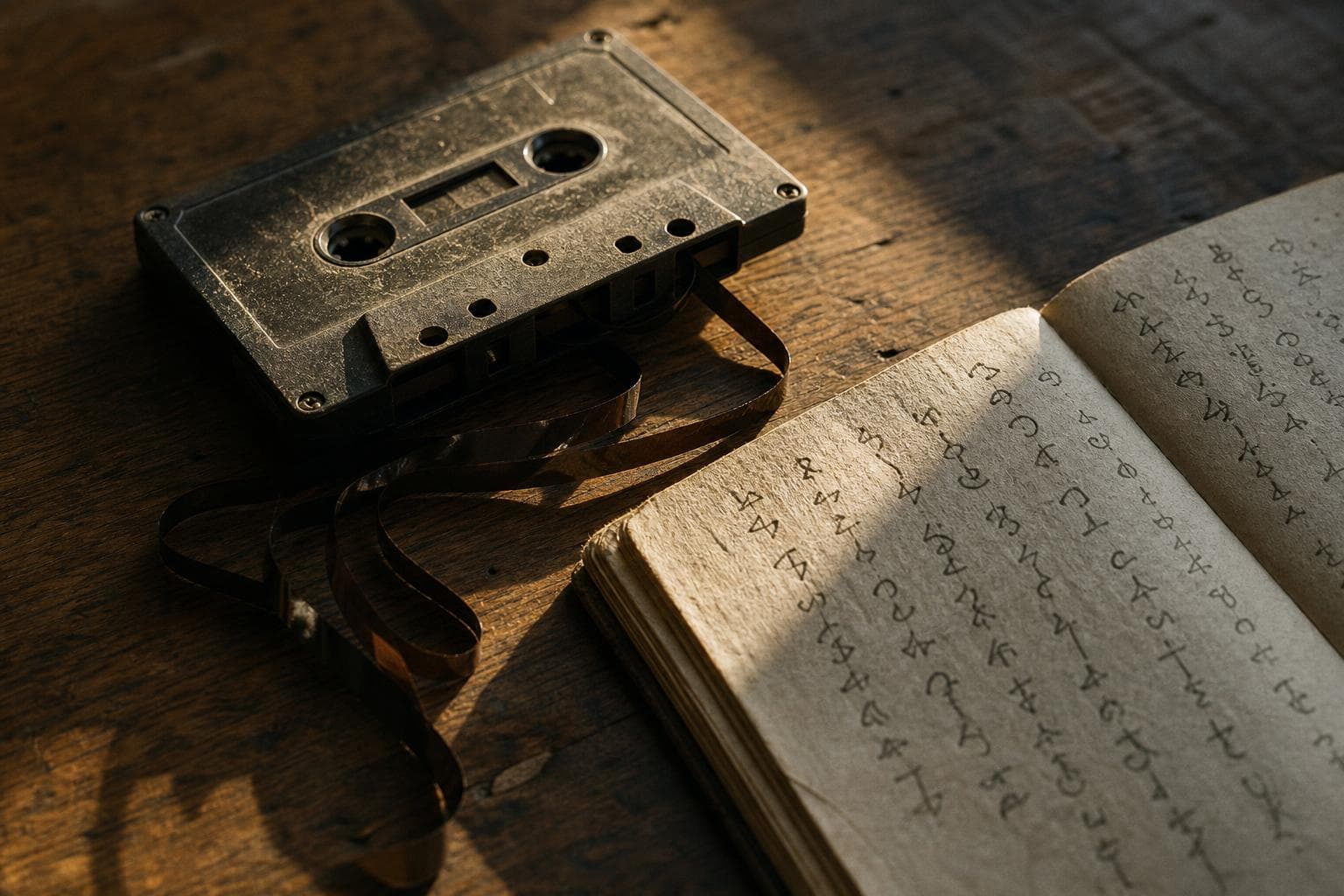

There is a cassette player somewhere in Nibutani, Hokkaido, and through it, a child named Maya Sekine heard her ancestors speak. Her bedtime stories came on magnetic tape — folk tales in Ainu, including one about a singing Hokkaido wolf whose narrative moved between sung phrases and barking vocalisations. At school, none of her friends understood a word of it. Her mother and grandparents knew some phrases, but mainly spoke Japanese. The tapes were, in a real sense, the last room where the language still lived.
That image — a language surviving on cassette reels, passed down through bedtime ritual rather than daily use — is where the Ainu revival begins. Not in a policy document or a university program, but in a family's stubborn insistence that the voice of their ancestors deserved to be heard, even if almost no one else was listening.
The Arithmetic of Erasure
The numbers behind Ainu's decline are not ambiguous. According to BBC Future, records suggest that in 1870 — the year after Ezo (now Hokkaido) was formally incorporated into Japan — roughly 15,000 people spoke local varieties of Ainu, and the majority spoke no other language. By 1917, that estimate had collapsed to approximately 350 speakers. The mechanism was deliberate: government policies included the banning of Ainu in schools, systematically severing the intergenerational transmission that keeps any language alive.
UNESCO now lists Ainu as "Critically Endangered." Only a handful of native speakers remain.
What makes this particular erasure worth examining closely is not just its scale but its method. Banning a language from schools doesn't kill it immediately — it kills it in the next generation, and the one after that. The speakers who survived into the 20th century carried the language in their bodies, but had no institutional mechanism for passing it forward. The cassette tapes Sekine's father chose for her bedtime stories weren't nostalgia. They were emergency preservation.
The Structural Problem No Policy Has Solved
In 2019, Japan legally recognised the Ainu as Indigenous people — a significant political milestone that included measures to foster their inclusion and visibility. But legal recognition and language revitalisation are not the same thing, and the gap between them is where the real difficulty lives.
A 2017 paper in Working Papers in Educational Linguistics identified a structural irony at the heart of Japan's language policy: the same globalisation discourse that has elevated English-as-a-foreign-language education to national priority status has simultaneously crowded out ideological and institutional space for minority language instruction. The disproportionate focus on English in Japanese education, the paper argues, has contributed to closing down what researchers call "implementational spaces" — the practical openings within policy where Ainu instruction could take root.
This is the mechanism that makes Ainu's situation so precarious even after legal recognition. A language needs speakers who use it daily, who argue in it, who make jokes in it, who dream in it. Classroom instruction alone cannot produce that. And when classroom time is already contested terrain — with English claiming an ever-larger share — Ainu education competes for scraps.
What AI Can and Cannot Restore
The most striking recent development in Ainu revitalisation is the application of artificial intelligence to the archive of old recordings — the same kind of magnetic tape that carried Sekine's bedtime stories. Projects now aim to train models on hours of recorded Ainu speech, creating tools that could help learners hear and practice a language for which living conversational partners are vanishingly rare.
Sekine herself has become a practitioner of this revival. Now in her mid-20s, she runs a conversational Ainu YouTube channel — a contemporary medium carrying an ancient language, in a village where about 80% of residents reportedly have Ainu heritage but knowledge of the language itself is scarce. The channel is not just documentation. It is an attempt to make Ainu feel like a living thing, not a museum exhibit.
What AI cannot restore is the cultural density that fluency carries. The BBC Future piece notes that Ainu knowledge includes more than 80 different ways of describing a bear — a lexical richness that encodes an entire relationship between a people and their ecosystem. That kind of knowledge doesn't transfer through a language model trained on recordings. It transfers through the slow accumulation of lived experience in a community that uses the language to navigate the world. No technology closes that gap. It can only hold the door open while communities do the harder work.
The Signal Worth Watching
The Ainu case is, in miniature, the central paradox of every language revival effort: the tools available to preserve a language multiply precisely as the community of speakers capable of sustaining it shrinks. Sekine's YouTube channel, the AI training projects, the 2019 legal recognition — these are genuine signals of momentum. But the measure that matters is not how many recordings exist or how sophisticated the language models become. It is whether children in Nibutani grow up hearing Ainu not just on tape, but from the people around them.
The cassette player in Sekine's childhood was a lifeline. The question now is whether the next generation will need one.


