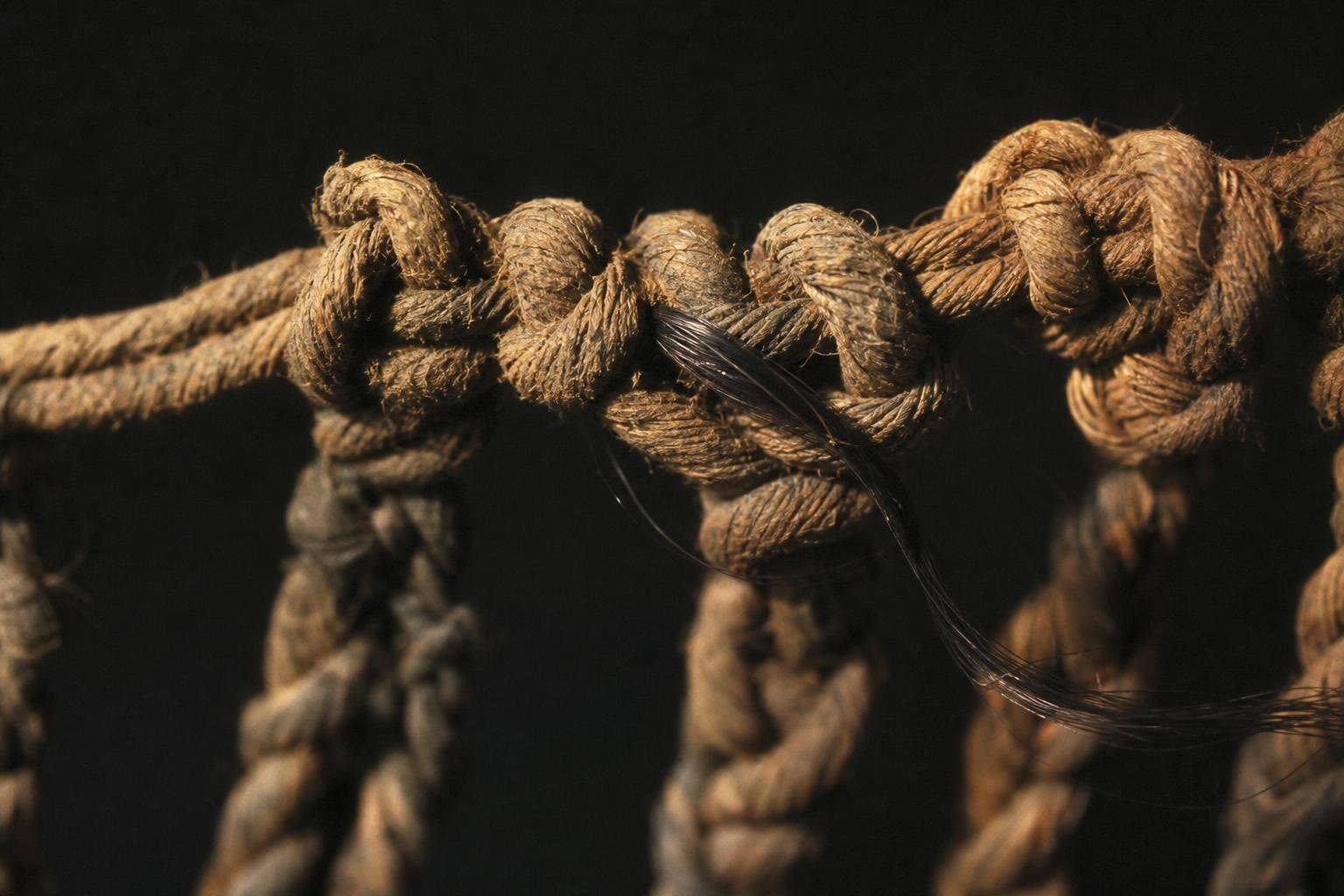

A meter-long braid of human hair, folded and twisted into a primary cord, sat in a Munich collection for over a century before anyone thought to ask whose hair it was.
The answer, published recently in Science Advances, is quietly revolutionary. Chemical analysis of the hair in the khipu known as KH0631 — radiocarbon-dated to around 1498, just before the Spanish conquest — showed a diet inconsistent with Inca elite status: no maize, no meat, the foods that marked privilege. According to Science, the khipu's creator was probably a commoner. Not a bureaucrat. Not a trained imperial specialist. Someone ordinary.
That finding doesn't just revise who made khipus. It reopens the question of what khipus actually were.
The Cord as Signature, the Knot as Cosmology
The standard account of khipu literacy — drawn from Spanish colonial chronicles — positioned it as an elite technology. Khipus were the province of khipukamayuqs, highly trained administrators who enjoyed the finest food and drink. The term itself carries weight: as The Conversation explains, kamayuq derives from kamay, meaning creation in the sense of energizing matter. A khipu expert didn't just record information — they imbued the cords with their own vitality.
Which is why the hair matters so much. In Inca cosmology, hair carried a person's essence. It retained identity even when separated from the body. A child's first haircut was a major rite of passage; the emperor's hair clippings were preserved and eventually fashioned into a life-size simulacrum worshipped after his death. When a khipu maker incorporated their own hair into the primary cord, they were signing it — not metaphorically, but ontologically. The hair was the maker's presence in the object.
Fieldwork in the highland village of Jucul in Peru, where anthropologist Sabine Hyland has been studying a collection of ancestral khipus, confirms this practice is not just historical abstraction. On the Jucul khipus, human hair attached to the primary cord represents the people who made each section. The cord is a record; the hair is the author's mark. If a commoner's hair is woven into KH0631, then a commoner authored it — and authored it in the full Inca sense of that word.
What the Knots Encode — and What We're Still Missing
The numerical architecture of khipus has been understood in broad strokes for over a century. Knot type encodes magnitude: a figure-eight knot represents one, long knots represent two through nine, single knots represent powers of ten. Position on the cord establishes place value. Color, fiber direction, ply, and spacing add further channels of meaning. A recent study in Latin American Antiquity applies formal mathematical knot theory to this system, finding that several common khipu knot forms can be transformed into visually distinct variations — or into other knot types entirely — without untying them. Topologically equivalent knots that look different to the eye may have been functionally identical, or may have carried subtle distinctions that khipukamayuqs recognized and that modern researchers have been misclassifying for decades.
This matters because it suggests the encoding system is even more layered than the numerical reading implies. A knot isn't just a digit. Its topology, its transformability, its relationship to adjacent knots — all of this may carry meaning. The largest khipu ever found, spanning more than five meters and comprising over 1,800 cords, was recently shown to share a numeric connection with another highly complex khipu from northern Chile — a link first identified by ethno-mathematician Marcia Ascher and anthropologist Robert Ascher in the 1970s and now being revisited with digitized data from the Open Khipu Repository.
The numerical system, in other words, is real and increasingly legible. What remains contested is whether it's the whole story — whether khipus also encoded narrative, history, or something closer to phonetic writing.
The Commoner's Cord Changes the Frame
Here is what the hair study forces us to reckon with: if commoners made khipus, then khipu literacy was not a closely guarded state technology. It was something more distributed, more embedded in daily life — closer to the way herders in highland Peru tied their own hair to cords "like a signature," signifying personal responsibility for the information recorded, as documented in contemporary fieldwork.
That changes what we're looking for when we try to decode them. A state census and a herder's personal tally are both numerical, but they're not the same kind of document. The assumption that all khipus are imperial records — the assumption that shaped a century of scholarship — may have been filtering out the very diversity that would help crack the system open.
Hyland's work in Jucul, where villagers possess over 90 ancestral khipus some made centuries ago, represents the best current hope for contextual decoding: cords whose community of origin is known, whose makers' identities may be traceable through the hair woven into them, and whose contents might be cross-referenced against oral tradition. The knots are still there. The signatures are still there. What's been missing, perhaps, is the assumption that anyone — not just an elite bureaucrat — might have tied them.


