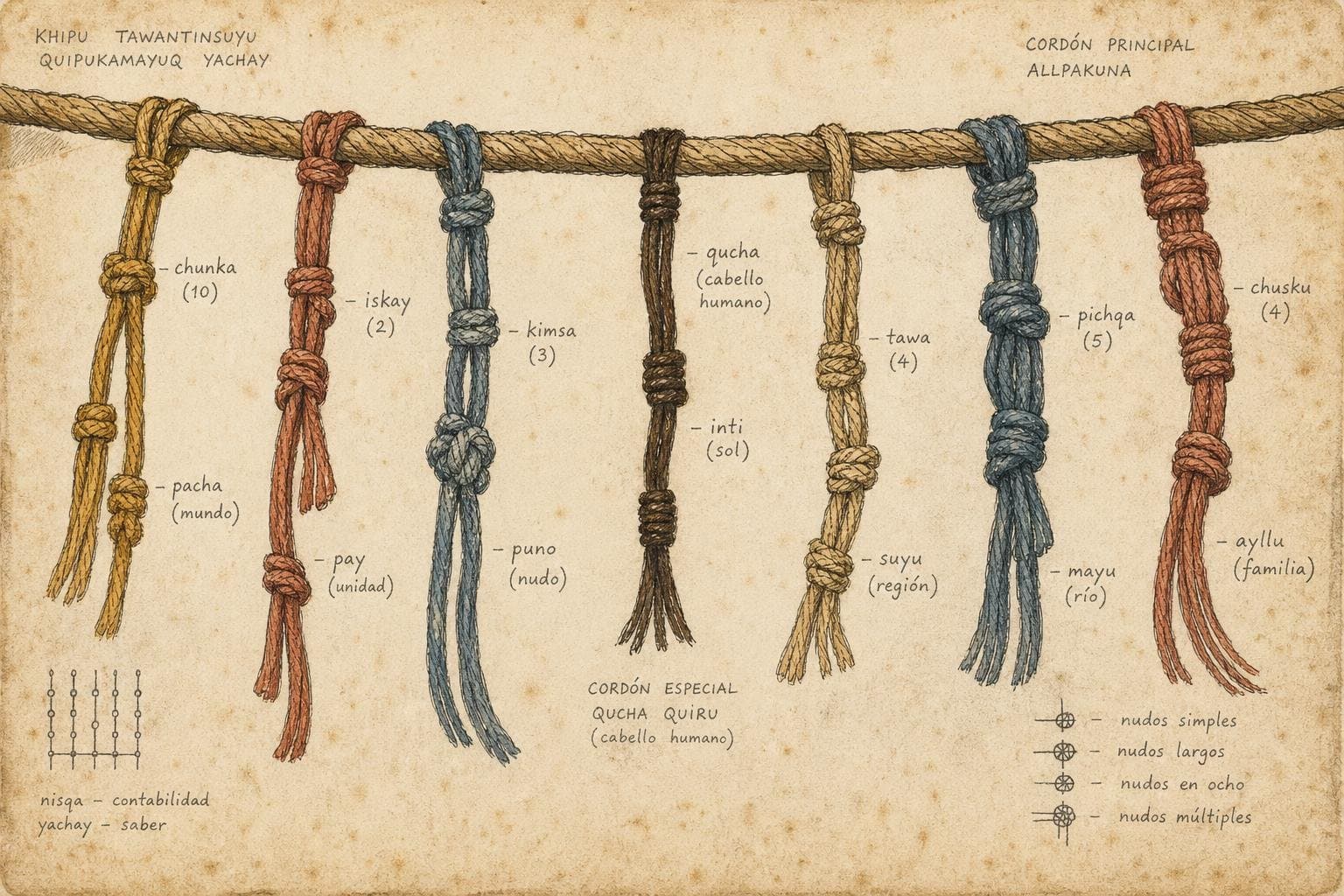

A cord of human hair, radiocarbon-dated to around 1498, has quietly upended one of the most persistent assumptions about Inca record-keeping. Researchers had long believed that khipu production was the exclusive domain of trained administrative elites — the khipukamayuqs, specialists schooled from childhood in the creation and interpretation of these knotted cords. When Sabine Hyland of the University of St. Andrews acquired a new khipu and her colleague Kit Lee identified its primary cord as human hair rather than llama or alpaca fiber, the implication was immediate: even low-class commoners may have been making khipus. An empire of millions, encoding its world in knots — and the practice may have reached far deeper into society than anyone suspected.
That single cord reopens a question that scholars have been circling for decades: what, exactly, were khipus for?
The Knot Is Not the Whole Story
The standard account goes like this. Khipus — bunches of knotted, colored cords hanging from a thick primary strand — encoded numerical data in a decimal positional system. Early Spanish chroniclers documented their use for storehouse inventories, population censuses, and tax obligations. The knots represent numbers; the positions represent place values; the system works. Case closed.
Except it isn't. The numerical reading accounts for some khipus, but researchers have long recognized that others resist this framework entirely. As the Open Khipu Repository — an open-source database of extant Inka-style khipus from archaeological sites and museum collections worldwide — notes in its documentation, khipus used "three-dimensional signs — primarily knots, cords, and colors — as symbols functionally akin to those of early writing systems in other cultures," and the recording system "remains undeciphered." The database exists precisely to enable decipherment efforts, not to celebrate a solved problem.
What makes khipus genuinely strange, linguistically, is the density of variables encoding meaning simultaneously. According to Cecilia Pardo-Grau, lead curator of the British Museum's Peru: a journey in time exhibition, khipus assigned meaning to the type and position of knots, the spaces between them, cord length, fiber color, and more. That's not an abacus. That's a multidimensional encoding scheme whose full grammar we still cannot read.
What Matching Khipus to Census Records Revealed
The most promising crack in the cipher came not from a senior scholar but from a Harvard undergraduate on spring break. Manny Medrano, working with professor Gary Urton, matched a set of six khipus to a colonial-era Spanish census document — cross-referencing the physical structure of the cords against known population data. The correspondence was close enough to suggest that specific cord colors and configurations mapped to specific villages and household categories. For the first time, researchers could read a khipu not just as a number but as a record of people.
Urton had spent years building toward this moment. UNESCO's Memory of the World register notes that he traveled to museums and private collections across three continents, eventually cataloguing records of hundreds of khipus in the Harvard Khipu Database — the largest systematic effort to find patterns across the surviving corpus. The database now underpins computational decipherment attempts that would have been impossible with physical specimens alone.
More recently, a researcher analyzing two khipus from northern Chile — one the largest ever found, spanning more than five metres with over 1,800 cords — identified a structural relationship between them: the smaller, more complex khipu appeared to be a summary and reallocation of the information in the larger one. Same data, different architecture. The khipu system, in other words, had something like document types — formats suited to different administrative purposes, the way a spreadsheet and a report can encode the same underlying figures.
The Writing Question Refuses to Stay Settled
Kit Lee, Hyland's research associate, has put the challenge plainly: khipus get overlooked as a form of writing because they don't look like writing. They're tactile, three-dimensional, made of fiber rather than inscribed on a surface. Our intuitions about what writing is are shaped almost entirely by alphabetic and logographic traditions — marks on flat things. A knotted cord challenges that at the level of medium, not just content.
Hyland's work in the Peruvian Andes, including her British Museum-funded project documenting khipu traditions in the community of Santa Leonor de Jucul, has pushed toward recognizing khipus as proto-writing — encoding not just numbers but narrative, historical memory, possibly phonetic elements. The human-hair cord fits this expanded picture: if commoners were making khipus, the system wasn't purely administrative. It was something people reached for to record their lives.
Five hundred years after the Spanish conquest severed the living tradition of khipu reading, we're still learning what was encoded in those knots. The hair cord from 1498 is a reminder that the people who made khipus were not just bureaucrats running an empire's accounts. They were people who needed to remember things — and who found a way to do it that we are only beginning to understand.


