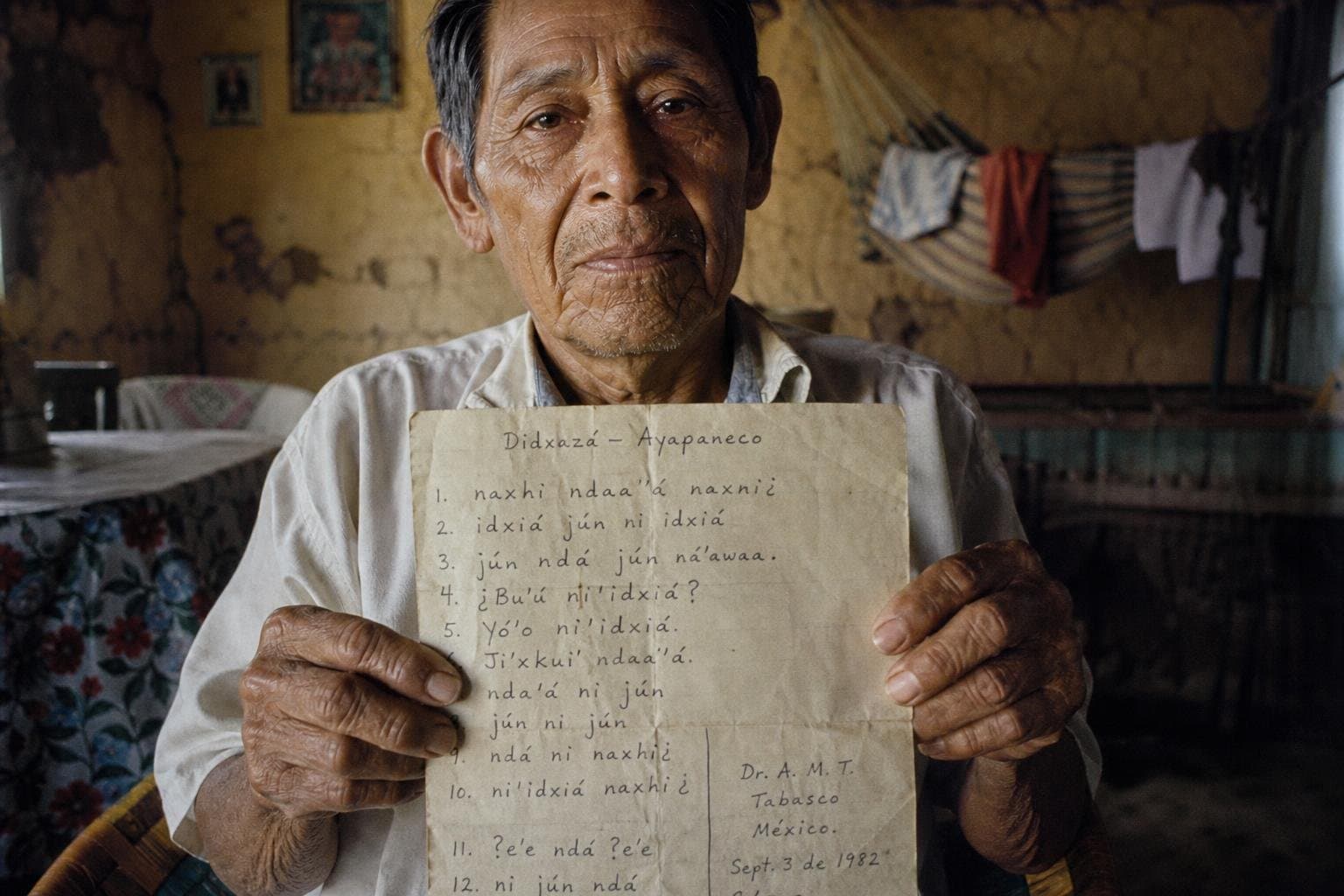

In April 2011, a story went around the world that was too good to check: in the village of Ayapa, in the Mexican state of Tabasco, only two men still spoke a language called Ayapaneco, and they refused to speak to each other. A language dying of a grudge. It ran in a major British paper and from there everywhere, because it had everything a language-death story is supposed to have — scarcity, drama, a clean ending waiting to happen (kwikke.be).
There was no feud.
The Anthropologist Who Actually Lived There
Daniel Suslak, an anthropologist who had worked in and around Ayapa for years and published on the language that same year, knew better. Manuel Segovia and Isidro Velázquez were not enemies. By Suslak's account they had done more than almost anyone to keep the language alive, and — this is the detail that unravels the whole premise — they weren't the only two speakers involved in the documentation work to begin with. What existed between them was ordinary personality friction, the kind any two elderly men in a small community might have. Not a vendetta. A village (kwikke.be).
That distinction matters because of who gets to author a "last speaker" story in the first place. A University of Montreal doctoral project — backed by the Wenner-Gren Foundation and supervised by Luke Fleming — set out to study exactly this phenomenon across five Latin American cases, Ayapaneco among them, alongside Tehuelche in Argentina, Yagán in Chile, Chaná in Uruguay and Argentina, and Tinigua in Colombia. The project's premise is blunt: "last speaker" status is often less a linguistic fact than a social construction, built through media coverage, government bureaucracy, activist framing, and the speakers' own performance of the role for outsiders (wennergren.org). Ayapaneco didn't just lose speakers. It became a case study in how the story of losing speakers gets manufactured.
The pattern isn't unique to Mexico. Yaghan, once spoken at the southern tip of South America, produced its own viral export — the "untranslatable" word mamihlapinatapai, describing two people each hoping the other will do something neither wants to do first. Its last native speaker, Cristina Calderón, died in 2022, and the word now circulates in listicles stripped of the grammar that made it make sense in the first place: an elaborate reciprocal-causative verb structure, not a cute coincidence (oxylipins.substack.com). Both cases show the same reflex — a language's actual mechanics get replaced by a single exportable anecdote.
Then a Phone Company Bought the Myth
In 2013, Vodafone built an advertising campaign around the feud — the company claimed credit for helping save the language, and the narrative vehicle it chose was the reconciliation of the two "warring" old men, filmed as if it were real (kwikke.be). A fabricated conflict turned out to be more useful to everyone — journalists, a telecom brand, readers hungry for a tidy parable — than whatever was actually happening on the ground. That's a familiar shape to anyone who's spent time around revitalization work: the version of events that travels is rarely the one that happened, it's the one that was easiest to tell. I've watched it happen with other last-speaker narratives too, and there's something almost predatory in how fast the myth outruns the correction.
What Was Actually Happening in Ayapa
Strip away the grudge narrative and the real work looks unglamorous in exactly the way language documentation usually does. Since 2012, Mexico's national institute for indigenous languages has supported the effort in Ayapa. A spelling system was agreed on — no small thing for a language that was barely written down before. Classes started in the village. A doctoral thesis on the language appeared in 2019 (kwikke.be). That kind of unglamorous institution-building looks a lot like what's kept Cherokee alive on the other side of the continent — weekly coffee-hour conversation practice, a community-run apprenticeship program, university researchers tracking exactly how and why fluency shifts across generations (unc.edu). Neither effort makes headlines. Both are the actual mechanism.
Fieldwork with the last active Ayapaneco speakers has documented something the feud story never mentioned: these speakers describe themselves as personally responsible for passing the language to the community's children, framing their own teaching as an obligation rather than a performance for cameras — and they attribute the language's decline in part to parental disinterest, not to any dispute among themselves (researchgate.net).
Speaker counts depend entirely on who's counting and by what standard — Mexico's 2020 census recorded a much larger number of self-identified speakers than the handful of elderly fluent speakers more recent estimates describe, a gap that shows up in nearly every endangered-language count once you separate "identifies with the language" from "speaks it daily" (kwikke.be). Worth noting too: speakers call their own language Nuumte Oote, roughly "the true voice." Ayapaneco is the name outsiders gave it — which is its own small lesson in who narrates whom (kwikke.be).
The Story That Doesn't Make the Headlines
This is what real language preservation actually looks like: slow, uncertain, full of meetings about orthography. It doesn't have a villain or a reconciliation scene, so it doesn't travel the way the feud did. Researchers are now asking whether computational tools — transcription models, machine-assisted annotation — can speed up the unglamorous parts of this work for languages with vanishingly few remaining speakers, though the same literature stresses that communities, not algorithms, have to keep guiding what gets documented and how (annualreviews.org). Whatever role that technology ends up playing, the number that will actually decide Nuumte Oote's fate isn't a speaker count or a headline — it's whether the orthography work and classroom teaching in Ayapa produce any new generation of speakers at all.


