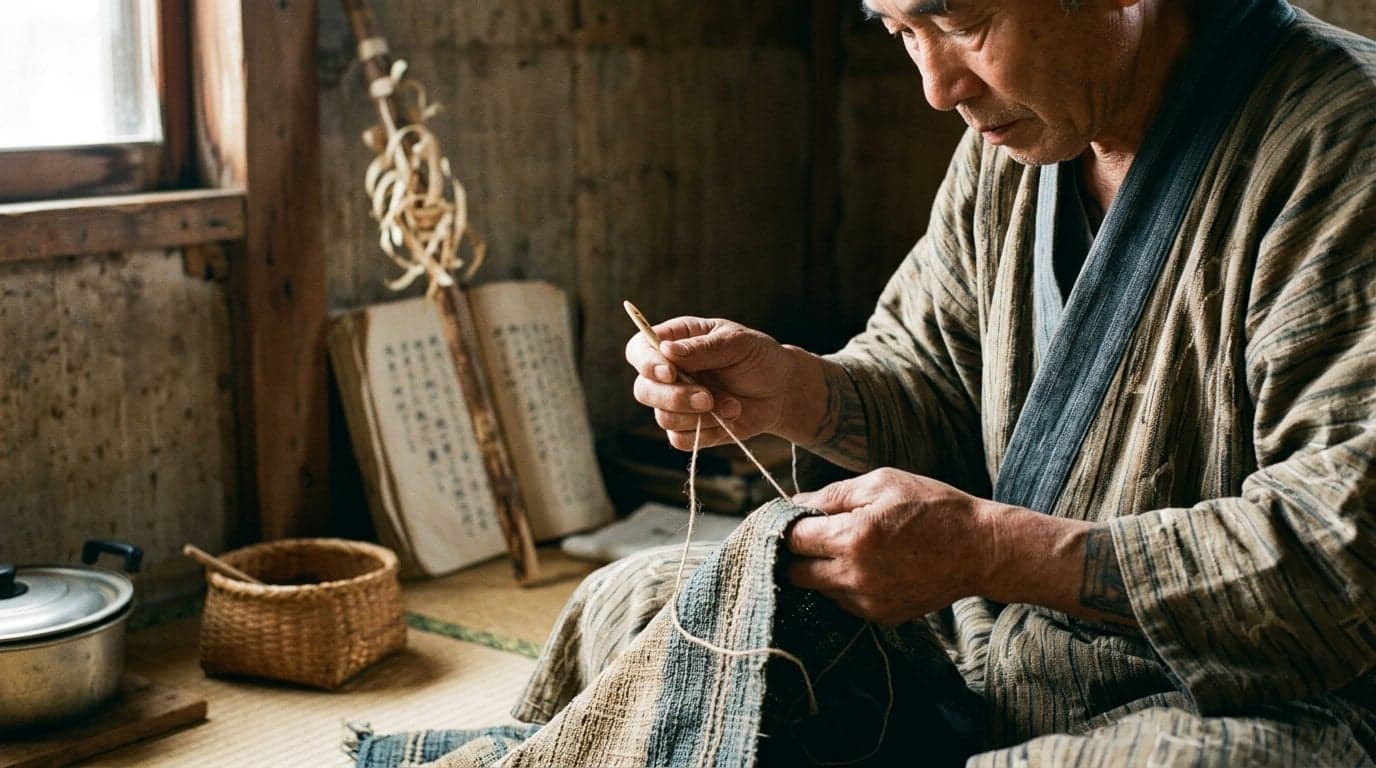

There is a word in Ainu — kamuy — that doesn't translate cleanly into Japanese or English. It refers not to gods in any distant, theological sense, but to the spiritual force present in bears, wolves, rivers, fire, and disease: everything that exceeds human control. To speak Ainu is, in part, to inhabit a world where that distinction — between the animate and the sacred, between nature and power — is grammatically unavoidable. Lose the language, and you don't just lose the word. You lose the cognitive architecture that made the distinction feel necessary.
That architecture is now critically endangered. UNESCO lists Ainu as "critically endangered," and the path to this point is not ambiguous: following the colonization of Hokkaido by the Meiji government in the late 1800s, Ainu was banned in schools, customs were suppressed, and assimilation was enforced as policy. Records suggest that in 1870 — one year after Ezo was declared part of Japan — some 15,000 people spoke local varieties of Ainu. By 1917, that number had fallen to an estimated 350. The decline since then has been precipitous.
What makes the contemporary moment complicated — and worth examining carefully — is that Japan has, in formal terms, changed course. In 2019, the government passed legislation officially recognizing the Ainu as an Indigenous people for the first time. The Upopoy National Ainu Museum and Park opened in Shiraoi, Hokkaido in July 2020. Revival programs, language workshops, and AI-assisted documentation projects are underway. The infrastructure of recognition exists. And yet the gap between that infrastructure and actual language reclamation remains wide — and, according to researchers, structurally maintained.
Recognition Without Reclamation
The distinction that matters here is between revitalization and reclamation — and it's not semantic hairsplitting. An increasing number of scholars and language activists now prefer the term "reclamation," which prioritizes decolonization, minoritized epistemologies, and social issues rather than focusing mainly on linguistic solutions like teaching and documentation. The difference is this: revitalization treats language as a cultural artifact to be preserved; reclamation treats it as a living right embedded in a community's political and social existence.
Japan's official approach, as analyzed in the Melbourne Asia Review, has consistently framed its goal as "raising awareness" of Ainu culture among the general public — a formulation that positions Ainu identity as an object of appreciation rather than a subject of rights. Policy discussions center on cultural visibility while sidestepping the contemporary social conditions — discrimination, economic marginalization, the absence of safe spaces to speak Ainu publicly — that make transmission nearly impossible regardless of how many workshops are offered.
Research on the Ainu and Ryūkyūan revival movements identifies "institutional invisibility" as a shared structural problem: languages that lack official recognition or state support struggle to move from cultural programming into the domains — schools, workplaces, legal proceedings — where daily use actually forms. Ainu has some institutional support; the Ryūkyūan languages have less. Neither has the kind of embedded, domain-spanning presence that sustains a language across generations.
What the Lawsuit Reveals
In May 2026, the tension between recognition and reclamation broke into the courts. On May 8, the Sibechari Ainu Tribe filed Japan's first lawsuit of its kind, demanding the national government return 279 ancestral skeletal remains currently stored at the Upopoy Memorial Site. The remains were originally taken from Hokkaido communities by researchers from institutions including Hokkaido University and the University of Tokyo during the colonial period — framed at the time as anthropological study, and described by contemporary scholars as work aimed at justifying the colonial project.
The lawsuit argues that Ainu burial tradition vests the right to manage remains in the kotan — the community — not the state. That the government consolidated these remains at a national museum and park, rather than returning them to descendants, is, for the plaintiffs, the policy contradiction made physical: a facility built to celebrate Ainu culture that simultaneously holds Ainu ancestors against the community's wishes.
Language revival cannot be separated from this. As Yosiyuki Uji, chairman of the Toyoura Ainu Association, describes it, Ainu identity persists through Ainu kimochi — the feeling of being Ainu, of belonging — even in a world where Japanese is dominant and the old subsistence practices are gone. That feeling is not something a language workshop produces. It comes from a community's relationship to its own history, land, and dead — precisely the things the lawsuit is about.
The Archive Is Not the Language
Maya Sekine, raised in Nibutani, Hokkaido — where roughly 80% of residents reportedly have Ainu heritage — grew up listening to Ainu folk tales on cassette tapes chosen by her father. She now runs a conversational Ainu YouTube channel. She is, by her own account, unusual: her father is an Ainu language teacher, her mother's family is known for traditional handicrafts. "I know I'm special and lucky," she says.
That sentence carries the weight of the whole situation. When a speaker describes herself as lucky to have access to her


