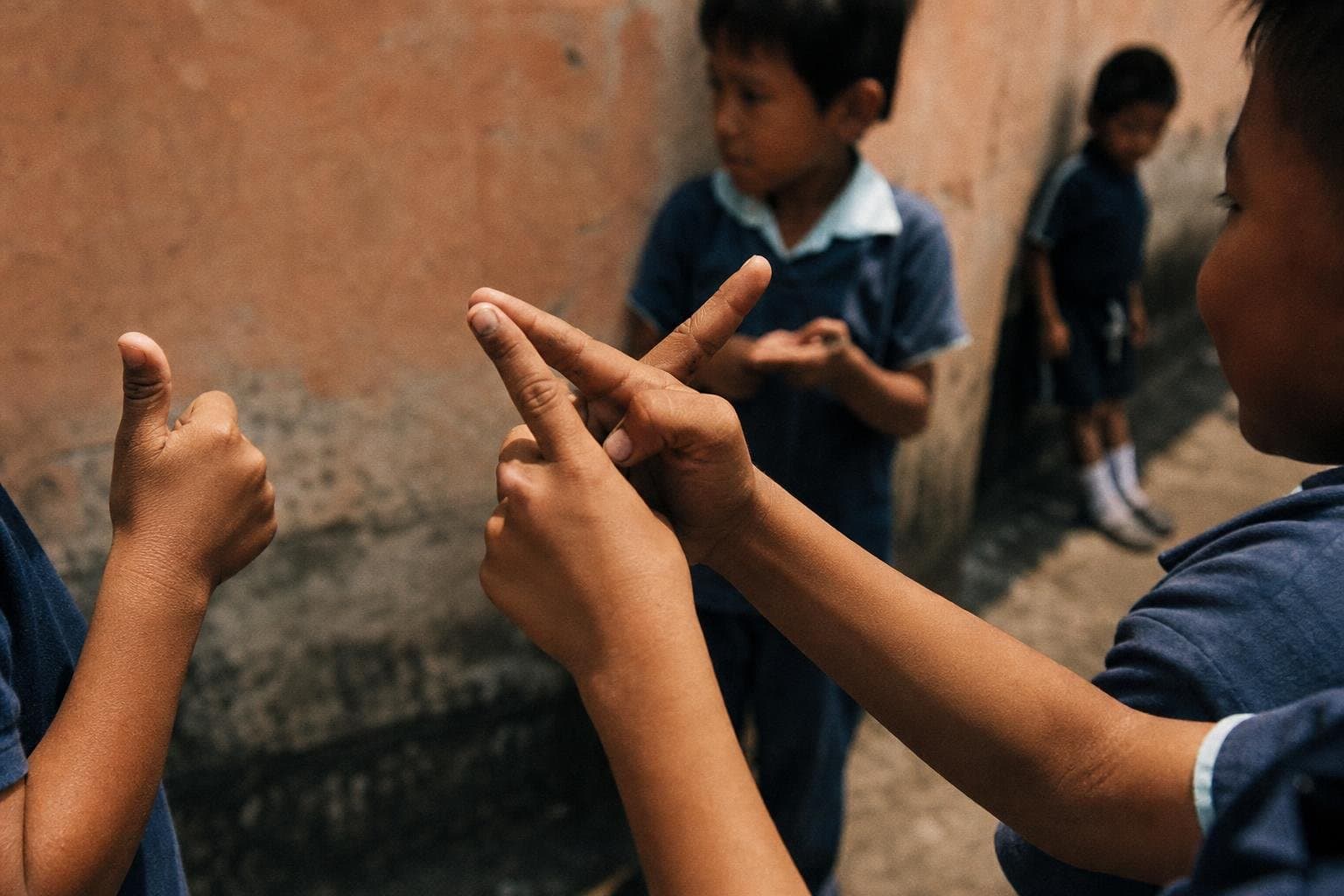

In 1980, a new school for deaf children opened in Managua. The students who arrived had grown up largely isolated from one another, each relying on homemade gesture systems developed within their own families. The teachers tried to teach them Spanish lip-reading. They mostly failed. But something else was happening in the schoolyard and on the buses home — something the teachers weren't orchestrating and couldn't have planned. The children were talking to each other.
What emerged from those interactions became one of the most studied linguistic events of the twentieth century: Nicaraguan Sign Language, known by its Spanish acronym LSN and later its more grammatically complex successor, ISN (Idioma de Señas de Nicaragua). For linguists, it remains the closest thing we have to watching a language be born.
The Schoolyard Was the Laboratory
The story of Nicaraguan Sign Language matters because it happened in documented historical time, with living witnesses. Most languages emerge across centuries, their origins obscured by the absence of records. LSN/ISN emerged across decades, with researchers present.
What the first cohort of students created was a pidgin-like system — functional, communicative, but relatively simple in structure. When younger children entered the school in subsequent years, something remarkable happened: they didn't just learn the existing system. They elaborated it. The second cohort produced a more grammatically complex language, with spatial grammar, verb agreement, and the kind of recursive structure that linguists associate with full natural languages. The children weren't taught this grammar. They generated it.
This is what makes the Nicaraguan case so theoretically charged. It offered apparent evidence for the idea that children don't just acquire language — they create it, given the raw material of social contact and communicative need. The linguist who brought the case to international attention, Ann Senghas, documented how each successive cohort of younger children drove the language toward greater grammatical complexity, a process she described as a kind of linguistic ratchet.
What "Spontaneous" Actually Means
The word "spontaneous" gets used loosely around this story, and it's worth being precise. LSN didn't emerge from nothing. It emerged from children who already had gesture systems, who had communicative intentions, and who were suddenly placed in sustained contact with peers for the first time. The school created the conditions; the children created the language.
This is consistent with what we know about how sign languages develop more broadly. As The Conversation documents in research on British Sign Language, BSL itself "was not invented by any single individual, but developed spontaneously" when deaf people gathered in communities — and its regional dialects emerged specifically in the playgrounds and dormitories of residential schools, where deaf children created signs that then became part of local varieties. The school, in both cases, is not the source of the language. It's the crucible.
The Nicaraguan case also complicates any clean separation between "language creation" and "language change." A 2022 study published in Language and reported by ScienceDaily on the evolution of ASL's copula system found that "the evolution of sign language grammar extends well beyond the initial formation once a deaf community becomes established" — meaning the creative work doesn't stop when a language gets off the ground. Grammar keeps elaborating, keeps complexifying, across generations of signers. Nicaraguan Sign Language is an accelerated, visible version of a process that never really ends.
The Brain Was Ready
One reason the Nicaraguan case captured so much attention is that it seemed to illuminate something about human cognitive architecture — specifically, the idea that children are biologically prepared to acquire and generate language in ways adults are not. The younger cohorts in Managua outpaced their older peers in grammatical complexity not because they were smarter, but because they were younger, and the language-acquisition window was still fully open.
This maps onto what neuroscience has established about how the brain handles sign language. Research published in Human Brain Mapping and summarized by ScienceDaily found that Broca's area — long known as central to spoken language grammar and meaning — is activated in sign language processing across virtually every study examined in a large meta-analysis. Deaf signers perceive signs not as movement sequences but as linguistic content, activating the same left-hemisphere language network that spoken language uses. The brain doesn't care whether the signal is acoustic or visual. It's looking for language, and it finds it.
The children in Managua weren't doing something miraculous. They were doing what human children do: finding language in the social world around them, and building more of it than they were given.
What Gets Lost When We Forget the Children
The Nicaraguan Sign Language story is often told as a triumph — proof of human linguistic creativity, evidence for universal grammar, a natural experiment that textbooks cite for decades. All of that is true. But there's something worth sitting with in the image of those first students: children who had spent their whole lives without a shared language, suddenly in a room together, inventing one.
The Guardian's recent survey of language endangerment notes that 44% of the world's roughly 7,000 known living languages are now classed as endangered. Most of those languages weren't born in a schoolyard in Managua. They were built over centuries, carrying ecological knowledge, social structure, and ways of organizing reality that exist nowhere else. What the Nicaraguan case shows is how much creative work goes into building a language from scratch — and therefore how much is lost when one disappears.
The children on those Managua school buses were doing something that took other communities generations. That we got to watch it happen is extraordinary. That we're still losing languages faster than we can document them is the part that should keep us up at night.


