
There are no words for "yes" or "no" in Kusunda. No words for direction — no "left," no "right," no "north." For a language that has survived two near-extinctions in the hills of Nepal, this is not an oversight. It is a window into an entirely different architecture of thought.
Kusunda is a language isolate — unrelated to any other known language on earth. Not Indo-Aryan, not Sino-Tibetan, not anything in between. It sits alone in the world's linguistic family tree like a single branch with no trunk, no roots anyone can trace. That isolation is itself a kind of record: the possibility, as one recent analysis notes, that Kusunda or similar languages were spoken in the sub-Himalayan region before either of the major language families arrived. The Kusunda people were hunter-gatherers until the twentieth century — the last such community in Nepal — and their language may carry the cognitive fingerprints of that world.
Today, according to Nepal's 2021 census, 253 people identify as Kusunda. One of them speaks the language fluently.
A Grammar That Refuses Familiar Categories
What makes Kusunda's structure so disorienting — and so irreplaceable — is not just its isolation but the specific ways it diverges from how most of us expect language to work.
A recent paper published in Language examines negation and nominalization in Kusunda, and the findings are striking. In most languages, negating a verbal clause is the baseline, the unmarked case — the thing grammar does most naturally. In Kusunda, this standard negation is "at best highly restricted." The language instead routes negation through mood and nominalizing strategies, essentially converting verbal ideas into noun-like forms to escape the constraints of the system. The grammar doesn't just say "not X." It restructures the sentence's entire architecture to avoid the problem.
This is not a quirk. It reflects a fundamentally different way of organizing predication — of deciding what counts as an action, a state, a thing. When a language encodes reality this way, it shapes what its speakers can say easily, what requires effort, and what may be nearly unsayable. Lose the language, and you lose that particular map of the possible.
The absence of directional words and yes/no markers, noted by the Nepali Times, compounds this picture. A community of forest-dwellers who navigated without cardinal directions, who affirmed and refused without binary markers — their language reflects a relational, contextual orientation to the world that no translation can fully reconstruct.
How a Language Dies Twice
Kusunda's near-extinctions were not accidents. They were policy outcomes.
The 1854 Muluki Ain — Nepal's legal code — codified caste-based discrimination that placed the Kusunda at the margins of Nepali society. A systematic review published in the Journal of Research in Education traces the collapse of Kusunda language and culture to forced sedentarization, labor migration, exogamous marriage, and educational exclusion. The Kusunda began identifying as Thakuri, adopting surnames like Sen, Shahi, and Khan to avoid ostracism. Children grew up speaking Nepali. The language retreated into households, then into memory.
By the time linguists began serious documentation in the early 2000s, Kusunda was considered functionally extinct. Then researchers found Gyani Maiya Sen Kusunda — an elderly woman who still carried the language. She became its ambassador, its proof of life, the source from which a generation of documentation work flowed. She died in 2020.
That second near-extinction was the one that should have been final. It wasn't, because Gyani Maiya had already passed the language to someone else.
The Woman Holding the Line
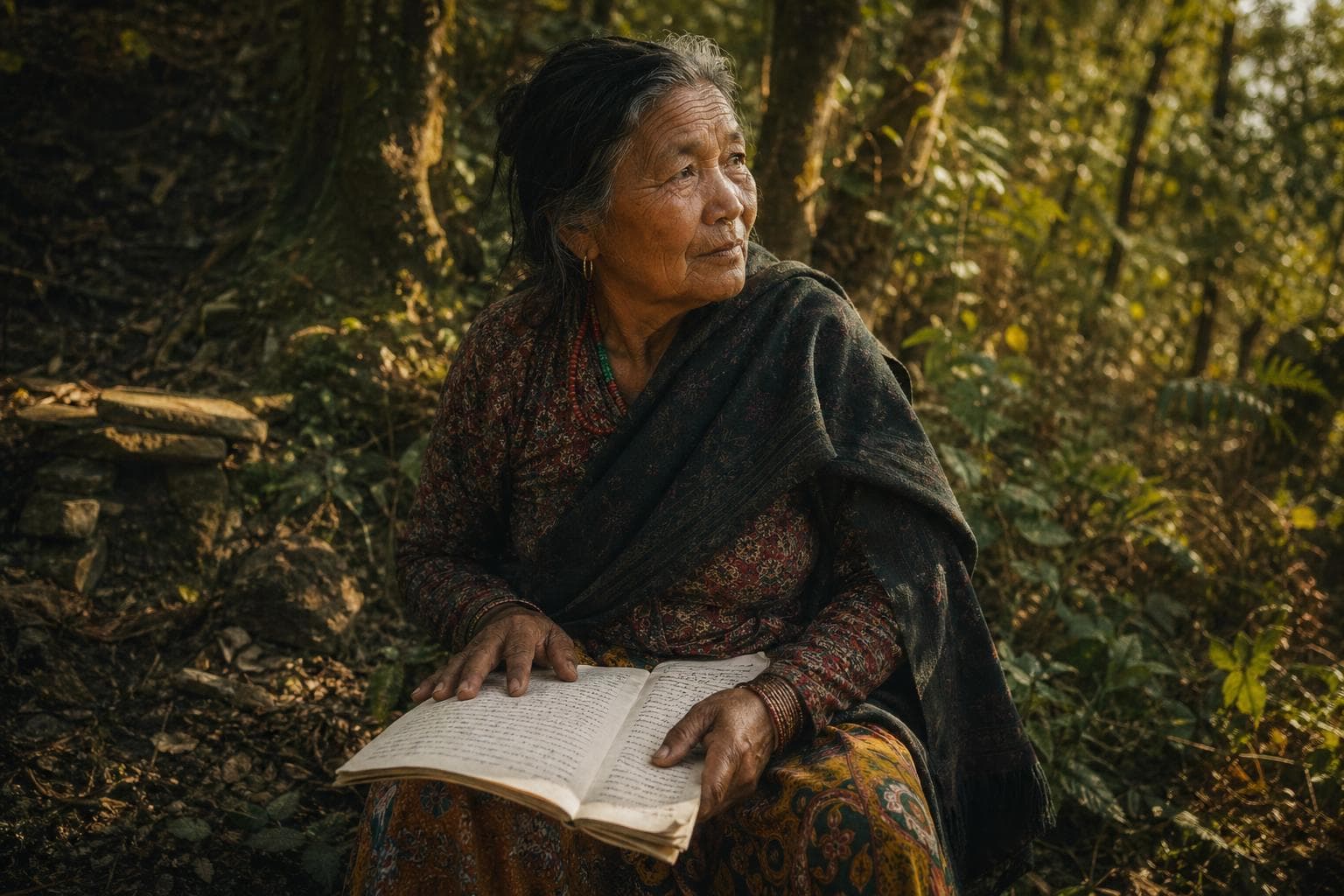
Kamala Sen Kusunda was born in 1975 in Rolpa, after her family had already settled from their nomadic life. She grew up speaking Kusunda at home — not as a political act, but because her family still did. She married young, into a Chhetri family, and her four children were raised in their father's culture. The language could easily have stopped with her.
It hasn't. Kamala is now the only fluent native Kusunda speaker alive, and she is teaching — both Kusunda community members and outsiders who want to learn. A government social security stipend introduced in recent years has given some Kusunda people economic reason to reclaim their identity, and with it, curiosity about the language.
The revitalization effort has also gone digital. A VR project by NowHere Media, documented by researchers at Anglia Ruskin University's StoryLab, captured the Kusunda world through volumetric filming — building an immersive environment where viewers can hear the language spoken and learn basic vocabulary. The project worked with shaman Lil Bahadur and his granddaughter Hima, who told researchers: "If the Kusunda language disappears then the existence of the Kusunda people in Nepal will also fade away. We'll lose our identity."
That sentence contains the whole argument. Language revitalization is not nostalgia. It is a community insisting that its particular way of organizing reality — one without yes or no, without left or right, with negation that restructures the sentence rather than simply inverting it — is worth the effort of survival.
The researchers behind the systematic review are direct about what's required: digital documentation tools, community-based bilingual education with Kusunda as a medium of instruction, economic interventions in food security and housing, and formal recognition of women's central role in intergenerational transmission. Kamala Sen Kusunda is already doing the last part. The question is whether the infrastructure catches up before she is the only one left who can.
Watch for Nepal's next census cycle and whether the government's stipend program expands — those two levers, identity reclamation and economic incentive, are currently the strongest forces keeping Kusunda speakers in the count.


