
There is a word in Ainu — kamuy — that refers not just to gods or spirits but to the animating force present in bears, fire, disease, and the act of speech itself. To speak Ainu is, in some sense, to participate in a world where language and the sacred are not separate categories. That world is now critically endangered. And the policy designed to protect it may be making things worse.
The Ainu language has been listed as "critically endangered" in the UNESCO Atlas of the World's Languages in Danger since 2009. The damage has deep roots: the Meiji government's colonization of Hokkaido in the late 1800s brought assimilationist policies that historian David L. Howell describes as "ethnic negation" — the systematic exclusion of Ainu identity from what he calls "the realm of the politically meaningful." The 1899 Hokkaido Former Natives Protection Act remained the sole Ainu policy in Japan until 1997. Nearly a century of legal erasure leaves marks that a museum and a recognition ceremony cannot undo.
I wrote about the Ainu revival's policy contradictions earlier this summer and again in June. What's become clearer since then is that the gap between official recognition and actual reclamation has a specific shape — and it's worth naming precisely.
Recognition Without Reclamation Is a Different Thing
In 2008, the Japanese government formally recognized the Ainu as an Indigenous people — a moment that Beyond Ainu Studies describes as "unparalleled political change." It was Ainu activist Uzawa Kanako who, in that same moment, signaled the need to move beyond the legacy of "Ainu studies" — a colonial academic tradition that treated Ainu people as research objects rather than knowledge holders. The recognition was real. So was the suspicion it inherited.
What followed has been a policy framework with a telling priority: raising "awareness" of Ainu culture among the general Japanese public, set as a prerequisite to establishing substantive Ainu rights. The Melbourne Asia Review's analysis of government documents puts the problem plainly — the "culture" envisioned under government-controlled standards is an extremely narrow one, in which Ainu social issues are systematically disregarded. Language teaching and documentation are treated as the primary levers. The deeper sociolinguistic reality — that speakers need safe spaces to be Ainu before they can speak Ainu — goes largely unaddressed.
This distinction between revitalization and reclamation matters enormously. Revitalization focuses on linguistic solutions: classes, recordings, curricula. Reclamation, as an increasing number of scholars and language activists now argue, prioritizes decolonization and the social conditions that make a language livable. You can teach someone vocabulary. You cannot teach them to feel safe using it in public.
What the Textiles Know That the Policy Doesn't
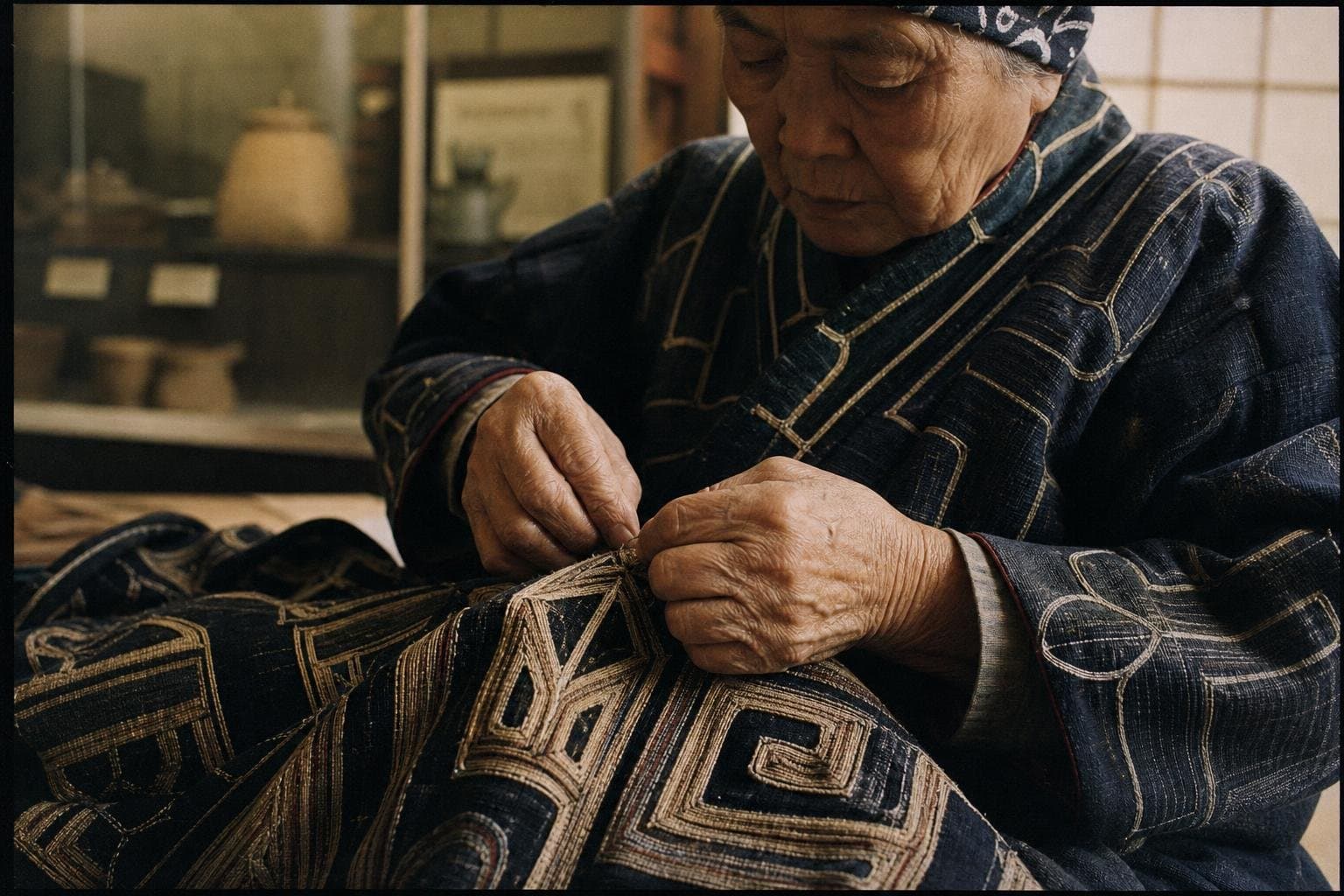
A peer-reviewed study published this month in npj Heritage Science offers an unexpected window into this problem. Researchers Vargas Meza Xanat and Ochiai Yoichi examined 393 Ainu garments held at the National Museum of Ethnology, using network analysis to map which textile patterns appeared together and how pattern usage shifted over time. Their framework — "compositional relationality" — treats Ainu textile design as an integrated knowledge system, not a decorative tradition. The patterns encode relationships: between materials, between makers, between the human and natural worlds.
The study's framing is significant beyond its textile findings. It opens by noting that museum management of Indigenous material heritage is undergoing a shift, driven by Indigenous communities challenging Western-centric interpretive frameworks. The Ainu garments in those museum cases carry cultural meanings that require recovery, not just preservation. That recovery depends on the survival of the knowledge system that produced them — which is, at its core, a linguistic system.
This is the connection that Ainu language policy keeps missing. The grammar of Ainu encodes spatial relationships, ecological knowledge, and ritual logic that have no clean equivalent in Japanese. When the language goes, the textile patterns become decorative. The kamuy becomes metaphor.
The Institutional Visibility Problem
Comparative context sharpens the picture. A 2021 study on institutional visibility and language revitalization in Japan contrasts the Ainu situation with the Ryūkyūan languages of Okinawa — which, unlike Ainu, have received no official recognition from the Japanese government at all. Yet the Ryūkyūan community built a complex network of speakers, volunteers, learners, and linguists that the study describes as a successful revitalization model. The Ainu, with official recognition and institutional support, have struggled to match that community-driven momentum.
The lesson is uncomfortable: state visibility can substitute for community agency rather than enabling it. When policy defines what counts as authentic Ainu culture, it narrows the space in which Ainu people can define it themselves.
Meanwhile, UNESCO's International Decade of Indigenous Languages (2022–2032) is now pushing into new territory — specifically, how AI systems trained on large language datasets represent, or fail to represent, Indigenous linguistic knowledge. A new UNESCO initiative, co-designed with a 19-member global Steering Committee of Indigenous language data experts, is building community-governed data commons to address exactly this risk. Whether Ainu communities will have the institutional standing to participate on their own terms is, at this point, an open question.
What's not open is the urgency. A language that encodes an entire cosmology — where speech itself is kamuy — cannot wait for policy to catch up with reclamation.


