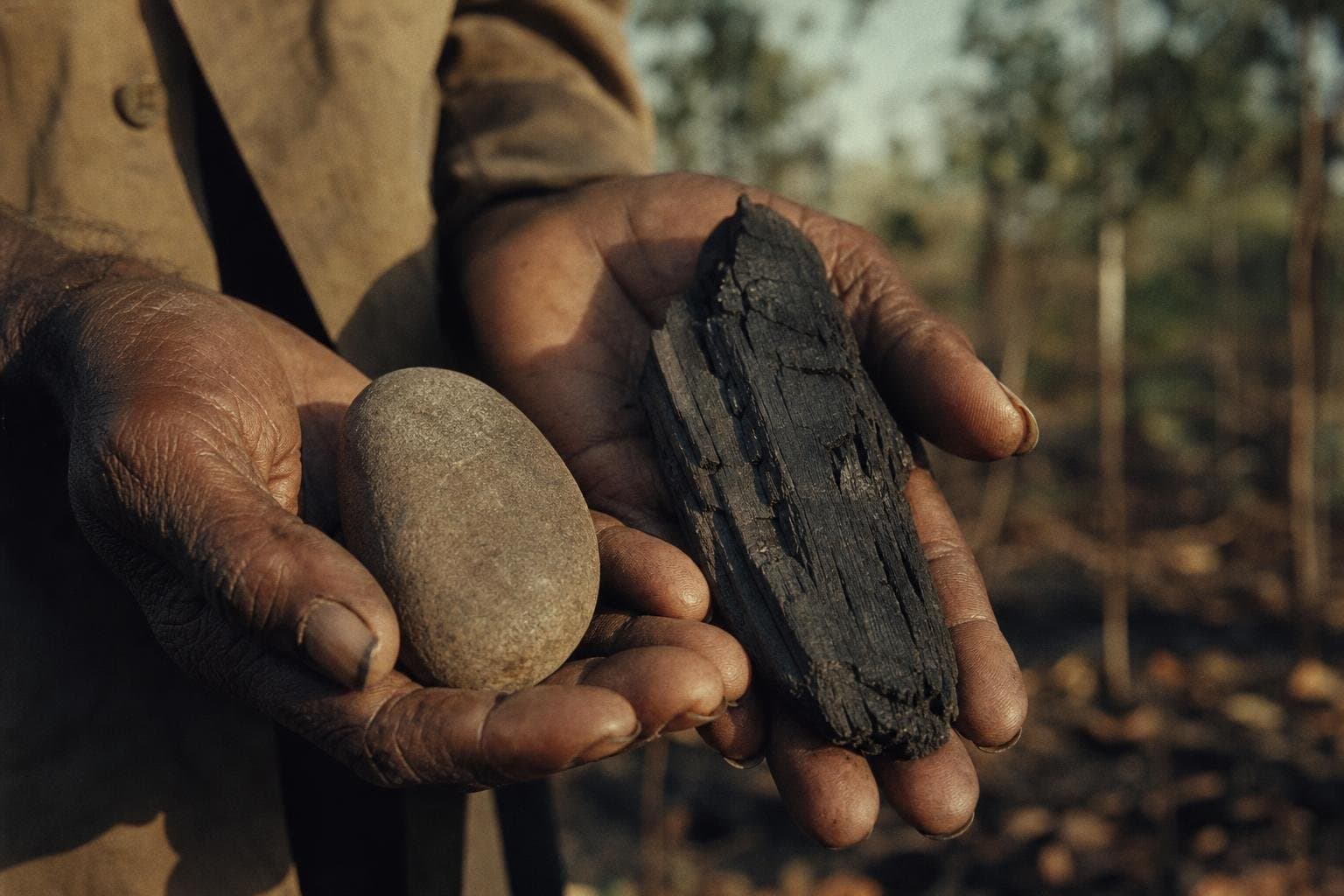

Pick up a stone in Dyirbal and you need a different word-class marker than you would for fire. Pick up fire and you're in the same grammatical bucket as women, water, and fighting. That is not poetry. It is the system of noun classification that made this North Queensland language one of the most cited grammars in linguistics, and it is also, as of R. M. W. Dixon's newly published grammar, a system that specialists are still working through fifty years after Dixon first recorded it.
Four Bins for an Entire Universe
As originally documented in the 1960s, Dyirbal sorted every noun in the language into one of four classes, according to Linguaphile Magazine's overview of the language. Class I held living beings and masculine things. Class III held edible vegetables and fruit. Class IV was the catch-all for everything left over — the grammatical junk drawer every classification system needs. Class II is the one that stops people: feminine things, water, fire, and fighting, grouped together under a single marker.
That grouping is the famous case for why noun class in Dyirbal is not really about biological sex or grammatical gender in the way French or German sort nouns. It is a classification built on mythological association and practical danger. Fire burns. Water drowns. Fighting wounds. Women, in the traditional cosmology the language encoded, sat in the same conceptual neighborhood — not because the language was making a crude equivalence, but because the class system tracked a network of myth, association, and hazard rather than a tidy biological binary. A stone axe and a woman and a fire can share a noun class because the system that assigns class membership is doing something closer to cultural taxonomy than morphological bookkeeping.
The Grammar That Took Fifty Years to Finish
Dixon's original 1972 description made Dyirbal a staple of linguistics coursework worldwide, prized for its ergative case marking and its noun classification system, according to a review of Dixon's new grammar circulated on LINGUIST List. The new edition, published by Oxford University Press, reanalyzes decades of additional fieldwork and expands the treatment of the language's syntactic "pivot" — the rule governing how subjects and objects link across clauses — along with a more detailed account of relative clauses and the applicative/causative system, per Oxford University Press's own description of the volume. The book comes with a companion website hosting the full corpus of texts the grammar draws on, plus a dictionary spanning ten Dyirbal dialects — the kind of archival generosity that matters enormously for a language with a documentation window that is closing, not opening.
Because that window is closing. Linguaphile Magazine put the number of remaining speakers at roughly 30 as of 2021, with UNESCO classifying Dyirbal as critically endangered. Dyirbal belongs to the Pama-Nyungan family, the group that covers roughly seven-eighths of the Australian continent, according to the reconstructed language-family history on Wikipedia — context that matters because it means Dyirbal's noun-class system isn't an isolated curiosity. It's one data point in a much larger, and much more fragile, continental picture of how Aboriginal languages organize meaning.
What Gets Lost Is Not Just Words
The noun classes weren't the only register under pressure. Dyirbal also carried Dyalŋuy, a taboo speech style used when certain in-laws were within earshot — speakers switched vocabulary entirely rather than address a mother-in-law directly, a system that Linguaphile Magazine notes broke down around 1930. When a social practice like that disappears, it doesn't just remove a vocabulary list. It removes a working theory of kinship obligation that the grammar had encoded as mandatory.
Academic work on the language's decline backs this up from a different angle. A study on ergativity in what researchers call "dying Dyirbal" traced how the grammar simplifies as fluency weakens across a continuum of semi-speakers, finding that the erosion follows patterns distinct from ordinary pidginization, according to research published in the journal Language. Grammar doesn't fail all at once. It frays selectively, and the noun-class system — built on an entire cosmology of what belongs with what — is exactly the kind of feature likely to go first, because it requires cultural knowledge, not just syntactic habit, to sustain.
A classification system that puts fire, women, and violence in the same grammatical box tells you something a dictionary never could: how a community once mapped danger onto the physical world. Dixon spent most of a career making sure that map didn't vanish with the last fluent speakers. The new grammar is both an act of scholarship and a kind of inheritance document — one that matters most if the Jirrbal and Dyirbal communities themselves can use it to teach the next generation what Class II was really tracking.


