


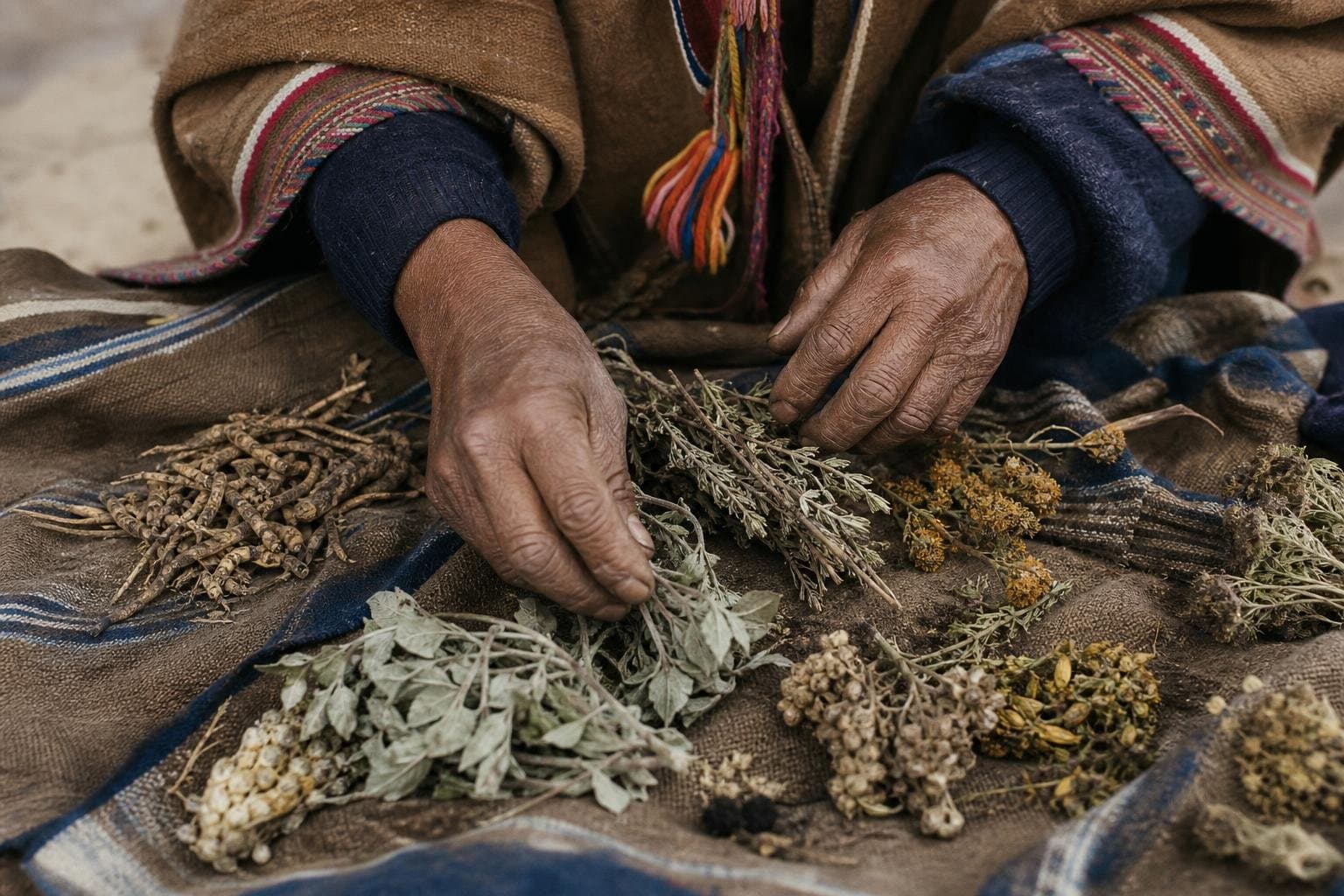

Bolivia's 2009 Constitution does something no other country in the Americas attempts: it names 37 official languages, one by one, in a single article. Spanish sits at the top of the list, followed by 36 indigenous languages — Aymara, Quechua, Guaraní, Bésiro, Chiquitano, Mojeño-Trinitario, Uru-Chipaya, and, tucked in alphabetically among names most outsiders will never encounter, Kallawaya (bushop.com). The article requires every level of government to operate in at least two of those languages. It is, as one travel guide to the country put it, "as much a statement of political recognition as a linguistic census" (bushop.com) — and that gap between naming and knowing is where the real story of a language like Kallawaya lives.
Recognition Is Not the Same as Documentation
Here is what I can tell you with confidence: Kallawaya appears in Bolivia's constitution as one of thirty-six indigenous languages granted equal legal status with Spanish. Here is what the sources in front of me cannot confirm: how many people speak it, what its grammar looks like, or whether the itinerant Andean herbalist tradition long associated with the name still transmits the language to new generations. That's a frustrating silence for a publication built on grammatical mechanics and speaker testimony, but the silence itself is the finding. A language can be written into a national charter and still be invisible in the demographic and linguistic data that would tell us whether it's dying, stable, or already gone.
This isn't a hypothetical problem. Bolivia's own 2024 census, conducted by the Instituto Nacional de Estadística, recorded roughly 37.6% of the population — about 4.28 million people — identifying as belonging to a native people, with Quechua the largest single group at about 14.5% and Aymara close behind at roughly 14.0% (bushop.com). Guaraní and the lowland peoples trail far behind those two giants. A language named in the constitution but absent from the headline census categories — which is the position Kallawaya occupies in the sources available to me — tells you something about where national attention and resources actually go. The two largest language communities get geography, infrastructure, and signage built around them. Everything smaller gets a line in a legal text and not much else.
The Shape of the Problem, Even Without the Specifics
What we do know about Bolivia's linguistic geography is that it tracks closely to the old travel corridors: Aymara dominates around La Paz, El Alto, and Lake Titicaca; Quechua runs through the Cochabamba–Sucre–Potosí belt (bushop.com). Languages tied to smaller, more specialized communities — and traditions of itinerant specialists, by their nature, don't map neatly onto fixed territory — are exactly the kind that fall through the cracks of this kind of regional accounting. A language carried by healers who moved between valleys rather than settling in one place would never have shown up clearly in a census built around where people live, not what they do or who they learned language from.
UNESCO's framing of the current International Decade of Indigenous Languages (2022–2032) is useful here, even in general terms: the initiative exists specifically because recognition on paper has outpaced the harder work of revitalization and documentation on the ground, with 2027 set as a midterm checkpoint to measure how much of the Global Action Plan has actually moved past the planning stage (unesco.org). Bolivia's constitution is, in effect, a decade-plus head start on that same problem — a list of names without the fieldwork to back most of them up.
I'd rather tell you less and tell you true than reconstruct a grammar I haven't seen documented. What I can say is that Kallawaya's presence on Bolivia's official list, next to a near-total absence from the demographic record, is itself a kind of linguistic fossil — a name preserved by law while the knowledge it refers to waits, somewhere in the Andean departments, for someone to go and ask whether anyone still speaks it to their children. That fieldwork hasn't surfaced in the documentation available to me yet. When it does, it will be worth returning to.