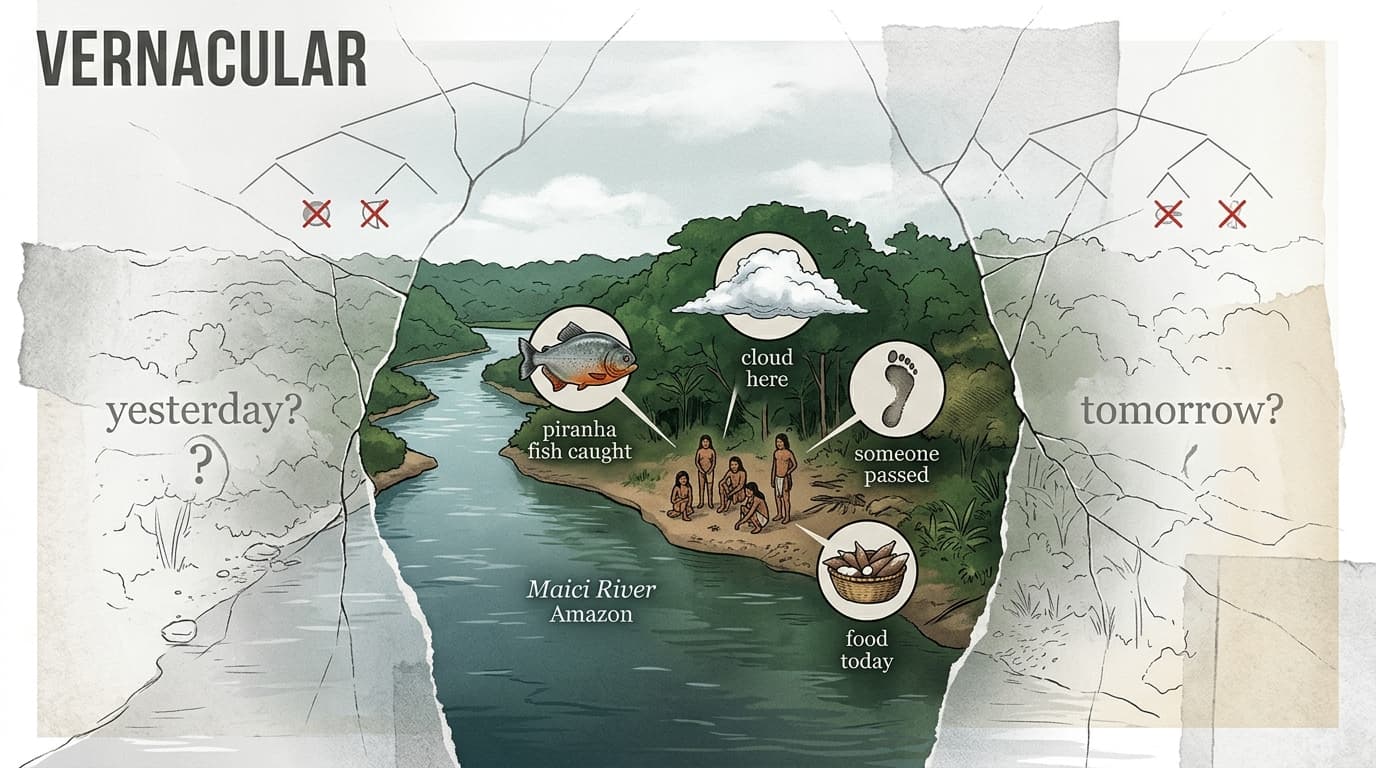

There is a moment, documented in the fieldwork of linguist Daniel Everett, when the Pirahã people of the Brazilian Amazon are asked about the origin of the world. The answer, rendered in a language that has no subordinate clauses, no numbers, no color terms, and no creation mythology, is something like: things are as they are. Not a deflection. Not ignorance. A complete cosmological statement, adequate to everything the Pirahã need to say about existence.
This is the puzzle that has occupied — and divided — linguists for decades. Pirahã, spoken by a community of roughly 300 to 400 people along the Maici River in Amazonas state, Brazil, is either the most extraordinary counterexample in the history of linguistics or the most contested set of fieldwork claims in the modern study of language. Possibly both. What is not in dispute is that Pirahã forces us to ask a question that most linguists assumed had already been answered: are there genuine cognitive universals encoded in all human languages, or can a language be organized around principles so different that it constitutes a fundamentally distinct way of being in the world?
I. The Immediacy of Experience Principle
The feature that Everett identified as the organizing logic of Pirahã grammar — and the one that has generated the most sustained debate — is what he called the immediacy of experience principle. The language, he argued, grammatically encodes only what is directly witnessed or can be traced to a living witness. Hearsay, inference, and conjecture are not merely stylistically marked; they are grammatically distinguished through an evidentiality system that makes the source of information a structural requirement of every assertion.
Evidentiality systems are not unique to Pirahã. Languages across the Americas, the Caucasus, and parts of Asia require speakers to mark whether they know something from direct perception, inference, or reported speech. What makes Pirahã's version distinctive, according to Everett's documentation, is the degree to which this principle propagates through the entire grammar and culture. It is not just a feature of verb morphology. It appears to explain the absence of creation myths — stories set before living memory — and the community's resistance to narratives about events no one present has witnessed.
This is where the linguistic claim becomes a cognitive and anthropological one. The Pirahã do not merely lack creation myths as a historical accident. The grammar, Everett argued, makes such myths structurally incoherent: you cannot grammatically assert something for which there is no living evidential chain. The language does not just fail to encode the deep past. It actively resists it.
The implications for the Sapir-Whorf hypothesis — the idea that language shapes or constrains thought — are obvious, and they are precisely why the claims attracted such fierce scrutiny. If Pirahã grammar genuinely prohibits certain kinds of assertion, does it also prohibit certain kinds of thought? Or does it simply require that those thoughts be expressed differently, or not expressed at all in formal speech?
II. Numbers, Quantities, and the Absence of Recursion
The claim that generated the most controversy in formal linguistics was not about evidentiality or myth. It was about recursion.
Noam Chomsky's influential theory of Universal Grammar holds that the capacity for recursive embedding — the ability to nest clauses within clauses, phrases within phrases, indefinitely — is the defining feature of human language. The man who saw the woman who found the key that opened the door is recursive. Every known human language, the theory held, has this capacity.
Everett's documentation of Pirahã suggested it does not. Pirahã, he argued, lacks grammatical recursion. Sentences are short, paratactic, and non-embedded. You cannot say I know that you said that she believes that the fish is ready. You say each proposition separately. This claim, published in the journal Current Anthropology in 2005, prompted responses from Chomsky, Marc Hauser, and Tecumseh Fitch, among others, and the debate has not fully resolved.
What is less contested is the numerical situation. Pirahã has no words for exact quantities. The vocabulary includes terms that approximate few and more, but no words for one, two, three, or any precise number. This is not a gap that speakers experience as a deficiency — it reflects a broader cultural orientation toward approximate quantity rather than enumeration. Studies by Peter Gordon, published in Science, tested Pirahã speakers on quantity-matching tasks and found that performance degraded with larger quantities in ways consistent with the absence of number words, suggesting that the linguistic gap corresponds to a cognitive one.
This is the strongest empirical support for a Whorfian effect in Pirahã: not that speakers cannot perceive quantity, but that without number words, exact quantity is harder to hold in working memory and manipulate in tasks that require it. The language does not make counting impossible. It makes it harder, in the same way that trying to remember a phone number in a language you don't speak fluently is harder — the cognitive scaffolding isn't there.
Color terms present a related case. Pirahã has no basic color vocabulary in the sense that English has red, blue, green. Speakers use circumlocutions — like blood, like the sky — rather than abstract color terms. This places Pirahã at the extreme end of the cross-linguistic spectrum documented by Berlin and Kay's foundational work on color universals, which found that languages acquire color terms in a roughly predictable order but differ enormously in how many they have. Pirahã, by this account, is not anomalous in lacking color terms; it is simply at one end of a real continuum.
III. What the Controversy Reveals About Linguistic Method
The Pirahã debates are not merely about one language. They are a stress test for the entire methodology of linguistic fieldwork and the claims that can be built on it.
Everett spent decades with the Pirahã, learning the language to a degree of fluency that few outside researchers have matched. His documentation is extensive. But Pirahã is also a tonal language with a phonology so complex — it can be whistled, hummed, or sung, with the consonants and vowels of spoken Pirahã sometimes reduced to pure prosodic contour — that learning it presents extraordinary challenges. The community is small, geographically isolated, and has historically been resistant to outside contact. Independent verification of Everett's most contested claims has been difficult.
Linguists Cilene Rodrigues and Andrew Nevins, along with Chomsky, published a detailed reanalysis arguing that what Everett documented as the absence of recursion could be explained by other grammatical mechanisms — that Pirahã does have embedding, just not the kind Everett was looking for. The debate turned on technical questions about what counts as recursion and how to identify it in a language with such different surface structure from the European languages that dominate linguistic theory.
This is a methodological problem that runs through all endangered language documentation. The analyst's theoretical framework shapes what they see. A linguist trained in generative grammar will look for phrase structure rules. An ethnographer will look for cultural functions. A cognitive scientist will look for correlations between linguistic features and non-linguistic tasks. Each approach captures something real and misses something else. With a language spoken by a few hundred people in a remote region, the opportunities for cross-checking are limited.
What the controversy has produced, whatever its ultimate resolution, is a sharper set of questions. What would it actually mean for a language to lack recursion? What is the relationship between grammatical evidentiality and cultural epistemology? Can a community's theory of knowledge — what counts as something worth asserting — be encoded in grammar deeply enough to shape what gets thought, not just what gets said?
IV. The Stakes of Getting Pirahã Right
Pirahã is not endangered in the conventional sense. The community is intact, the language is being transmitted to children, and there is no immediate pressure from a dominant language displacing it. What is endangered is the quality of its documentation and the possibility of resolving the debates that surround it.
This matters beyond the academic. If Everett's core claims are correct — that a language can be organized around an immediacy-of-experience principle that propagates through grammar, culture, and cognition — then Pirahã is evidence that the range of possible human languages is wider than linguistic universalists have assumed. It means that the features we take to be universal — recursion, number, color terms, narrative about the deep past — are not architectural requirements of human language but cultural choices, encoded in grammar over generations.
If the critics are correct, and Pirahã has recursion that Everett missed, and the cultural features he documented are real but not grammatically determined, then Pirahã is still extraordinary — a language with a distinctive evidentiality system, a community with a distinctive epistemology — but it does not overturn Universal Grammar. It becomes a fascinating edge case rather than a refutation.
Either way, the language encodes something worth preserving and understanding. The Pirahã relationship to time — the grammatical insistence on the witnessed present, the absence of a retrievable past or a projected future — is not a cognitive limitation. It is a different theory of what language is for. Most languages treat speech as a tool for encoding and transmitting information across time and space, including information about events no speaker witnessed. Pirahã, if Everett's account holds, treats speech as a tool for coordinating shared experience in the present moment. The grammar enforces a kind of radical epistemic honesty: you can only assert what you or a living witness has seen.
There is something clarifying about


