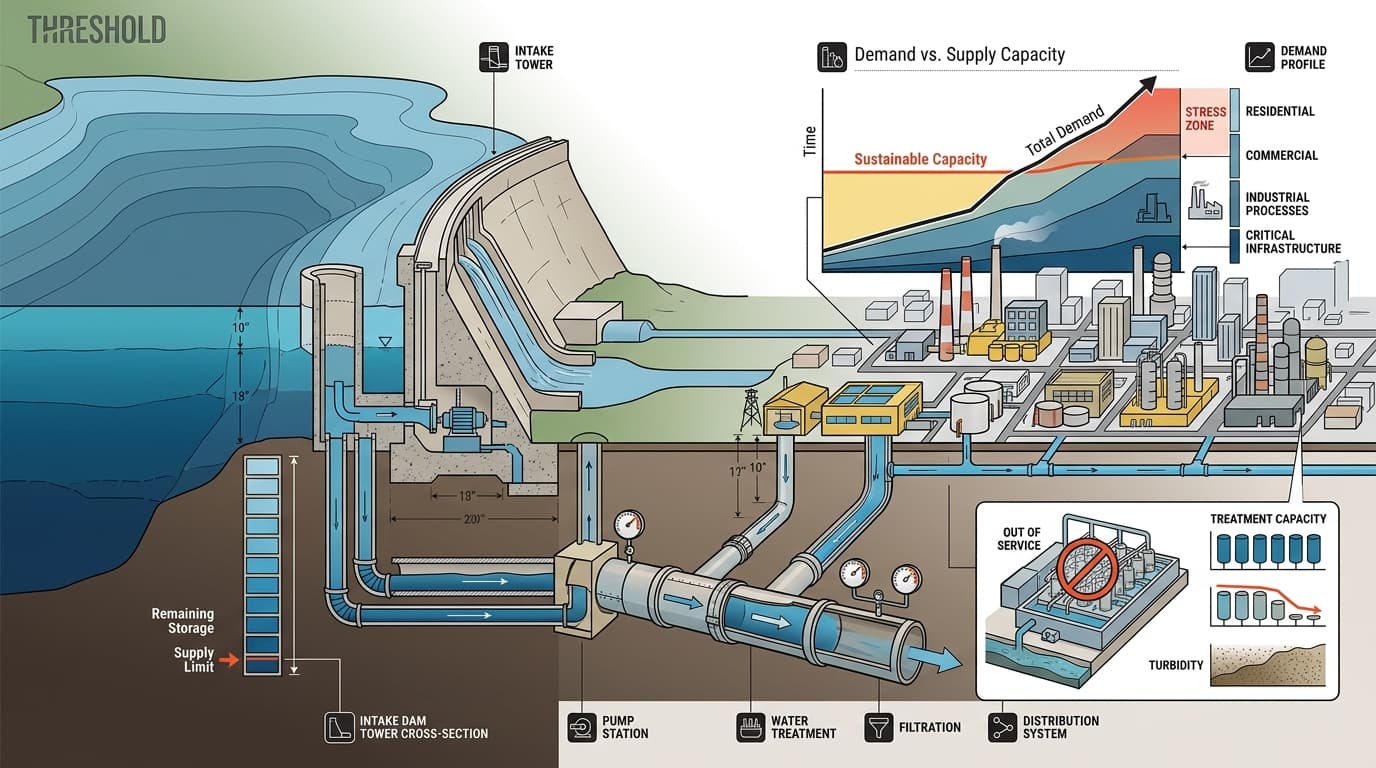

The math in Corpus Christi is brutally simple. The city's reservoirs are draining. Industrial demand — Exxon's plastics plant, jet fuel supply chains running through one of the nation's largest petroleum ports — keeps climbing. And without significant rainfall, Inside Climate News reports that city supply will no longer meet demand sometime next year. "It's going to be an economic disaster," said James Dodson, former director of the Corpus Christi Water department. "It's the very worst scenario that I've ever seen."
That's not a drought story. That's a capacity story — a decade of demand growth outrunning supply planning, with no margin left when conditions turned.
Capacity Isn't Just About Volume — It's About Margin
Water system capacity has two failure modes. The first is the obvious one: not enough water. The second is subtler and more common: a system technically capable of serving its population under normal conditions, but with no buffer when anything goes wrong.
Owen Sound, Ontario just illustrated the second mode. When heavy rainfall increased turbidity in the bay the city draws from, the Mitchell Advocate reported that one of the plant's four filters was already out of service for scheduled upgrades — reducing treatment capacity exactly when incoming water quality demanded more of it, not less. The result was a precautionary boil water advisory. No catastrophic failure. Just a system running at reduced margin that couldn't absorb a routine weather event.
This is the pattern that deserves more attention than the dramatic pipe collapses. Most water treatment plants aren't failing outright. They're operating with shrinking margins: aging equipment cycling in and out of service, source water quality degrading, and population growth pushing utilization toward design limits. The gap between "functioning" and "resilient" is measured in redundant capacity — and that's exactly what deferred maintenance and underfunding erode first.
The Sewage Side of the Same Equation
Treatment capacity isn't only about clean water coming in. It's about wastewater going out. And that side of the system is in measurably worse shape.
In January, a pipe collapse dumped 244 million gallons of sewage into the Potomac River, triggering an emergency declaration and federal assistance. Dramatic — but, as the AP reported, not representative of how the system usually fails. The more common failure is quieter: the EPA estimates between 23,000 and 75,000 sanitary sewer overflows annually across the U.S. At least 18.7 million people are served by utilities in serious violation of pollution limits. At least 2.7 million live with systems that violated federal clean water rules continuously over the last three years.
The ASCE's 2025 Infrastructure Report Card gave the nation's overall infrastructure a C — the highest grade since the assessment began in 1998, which tells you something about the baseline. Wastewater specifically earned a D-plus. The country faces a $3.7 trillion gap between planned investment and what's actually required to bring systems to good working order. Nine of 18 assessed categories still sit at D or D-plus.
A D-plus wastewater system serving a growing city isn't a system that's about to collapse. It's a system with no margin — one that handles average loads adequately and fails when conditions deviate from average. Which, increasingly, they do.
Pinellas County Is the Near-Term Case Study
While Corpus Christi faces a supply cliff measured in months, Pinellas County, Florida is already operating under a Modified Phase III "Extreme" Water Shortage Order, issued by the Southwest Florida Water Management District in response to severe drought and declining supplies. Outdoor water use accounts for more than 50% of household consumption in the county. Restrictions now include one-day-per-week watering across all sources — potable, reclaimed, well, lake, and pond — with $193 fines for violations replacing the usual warnings.
That's the operational reality of a system hitting its limits in real time: not a failure announcement, but a rationing order. The infrastructure is still running. The margin is gone.
The question for city planners isn't whether their treatment plant can serve today's population under today's conditions. It's whether it can serve next decade's population when one filter is offline and a storm rolls through. In Owen Sound, that scenario produced a boil water advisory. In Corpus Christi, the same logic — demand outpacing supply, no buffer left — is producing something closer to an existential reckoning.
Watch Corpus Christi's reservoir levels through summer 2026. The city's own water supply dashboard is tracking the drawdown in near real-time. If rainfall doesn't materialize before peak industrial demand season, the "water emergency" declaration the city has been anticipating moves from projection to event — and the downstream effects on Texas fuel supply chains will make this a national infrastructure story, not a regional one.


