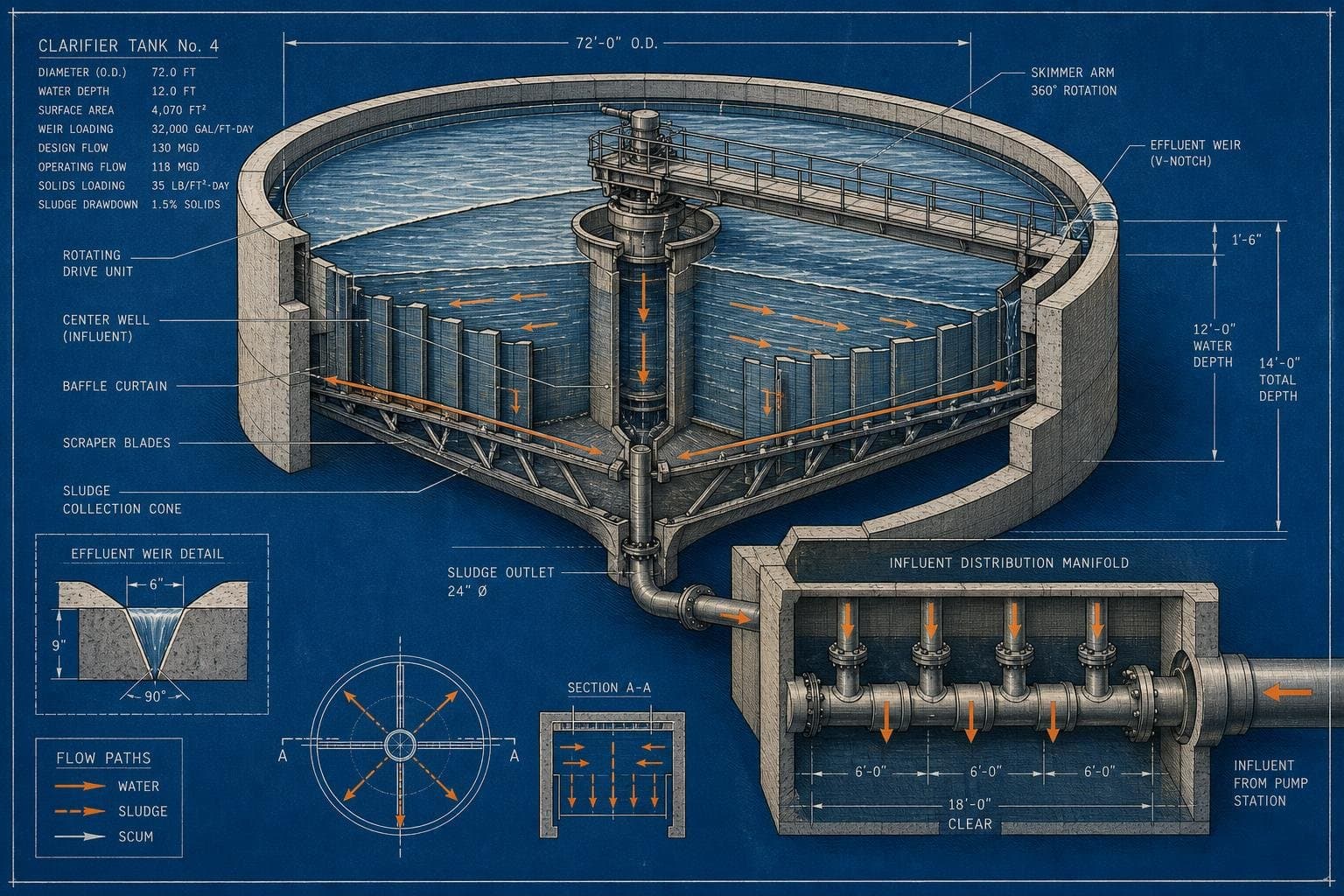

Corpus Christi's reservoirs are sitting at roughly 8% of combined capacity as of May 2026. The city's 318,000 residents have been under outdoor watering restrictions since August 2024. And without significant rainfall, city officials may have to declare a water emergency as soon as December 2026 — one that would cap household use at 6,000 gallons per month, roughly two-thirds of the U.S. average. That's not a drought story. That's a capacity story. The city's treatment and distribution system was sized for a growth projection that didn't account for what actually arrived: a petrochemical boom tied to the Port of Corpus Christi, which more than doubled its trade value between 2013 and 2023 as West Texas fracking accelerated and oil export restrictions loosened.
The lesson isn't that cities shouldn't grow. It's that water infrastructure has a fixed throughput ceiling, and when industrial and residential demand converge on that ceiling simultaneously, the math stops being theoretical.
The Ceiling Is Structural, Not Just Financial
The Corpus Christi situation illustrates a pattern that shows up across the country in different forms. In Waterloo Region, Ontario, a water capacity constraint at the Mannheim treatment facility has stalled building approvals in Kitchener, Waterloo, Woolwich, and parts of Cambridge since late 2025. A provincial facilitator was brought in this spring specifically to untangle the capacity constraint from the development pipeline. The region is now debating whether to hold a 10% or 20% resiliency buffer in the Mannheim Service Area — a technical argument about how much headroom to maintain against catastrophic system failure before issuing new building permits.
That debate is the right one to be having. A resiliency buffer isn't bureaucratic padding; it's the margin between normal operations and a failure cascade. The disagreement between regional staff (recommending 20%) and a council motion proposing 10% reflects a genuine tradeoff: tighter buffers unlock more development capacity now, but they shrink the system's ability to absorb an unexpected failure — a main break, a contamination event, a drought-driven supply reduction — without service disruption.
Neither number is obviously wrong. But the fact that the argument is happening at all signals that the treatment system has been running close enough to its ceiling that the margin matters politically, not just operationally.
The Funding Gap Underneath the Capacity Gap
Capacity constraints don't appear overnight. They accumulate through decades of deferred investment. The American Society of Civil Engineers gives U.S. wastewater infrastructure a D-grade, with capital investment needs estimated at $298 billion over the next 20 years — and the EPA's own figure for reliably transporting and treating wastewater over that same period runs to approximately $600 billion. Those two numbers aren't contradictory; they're measuring different scopes of the same problem.
The more immediate pressure point is the funding cliff approaching September 30, 2026. The Infrastructure Investment and Jobs Act's five-year supplemental water funding expires then, and cities are pushing Congress to reauthorize the $5.85 billion each to the Clean Water and Drinking Water State Revolving Funds that have been the primary mechanism for capital improvements. The National League of Cities has flagged reauthorization as a top priority. Without it, utilities that were counting on SRF financing for capacity expansion projects face a gap in their capital programs — at precisely the moment when demand from data centers, industrial growth, and population increases is accelerating.
The Black & Veatch 2026 Water Report, based on surveys of more than 600 water and wastewater professionals, found that 45% of respondents expect current funding to fall short of infrastructure needs over the next decade. Aging infrastructure remains the top concern, cited by 66% of respondents — but the report notes that costs have now overtaken regulatory uncertainty as the dominant barrier to action. That's a meaningful shift. It means utilities aren't primarily stuck waiting for regulatory clarity; they're stuck waiting for money.
What the Math Actually Requires
The pattern across Corpus Christi, Waterloo Region, and the national funding picture is consistent: water treatment capacity is a hard constraint on urban growth, not a soft one. Zoning approvals, development permits, and industrial recruitment all assume the pipes can handle what's coming. When that assumption is wrong, the correction is expensive and slow.
Treatment plant expansions typically take years from design through commissioning. The shift toward Progressive Design-Build delivery is partly a response to this timeline problem — bringing engineering and construction teams together earlier to reduce late-stage redesigns and compress schedules. That helps at the margins. But it doesn't substitute for the capital commitment that has to precede design by years.
The cities that avoid the Corpus Christi scenario aren't the ones that got lucky with rainfall. They're the ones that treated treatment capacity as a prerequisite for growth planning, not a consequence of it. Watch for what Congress does with SRF reauthorization before September 30 — that decision will determine how many cities spend the next decade trying to retrofit capacity into systems that were already running out of headroom.


