


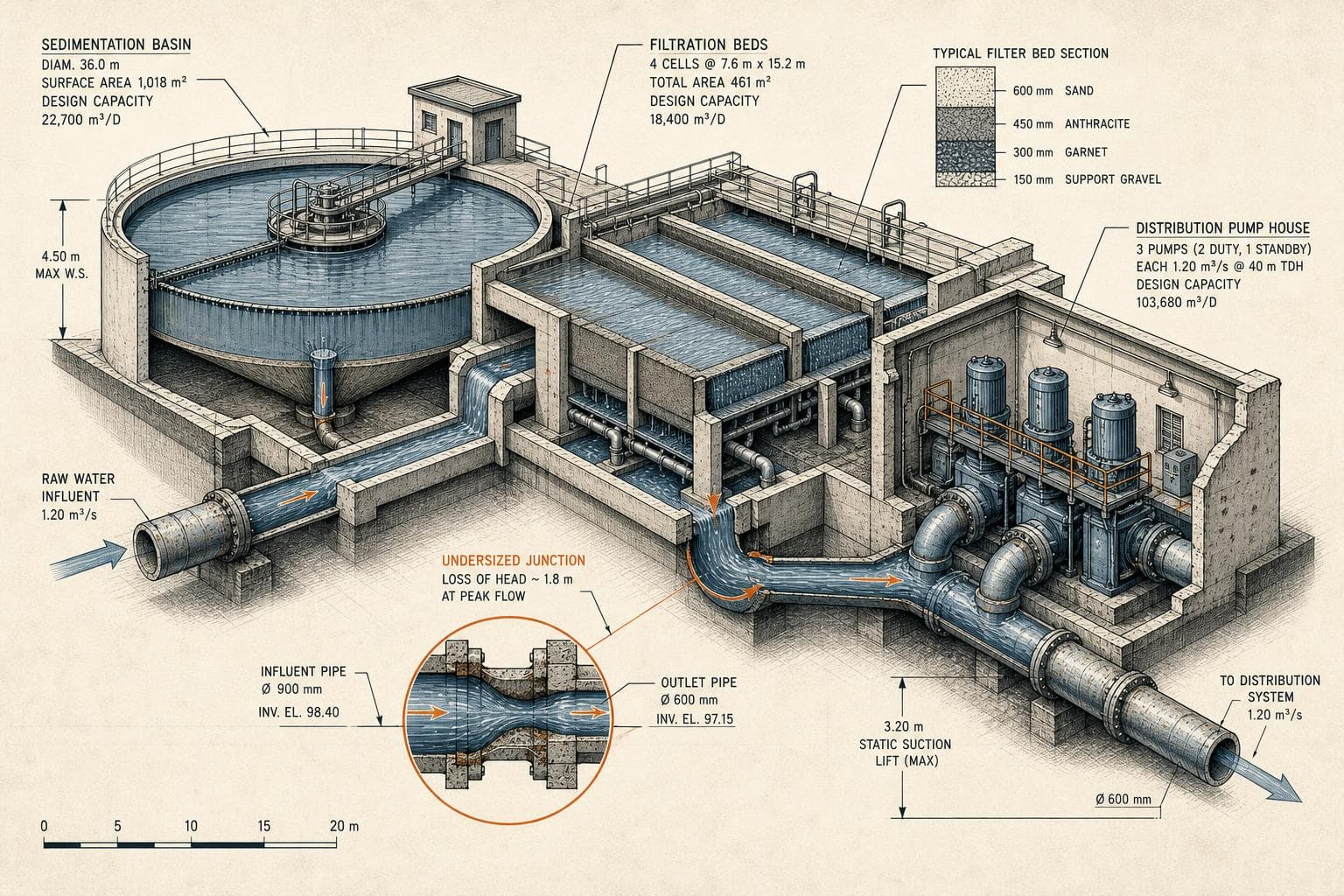

A city can rezone land, approve developments, and issue building permits faster than almost any other infrastructure decision. What it cannot do is make a water treatment plant built for 1970s population levels process 2020s demand. That gap — between what planners approve and what pipes can actually deliver — is where urban growth quietly stalls.
The Capacity Equation Cities Keep Ignoring
The math is straightforward, even when the politics aren't. According to the EPA, water infrastructure across the country is aging and in need of repair to meet 21st-century demands. The Department of Energy puts a sharper number on the wastewater side: roughly $600 billion will be required over the next 20 years just to continue reliably transporting and treating wastewater at current service levels — not to expand capacity, not to modernize, just to maintain what exists. The ASCE's national wastewater infrastructure grade, cited by the DOE, is a D. Capital investment needs for wastewater and stormwater systems alone are estimated at $298 billion over the next two decades.
That D doesn't mean treatment plants are failing today. It means the margin between current capacity and failure is shrinking, and the cost curve for deferred maintenance is bending upward. Every year a utility delays pipe replacement or plant upgrades, the eventual bill grows — and the window for planned, orderly expansion narrows.
Growth Pressure Meets a Fixed Pipe Diameter
The constraint isn't abstract. A treatment plant designed for a specific daily flow volume has a hard ceiling. You can optimize operations, improve scheduling, and squeeze efficiency gains at the margins — but you cannot process more water than the physical infrastructure allows without capital investment in new capacity.
A survey of public works directors and city officials captured the problem plainly: aging assets, rising construction costs, capacity constraints, and the long timelines associated with utility upgrades are converging simultaneously. Underground infrastructure is expensive precisely because it's underground — you can't phase it in incrementally the way you might add a lane to a road. You dig, you replace, you restore. The disruption and cost are front-loaded, which makes it politically easy to defer.
Minnesota's 2026 ASCE Infrastructure Report Card illustrates the funding gap directly. The state's $2.6 billion bonding bill passed in 2023 provided meaningful relief for wastewater treatment and other systems — but the report notes that recent bonding bills, measured in millions, have not kept pace with a project backlog measured in billions. That's not a rounding error. That's a structural mismatch between what's being invested and what's actually needed.
The Mumbai Comparison Shows What Intentional Capacity Planning Looks Like
For contrast, consider what deliberate capacity investment actually requires. Mumbai is currently building two new water treatment plants — at Bhandup and Panjrapur — at a combined cost of Rs 4,210 crore, with the goal of adding 3,000 million litres per day of supply capacity by 2030. The city currently faces a gap between demand (4,300 MLD) and supply (3,850 MLD), and it's addressing that gap with capital projects sized to the actual need.
That's the model: identify the gap, quantify it in flow volumes, fund the infrastructure to close it, and build on a timeline that precedes the crisis rather than responds to it. American cities that are approving dense residential development without parallel investment in treatment capacity are running the inverse playbook — growth first, infrastructure catch-up later, ratepayers absorbing the emergency premium when later finally arrives.
The Permit Isn't the Bottleneck — The Plant Is
The practical implication for city planners is uncomfortable. Zoning decisions and building permits operate on political timelines. Water treatment capacity operates on engineering and construction timelines that routinely run five to ten years from funding approval to operational plant. When those two clocks aren't synchronized, growth approvals outpace the infrastructure that makes growth livable.
The question worth asking before the next upzoning vote isn't "can we approve this development?" It's "what is the current daily treatment capacity utilization at the plant serving this district, and what does that number look like if this development builds out fully?" If the answer isn't in the staff report, that's the gap — not in the pipes, but in the planning process.
Watch for EPA's Drinking Water State Revolving Fund allocation updates later this year, which will signal which states are actively closing the gap between approved growth and treatment capacity — and which are still deferring the math.