
A city of 320,000 people. One of the nation's largest petroleum ports. And, according to Inside Climate News, officials who expect to fully run out of water next year.
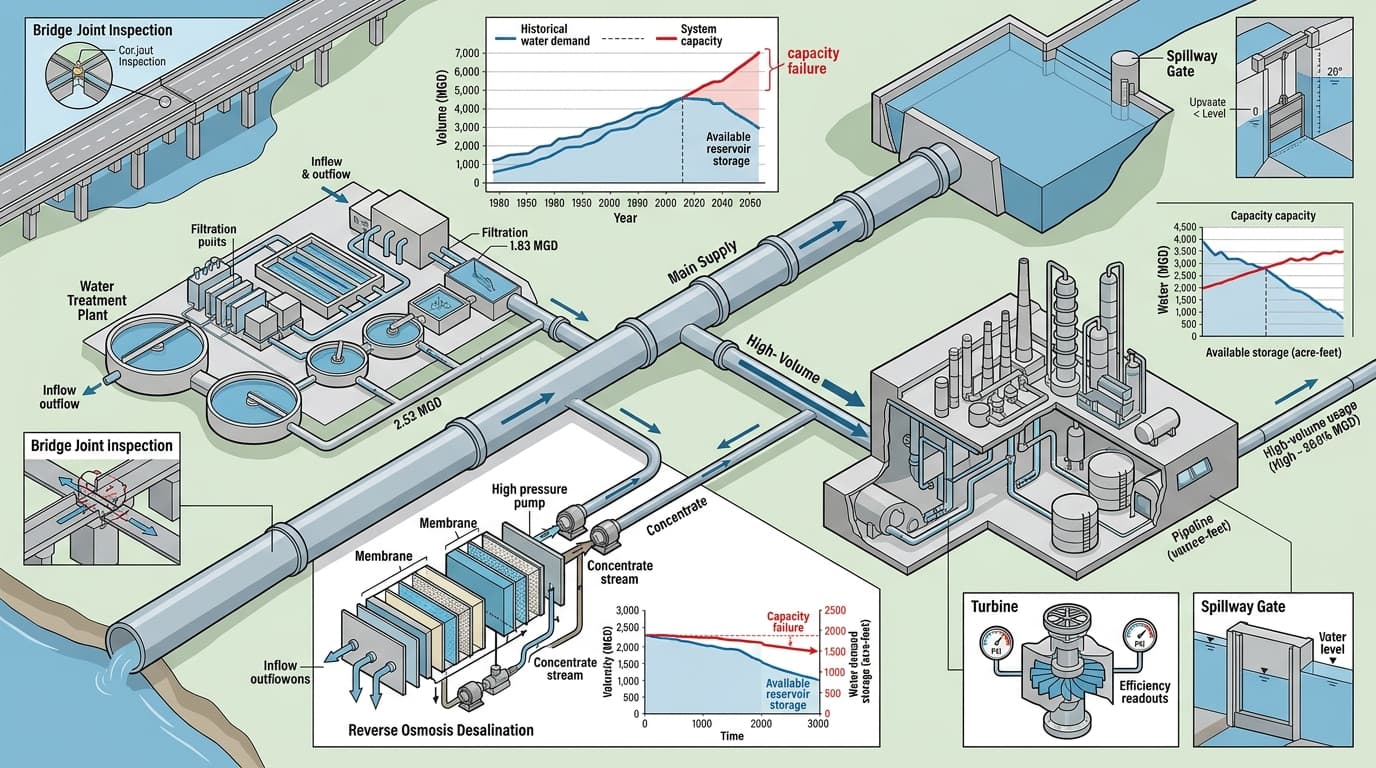
That's not a drought story. That's a capacity story — and the distinction matters enormously for how cities plan, spend, and respond.
Corpus Christi Is the Lead, Not the Exception
Corpus Christi's situation is extreme, but the variables driving it are ordinary. The city sold water rights to industrial users — including Exxon's new plastics plant — while betting on a desalination project that hasn't delivered. Reservoirs have been dwindling. And now, per Inside Climate News, former water department director James Dodson is calling it "the very worst scenario that I've ever seen" — one that would halt jet fuel supplies to Texas airports and trigger what he describes as an "economic disaster."
The cascade is worth tracing: water shortage → refinery and port operations curtail → jet fuel supply disrupts → energy price spike. That's not hyperbole. That's what happens when a treatment and distribution system is sized for one demand profile and then asked to serve a fundamentally different one.
The pattern suggests this is what capacity failure actually looks like in practice. It's rarely a single catastrophic break. It's a decade of incremental commitments — industrial contracts, population growth, deferred reservoir investment — that quietly push demand past the system's design limits. By the time the math becomes undeniable, the options are expensive, slow, or both.
The Pipe Problem Underneath the Capacity Problem
Corpus Christi's crisis is about supply. But across most of the country, the more common version of this failure is distribution: water that gets treated but never reaches the tap.
An estimated 6.75 billion gallons of treated drinking water leak through cracked and aging pipes every single day in the United States, according to reporting by The Epoch Times (via ZeroHedge). That number reframes the capacity question entirely. A city doesn't have to outgrow its treatment plant if it's hemorrhaging output through a distribution network built for a smaller, earlier version of itself.
The same reporting notes that nearly 30 million Americans live in areas with high water stress, and that data centers — some consuming upward of 5 million gallons per day — are adding industrial-scale demand to systems that were never designed to absorb it. A single large data center can draw the equivalent of a town of 10,000 to 50,000 people. Multiply that across an estimated 4,149 operational facilities nationwide, with another 2,788 announced or under construction, and the demand-side math gets uncomfortable fast.
Reduced Capacity During Maintenance Is Its Own Risk
Owen Sound, Ontario offers a smaller but instructive case. When heavy rainfall increased turbidity in the bay this spring, the city's water treatment plant was already operating with one of its four filters out of service for upgrades. The combination — reduced treatment capacity meeting elevated source water contamination — triggered a precautionary boil water advisory, per the Mitchell Advocate.
This is the maintenance trap that water system operators navigate constantly. Deferred upgrades create long-term risk. But scheduled upgrades temporarily reduce the margin between design capacity and actual demand. If a stress event — a storm, a contamination spike, an equipment failure — arrives during that window, a system operating at 75% capacity has far less room to absorb it than one running at full strength.
The engineering principle here is straightforward: margin is what keeps normal operations from becoming emergencies. When cities defer maintenance to avoid the cost of reduced capacity, they're not avoiding risk — they're concentrating it.
The Number That Should Be on Every City Council Agenda
The ASCE 2025 Infrastructure Report Card frames resilience as a design and planning problem, not just a funding problem. That framing is right, but it undersells the urgency of the specific math cities need to be running right now: current peak demand versus rated treatment capacity, distribution loss rates, and the demand trajectory implied by approved industrial permits and population projections.
Corpus Christi's crisis didn't materialize overnight. The city's own water supply dashboard apparently showed the trend. The question isn't whether the data existed — it's whether anyone was required to act on it before the margin disappeared entirely.
Watch for Corpus Christi's emergency declaration timeline over the next 90 days. If the city formally declares a water emergency before significant rainfall arrives, it will force a concrete test of whether emergency water projects already underway can close the gap — and at what cost per gallon compared to what proactive reservoir investment would have run a decade ago. That comparison, when it becomes available, will be the most honest accounting of what deferred infrastructure decisions actually cost.


