



The Bellaire dam is 120 years old. When spring snowmelt and rainfall combined to push the Intermediate River to near-record levels this month, Antrim County's deputy administrator watched the structure struggle and said the quiet part out loud: "It was not built to do this."
That sentence is the entire dam safety problem, compressed into seven words.
The Spillway Math Nobody Wants to Do
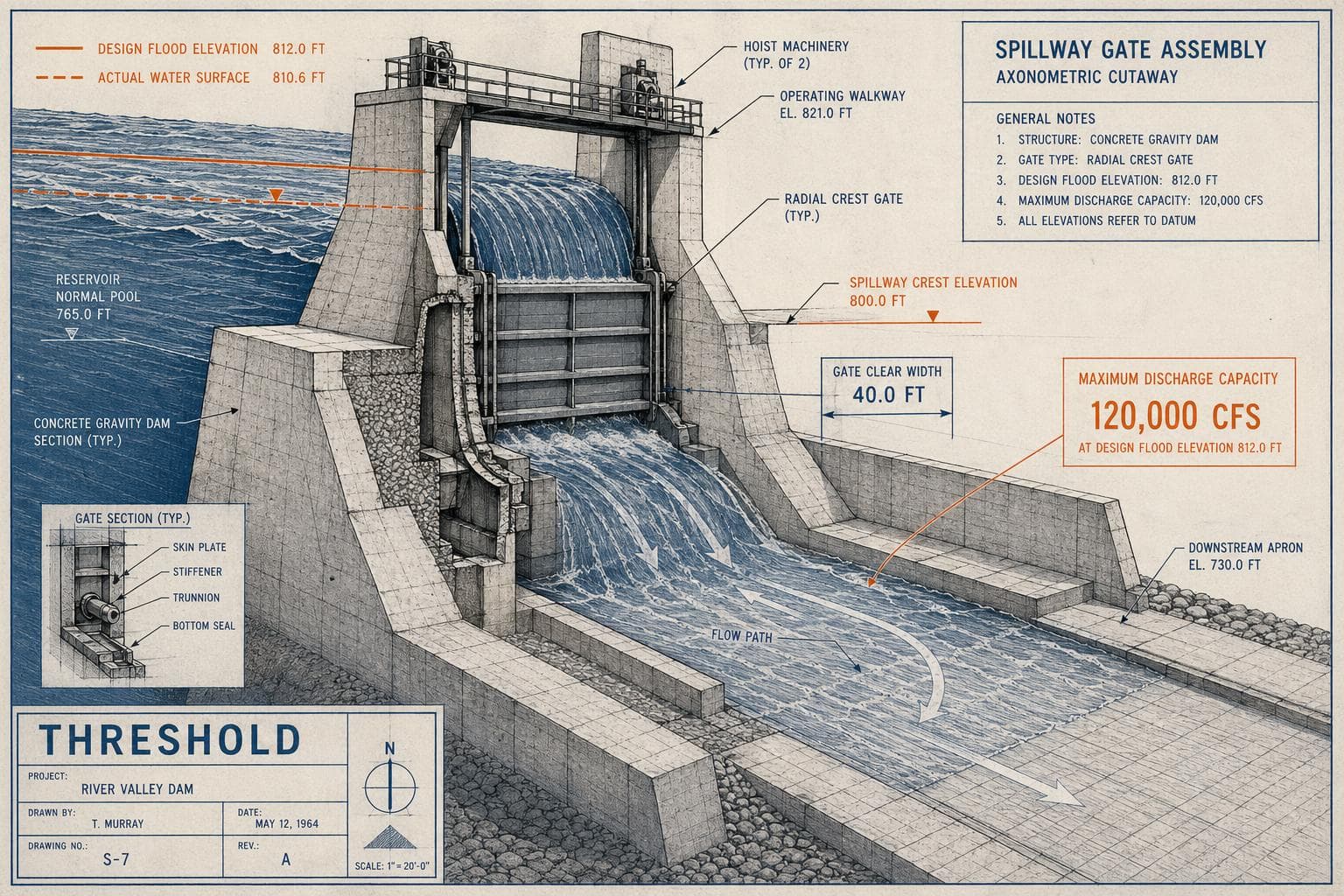
Every dam has a design flood — the maximum flow the spillway was engineered to pass. Build the dam in 1905, and that design flood reflects the hydrology of 1905: historical precipitation records, seasonal snowmelt estimates, and a safety margin calibrated to what engineers then considered a worst-case event.
Climate change doesn't care about 1905 assumptions. What it produces — blizzards in March followed by 70-degree days within weeks, as northern Michigan just experienced — is precisely the kind of rapid, compounding event that overwhelms structures sized for a different hydrological era. The spillway capacity hasn't changed. The flood it's being asked to pass has.
Bridge Michigan reports that two-thirds of Michigan's 2,600 dams have exceeded their design lifespan, 100 have been deemed in poor condition by regulators, and the Association of State Dam Safety Officials estimated the state's dams need at least $1 billion in repairs. In Cheboygan, federal officials had ordered capacity upgrades to the 104-year-old Lock and Dam complex — repairs that would have allowed it to pass more water — but granted repeated extensions. The structure entered this spring's flooding event still undersized.
That's not a maintenance failure. That's a math failure. The gap between what the spillway can pass and what the river is now capable of delivering grew while the paperwork sat.
The Inspection Order That Followed
When floodwaters peaked, the Federal Energy Regulatory Commission ordered immediate inspections of the Cheboygan Dam powerhouse. AP News reports that FERC also ordered inspections of three upstream dams — Alverno, Tower, and Kleber — citing concerns that included leaking observed during high water and the absence of engineers on-site during the flooding event itself.
That last detail matters. A dam under hydraulic stress with no licensed engineer present isn't just a staffing gap — it's a monitoring gap. Spillway gates, outlet works, and embankment faces behave differently under sustained high head pressure than they do during normal operations. The 1986 precedent is instructive: Michigan's dam safety chief told Bridge Michigan that after similar flooding that year, "a couple of dams failed weeks later because they sustained damage that didn't get adequately assessed." Failure doesn't always announce itself during the flood. Sometimes it waits.
The Funding Equation Doesn't Close
Michigan has spent real money on this problem. MITechNews reports that the state's Dam Risk Reduction Grant Program has invested nearly $44 million over three fiscal years to repair or remove 57 dams, with an additional $14.9 million announced in May 2025 for 19 more projects. A $6 million Dam Safety Emergency Action Fund exists for urgent repairs, with roughly $3 million remaining before the end of fiscal year 2026.
Against a $1 billion need, that math doesn't close. The state's own post-2020 Dam Safety Task Force — convened after the Edenville and Sanford dam failures inundated the Midland area — pointed toward a funding framework measured in hundreds of millions over decades. What's been appropriated is a fraction of that, delivered in one-time bursts rather than the sustained capital program the task force envisioned.
The result is a triage system, not a repair program. The most urgent cases get stabilized. The underlying capacity deficit — dams sized for 1905 hydrology trying to pass 2026 floods — remains.
What the Escanaba Treatment Plant Confirms
The dam story has a parallel a few hundred miles away. When the same weather event hit Escanaba, the city's water treatment plant — designed to process 1.8 million gallons per day — found itself handling four times that volume. "We're not designed for this flow," the city's water superintendent said.
Same problem, different system. The design envelope was set for a different era. The loads have changed. The infrastructure hasn't.
That's the through-line in Michigan's infrastructure crisis right now: not neglect in the conventional sense, but a systematic mismatch between what was built and what the climate is now delivering. Spillway capacity is a fixed number. Flood risk is not. Watch whether FERC's inspection orders translate into mandatory capacity upgrades — and whether Michigan's legislature funds the dam safety program at the scale its own task force recommended, or continues to manage the gap one sandbag at a time.