


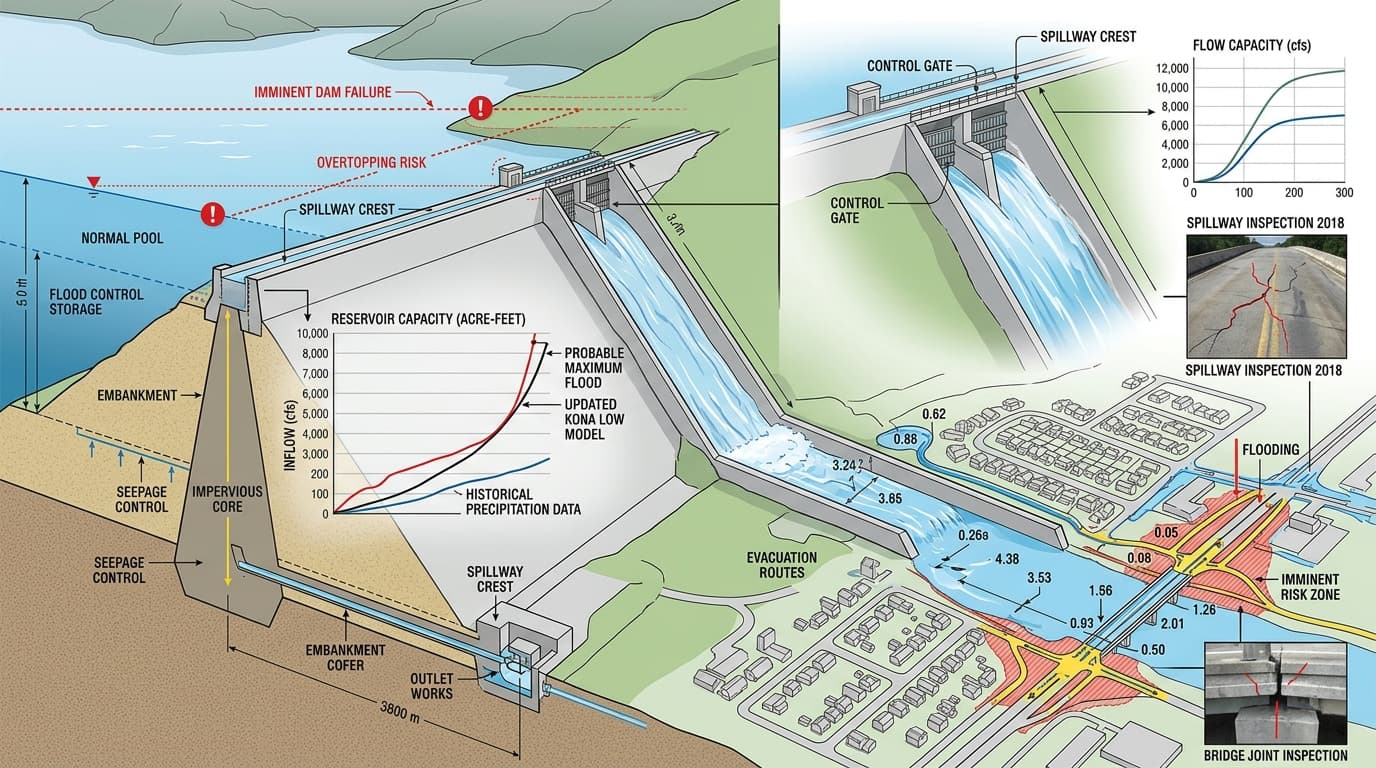

Last Friday morning, an "imminent dam failure" notice went out for Wahiawā Dam on Oʻahu. Downstream towns were already flooding. Residents were posting on social media that evacuation routes were underwater. The dam held — but the near-miss wasn't a surprise to anyone who'd been paying attention. According to Honolulu Civil Beat reporting via Governing, Dole Food Co. has known for nearly five decades that the dam could flood in heavy rainfall, putting roughly 2,500 lives at risk. State warnings had been accumulating for years before last week's Kona low made them urgent.
That gap — between documented risk and actual remediation — is the story. Not just at Wahiawā, but at aging dams across the country. The engineering math is knowable. The failure to act on it is a choice.
Spillway Capacity Is a Hard Number With a Moving Target
Every dam is designed around a concept called the Probable Maximum Flood — the largest flood event that could reasonably be expected at that location. To calculate the PMF, engineers first estimate the Probable Maximum Precipitation: the greatest depth of rainfall meteorologically possible over a given area in a given timeframe. Spillways are then sized to pass that flood without the reservoir overtopping the dam.
The problem is that those rainfall models are built on historical data, and the historical record is becoming a poor guide to the future. A 2022 study from UNSW Sydney and the University of Melbourne, analyzing 546 large dams across Australia, found that PMP estimates are expected to increase between 14 and 38 percent on average due to rising atmospheric moisture. The researchers noted that existing PMP models hadn't been updated in at least 20 years — meaning the spillway capacity that looked adequate when the dam was built may no longer be adequate for the storms it will actually face.
That's not a theoretical concern. It's a design margin problem. A spillway sized for a PMF calculated in 1985 may be undersized for the PMF that a warming atmosphere can now produce. The dam doesn't fail because it was built badly. It fails because the assumptions baked into its design have drifted away from physical reality.
The Governance Gap Is Where Risk Accumulates
Knowing the math and acting on it are different problems. A recent World Bank analysis of Japan's dam safety framework, covered by International Water Power, documents what a functioning institutional system looks like: legal frameworks, regular inspection cycles, operational protocols tied to hydrological monitoring. Japan manages a large and diverse dam portfolio under complex natural conditions — typhoons, seismic activity, steep catchments — and does so through layered governance that connects data collection to regulatory action.
The contrast with the U.S. situation is instructive, even if the comparison isn't direct. American dam safety is a patchwork: federal oversight for federally owned dams, state programs of wildly varying quality for everything else. The ASCE 2025 Infrastructure Report Card has consistently flagged dams as one of the lower-graded categories in the national inventory. Hazard classification — high, significant, or low hazard — tells you the consequence of failure, not the probability. A high-hazard dam with a well-maintained spillway is safer than a significant-hazard dam with a corroded gate nobody has tested in a decade.
Wahiawā is classified as a high-hazard dam. That classification was accurate. The warnings were documented. The remediation didn't happen at the pace the risk required.
The Concrete Version of an Abstract Problem
Here's what the Wahiawā near-miss actually illustrates: spillway capacity math is only useful if someone is responsible for updating it and empowered to enforce the result. The engineering tools exist. Hydrological models can be rerun with updated climate inputs. Spillway adequacy can be reassessed. The question is whether the institutional chain — owner, state regulator, inspection cycle, enforcement mechanism — is tight enough to translate that analysis into physical upgrades before the storm arrives.
In Hawaii's case, Governing reports that warnings stretched back nearly five decades without producing the necessary fixes. That's not an engineering failure. That's a governance failure with engineering consequences.
The next stress test worth watching: whether Hawaii's post-event review produces a binding remediation timeline for Wahiawā, or another round of documented warnings. The difference between those two outcomes is the difference between a near-miss that changes something and one that just resets the clock.