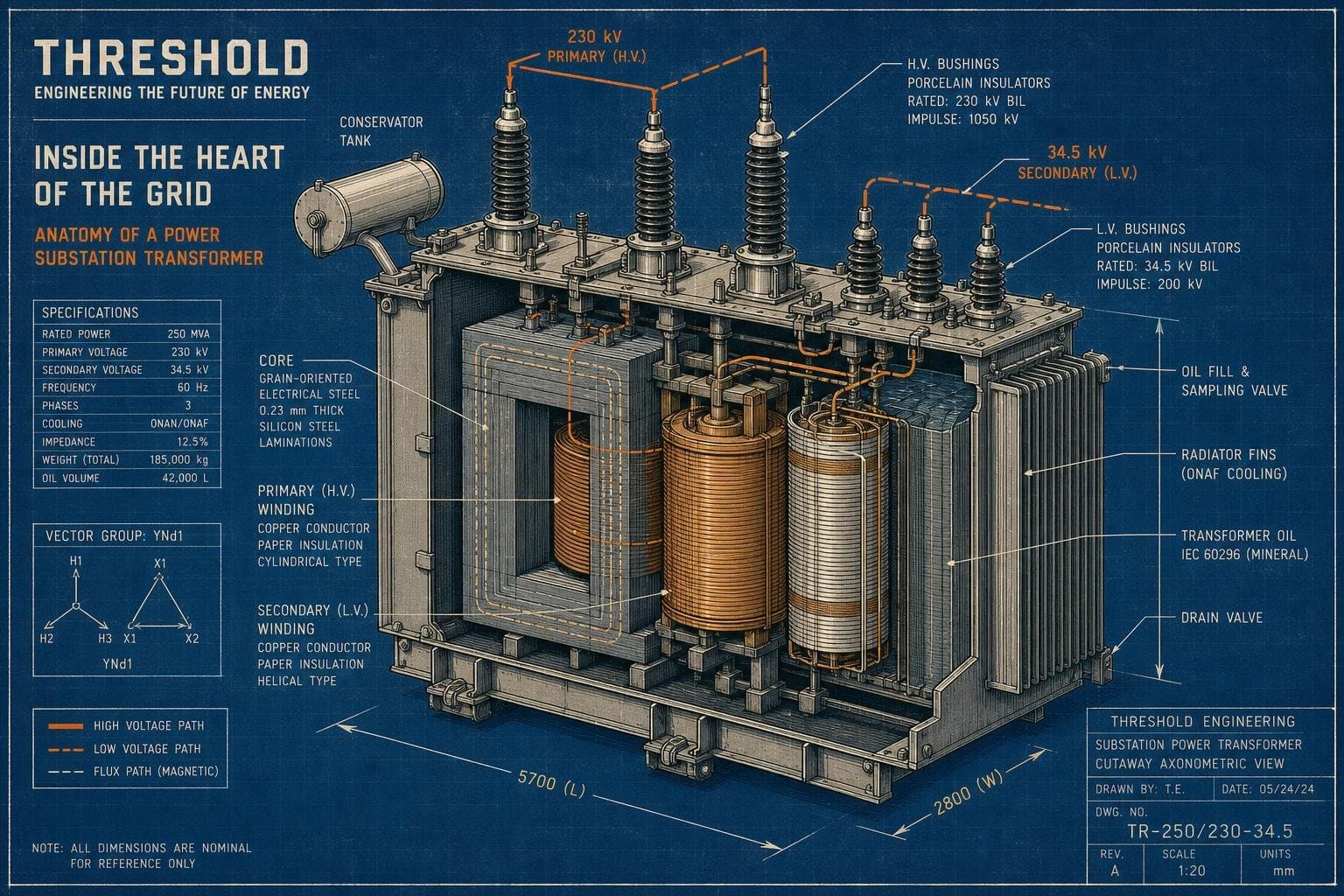

The substation transformer sitting at the heart of your local grid may be older than your car, older than your house, possibly older than you. That's not unusual — large power transformers routinely operate for 30 to 40 years, and many are well past that mark. What's changed is what happens when one fails: you can't just order a replacement.
Lead times for high-capacity transformers have stretched to as long as four years, according to analysts from PwC cited in a Reuters Events report. That number deserves a moment to land. Four years. If a critical substation transformer fails today, the utility managing it may not receive a replacement until 2030 — assuming it can secure a production slot at all.
This is the core reliability math that most grid coverage misses. The conversation tends to focus on generation capacity: do we have enough megawatts? But the transformer shortage reframes the question. It doesn't matter how many solar farms or gas peakers you can bring online if the substation hardware connecting them to the grid is unavailable, unaffordable, or simply not built yet.
Demand Doubled While Supply Stalled
The supply crunch didn't emerge from nowhere. Demand for generator step-up transformers increased 274% between 2019 and 2025, while demand for substation transformers rose 116% over the same period, according to Wood Mackenzie data. The drivers are familiar: AI data centers drawing enormous new loads, electrified transportation, industrial reshoring. Each of these trends individually would stress transformer supply. Together, they've overwhelmed it.
Prices have followed. Industry experts note that transformer costs have jumped roughly 80% over the last five years. Some developers are now purchasing factory production slots before they've finalized a project site — paying a premium to reserve manufacturing capacity for equipment they haven't yet fully specified, for projects that don't yet have permits.
The raw material constraints compound the problem. Grain-oriented electrical steel, which is required for transformer cores, faces its own global supply chain limits. Domestic production is constrained, leaving manufacturers dependent on imports for a component that is, functionally, irreplaceable.
Aging Equipment, No Spare Bench
The supply problem would be manageable if the existing installed base were young and healthy. It isn't. The Department of Energy's TRAC program — the Transformer Resilience and Advanced Components initiative — notes that many large power transformers are "approaching or exceeding their design lives," and that their high costs and custom specifications prohibit utilities from maintaining extensive spare inventories. These units can weigh hundreds of tons and cost millions of dollars. You don't keep one in a warehouse as a backup.
This is the failure cascade that keeps grid engineers up at night. An aging transformer fails. The utility calls for a replacement. The manufacturer quotes a two-to-four-year lead time. The utility scrambles for a refurbished unit or a loaner from a mutual aid pool — options that Mesa Associates describes as increasingly strained as more utilities compete for the same limited secondary market. Meanwhile, the affected substation operates in a degraded state, with reduced redundancy and elevated risk if a second unit shows stress.
Risk-informed prioritization matters here. A 40-year-old transformer serving a hospital network or a major transmission corridor is a different problem than one serving a low-density rural feeder — same age, different consequence profile. Utilities that haven't done rigorous asset condition assessments are essentially flying blind on which units are most likely to fail next.
NERC Is Watching the Load Side, Not Just the Supply Side
NERC's Level 3 alert issued in May 2026 focused on computational large loads — the data centers and AI infrastructure that are reshaping demand curves faster than grid planners anticipated. The alert requires utilities to take specific actions to mitigate reliability risks from these new load profiles. That's significant: a Level 3 alert is NERC's highest-urgency advisory tier.
NERC's summer 2026 reliability assessment found that three regions and one locality remain at elevated risk for supply shortfalls under abnormal conditions — an improvement from six regions at risk in 2025, but not a clean bill of health. Early summer heat and drought conditions were flagged as factors that increase reliability risk. The substation infrastructure connecting all that new generation to load centers is the variable that doesn't show up cleanly in resource adequacy models.
New domestic manufacturing investment is coming. Hitachi Energy announced over $1 billion in U.S. production investment, including a new plant in South Boston scheduled to come online in 2028. Siemens committed $421 million to a transformer factory in Charlotte, North Carolina. Both are meaningful commitments. Neither addresses the gap between now and 2028.
The watch item for the next 18 months: whether NERC's large-load alert translates into procurement rule changes that give utilities priority access to transformer supply — or whether the market continues to allocate production slots to whoever can pay the premium. The engineering problem is solvable. The procurement problem is the one with a four-year lead time.


