
A 1931 dam. A spillway designed for a world that no longer exists. And hydraulic modeling that revealed the gap only after a catastrophic failure somewhere else forced engineers to look.
That's the Tiger Creek story — and it's not an isolated case. It's a template.
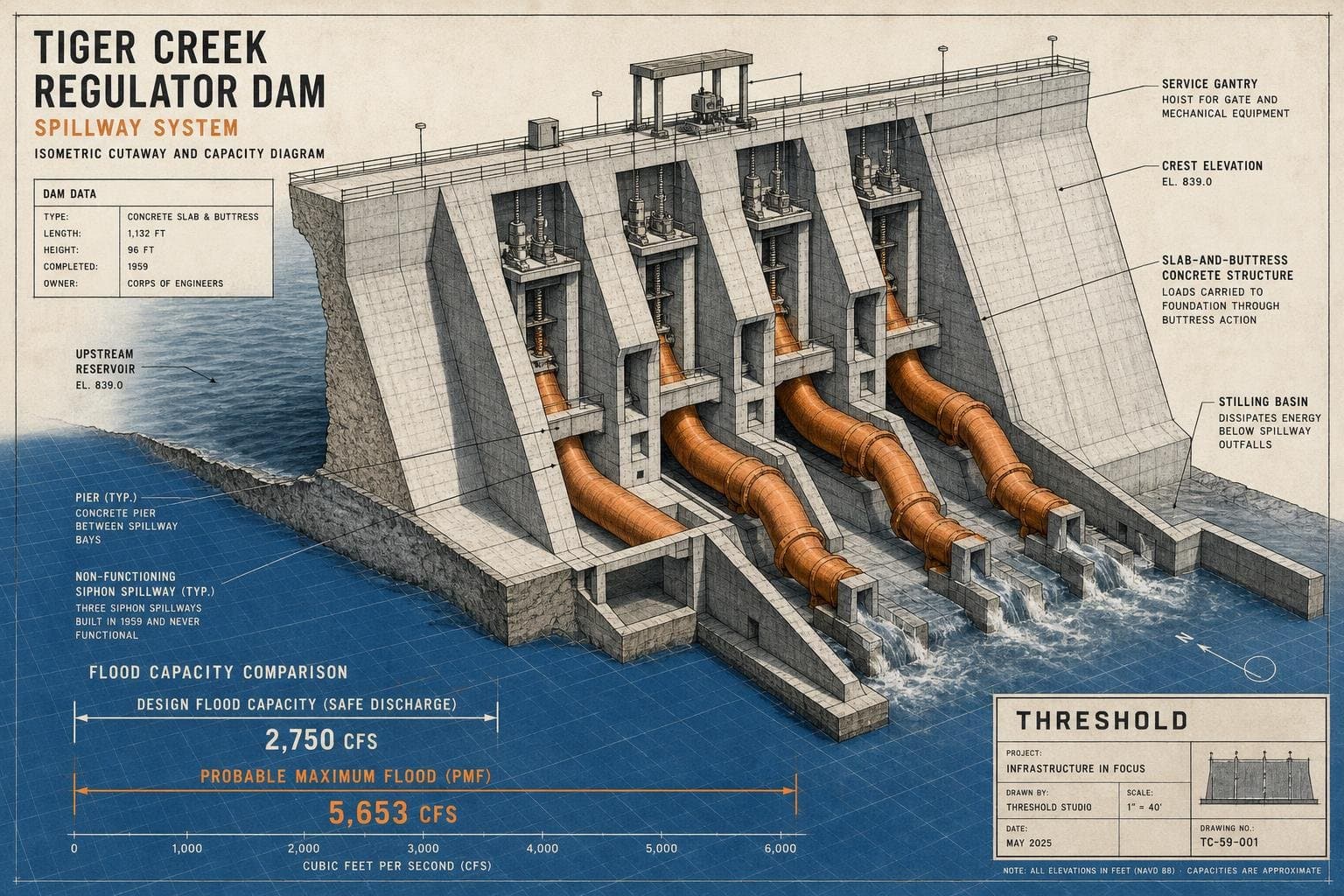
Granite Construction announced July 22 that it has received a $50-million contract from PG&E to replace the spillway at Tiger Creek Regulator Dam in Northern California. The trigger wasn't a failure at Tiger Creek. It was the 2017 Oroville Dam spillway collapse, which prompted California and federal regulators to require hydroelectric operators to reexamine aging spillways using updated hydrologic modeling. When engineers ran the numbers at Tiger Creek, they found the existing spillway could safely pass roughly 2,750 cubic feet per second — less than half the site's estimated probable maximum flood of 5,653 cfs. The 486-ft-long, 110-ft-high concrete slab-and-buttress dam was not designed to withstand overtopping. The margin wasn't thin. It was gone.
That's the spillway maintenance problem in one equation: a structure built to a standard that no longer reflects the actual hydrology, left in place until something elsewhere forces a reassessment.
The Inspection System Is Running Behind the Aging Curve
Tiger Creek is a $50-million problem that got found. The harder question is how many similar problems haven't been.
According to ASCE's 2025 Report Card for America's Infrastructure, the nation's dams received a D+. The average age of the more than 92,000 dams in the National Inventory of Dams is 65 years. Nearly 17,000 are classified as high-hazard potential — meaning failure could result in loss of life. Of those, roughly 2,522, or about 15%, were considered in poor or unsatisfactory condition as of the report's data year.
The inspection system meant to catch deterioration before it becomes failure is itself under strain. Brian Graber of American Rivers, cited in the ASCE piece, noted that dam failures and emergency interventions have climbed from an average of three per year in the 1994–2003 period to 76 per year in the 2014–2023 period. That's not a measurement artifact — it reflects real deterioration in an aging stock of structures. And the inspection capacity tracking that deterioration hasn't kept pace: on average, a single state dam safety official is responsible for overseeing 190 existing dams. When caseloads run that high, the inspection interval becomes the risk variable, not the inspection result.
The spillway problem specifically compounds this. Spillways are not inspected the same way a dam face or foundation is. Hydraulic capacity assessments require modeling — updated precipitation data, revised probable maximum flood calculations, analysis of whether mechanical components like siphons will actually activate under design conditions. Tiger Creek's review found uncertainty about whether its three spillway siphons would function as intended. That kind of finding doesn't come from a visual walkthrough. It comes from a systematic engineering analysis that many states simply don't have the staffing to conduct on schedule.
The Funding Gap Has a Number — and a Workaround in Progress
The Association of State Dam Safety Officials estimated in March 2025 that rehabilitating the nation's nonfederal dams would cost $165.2 billion in total, with the most critical subset running $37.4 billion. The 2021 Infrastructure Investment and Jobs Act allocated roughly $3 billion for dam safety — a meaningful number, but one that covers less than 10% of the critical rehabilitation need, and much of it has since been redirected.
Congress is moving to address at least part of the structural problem. The House Transportation & Infrastructure Committee unanimously approved H.R. 9497 on July 14, the Water Resources Development Act of 2026, which includes a five-year reauthorization of the High Hazard Potential Dam Rehabilitation Grant Program. The Senate Environment & Public Works Committee advanced its companion bill, S. 4949, the same week. Both passed committee unanimously. ASCE flagged the grant program reauthorization as a priority, and the House bill also adjusts the National Dam Safety Program's state assistance grant formula to remove low-head dams from the calculation — a technical fix that prevents states from losing funding simply because they lack the capacity to count every small structure in their inventory.
These are real improvements to the funding architecture. They don't close the $37.4 billion gap, but they extend the programs that let states conduct inspections and emergency action planning in the first place.
What Tiger Creek Actually Tells Us
The $50-million Tiger Creek contract — covering a new spillway crest structure, concrete chute, flip bucket, cofferdam, rock anchoring, and permanent access road, with completion scheduled for May 2028 — is a case study in what post-failure reassessment costs when the original design assumptions no longer hold.
The National Inventory of Dams tracks 92,075 structures with an average age of 61 years. Many were designed to precipitation and flood standards that predate modern hydrologic modeling. The Oroville failure forced California's hydroelectric operators to rerun the math. The question for the rest of the country's high-hazard inventory is whether that reassessment happens proactively — through funded inspection programs and updated hydraulic analyses — or reactively, after the next spillway that was never designed for the flood it's now expected to pass.
The math at Tiger Creek was 2,750 cfs against a probable maximum flood of 5,653 cfs. That's a 51% capacity shortfall on a structure holding back a river. Finding it cost a modeling study. Not finding it would have cost considerably more.


