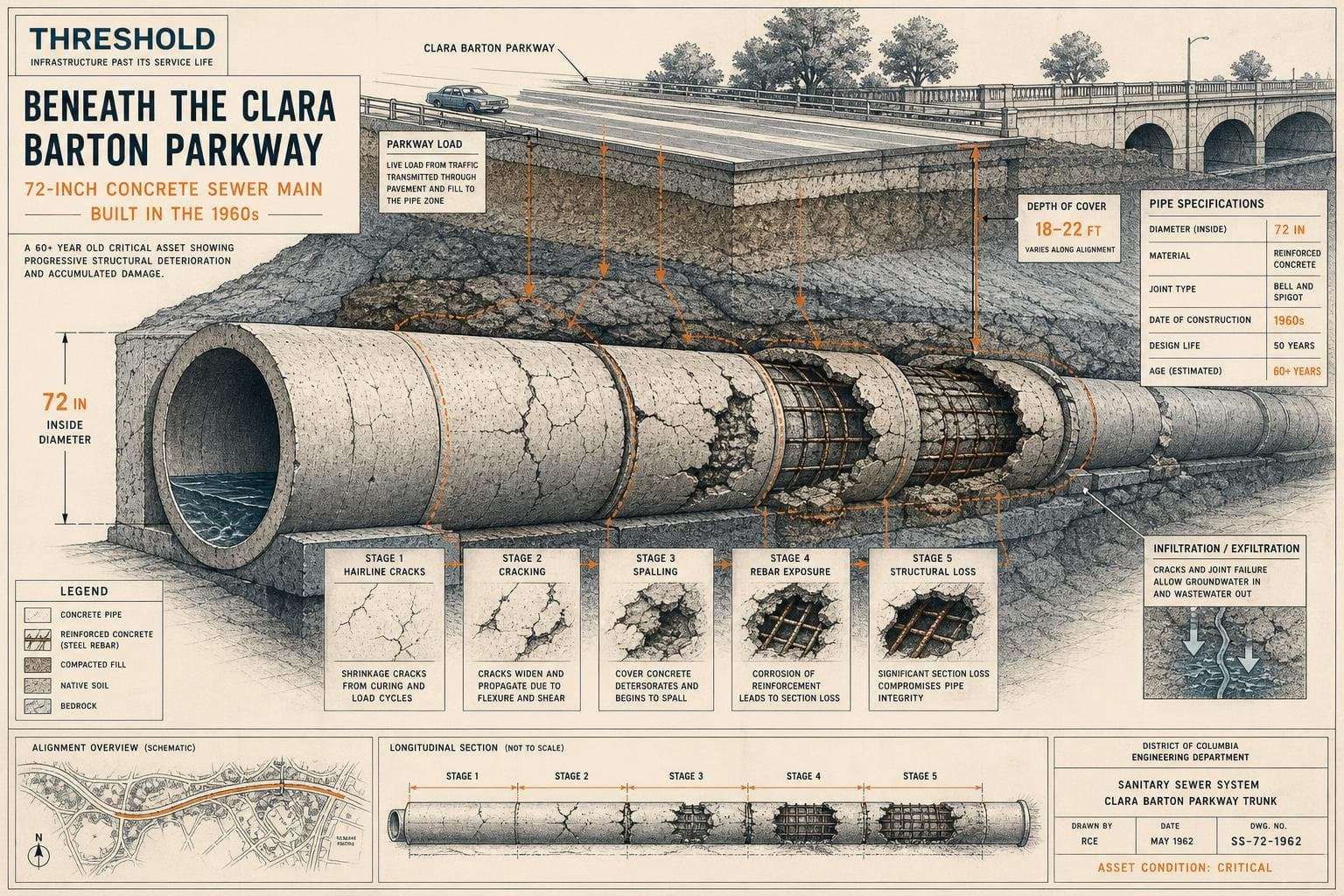

On January 19, 2026, a 72-inch concrete sewer main collapsed along the Clara Barton Parkway in Montgomery County, Maryland. The pipe — part of a system called the Potomac Interceptor, built in the early 1960s — was already past its service life. DC Water knew this. A replacement was scheduled for that spring. The specific segment that failed was on the list.
It failed in January instead.
Over roughly ten days, an estimated 200 to 300 million gallons of raw sewage poured into the C&O Canal and the Potomac River — the primary drinking water source for Washington, D.C. Bacterial contamination at the spill's peak reached over 4,000 times the safe recreational level, according to monitoring data from the Potomac Riverkeeper Network. FEMA approved an emergency assistance request for the District of Columbia on February 21.
This is the core problem with aging water infrastructure: the failure mode isn't unknown. The timeline isn't a mystery. The pipe was already on a replacement schedule. What failed wasn't the engineering assessment — it was the gap between knowing and doing.
The Backlog Has a Shape
The Potomac collapse wasn't an outlier. A 2026 Sewer Stress Index compiled by Nationwide Waste Service — cited by Nature World News — classified three U.S. cities as "Critical." Philadelphia ranked first, discharging an average of 12.7 billion gallons of untreated sewage annually, with its combined sewer overflow problem compounded by the escalating cost of required modernization.
That figure — 12.7 billion gallons annually, in one city — is worth sitting with. It's not a projection. It's the current operating reality of a system that was built for a smaller city, under older standards, with a maintenance budget that has never caught up to the replacement curve.
The scale of the national gap is equally stark. EPA estimates the country will require more than $1 trillion in water infrastructure investment in the coming years. The Drinking Water and Clean Water State Revolving Fund programs have provided more than $265 billion to support approximately 76,000 infrastructure projects since their creation — a meaningful number, but one that illustrates the distance between what's been invested and what's needed.
Meanwhile, more than 92% of U.S. community water systems serve fewer than 10,000 people, according to the National Rural Water Association. Small systems face the same aging-pipe problem as large ones, with a fraction of the rate base to fund repairs and far less capacity to navigate federal financing programs.
What a Working Solution Actually Costs
Winnipeg offers a useful data point on what it takes to get ahead of this problem rather than behind it. The city's North End Water Pollution Control Centre — which treats about 70% of Winnipeg's wastewater and processes biosolids from all three municipal treatment facilities — was facing a capacity constraint that city reports warned could exhaust remaining treatment capacity within five to eight years. Winnipeg is projected to approach one million residents over the next quarter century.
On July 16, the city awarded a roughly $580-million contract to an Aecon-led joint venture to build new biosolids facilities at the plant. That's the second major phase of a modernization program expected to exceed $2 billion in total — covering power supply, headworks, biosolids treatment, and a future nutrient-removal phase. Biosolids treatment is scheduled to begin in October 2030, with substantial completion targeted for March 2031.
The $580 million figure covers construction of the biosolids facilities; the broader program cost includes design, prior phases, and future nutrient-removal work. The point isn't the number itself — it's what the number represents: a city that identified a five-to-eight-year capacity window and committed to acting inside it, rather than waiting for the failure.
That's the decision the Potomac Interceptor's managers were also trying to make. They scheduled the replacement. The pipe didn't wait.
The Funding Machinery Is Moving — Slowly
On June 17, 2026, EPA announced $25.5 million in new technical assistance funding under the Clean Water Act, targeting small, rural, and Tribal communities facing wastewater and water quality challenges. A separate EPA roundtable convened by Assistant Administrator for Water Jess Kramer focused on reducing delays in the State Revolving Fund and WIFIA loan programs — with particular attention to barriers facing small and rural communities that struggle to access financing even when it's nominally available.
The roundtable produced a commitment to develop an online toolbox for lenders and funding recipients, and to establish collaborative workgroups with states and water sector organizations. Those are process improvements, not capacity additions. They matter — delays in SRF disbursement mean projects sit in planning while pipes continue aging — but they don't close the trillion-dollar gap.
The math here is unforgiving. A pipe that's past its service life doesn't care whether the replacement funding is stuck in a state revolving fund queue. The Potomac Interceptor was scheduled. The schedule wasn't fast enough. Every system running a similar backlog is running the same race, and the pipes are not waiting for the paperwork to clear.
Watch for the House WRDA 2026 markup — H.R. 9497 was introduced June 26 and includes reauthorization of the High Hazard Potential Dam Rehabilitation Grant Program, set to expire September 30. Whether that bill moves before the deadline is the next concrete indicator of whether Congress is treating water infrastructure as a scheduling problem or a funding one.


