


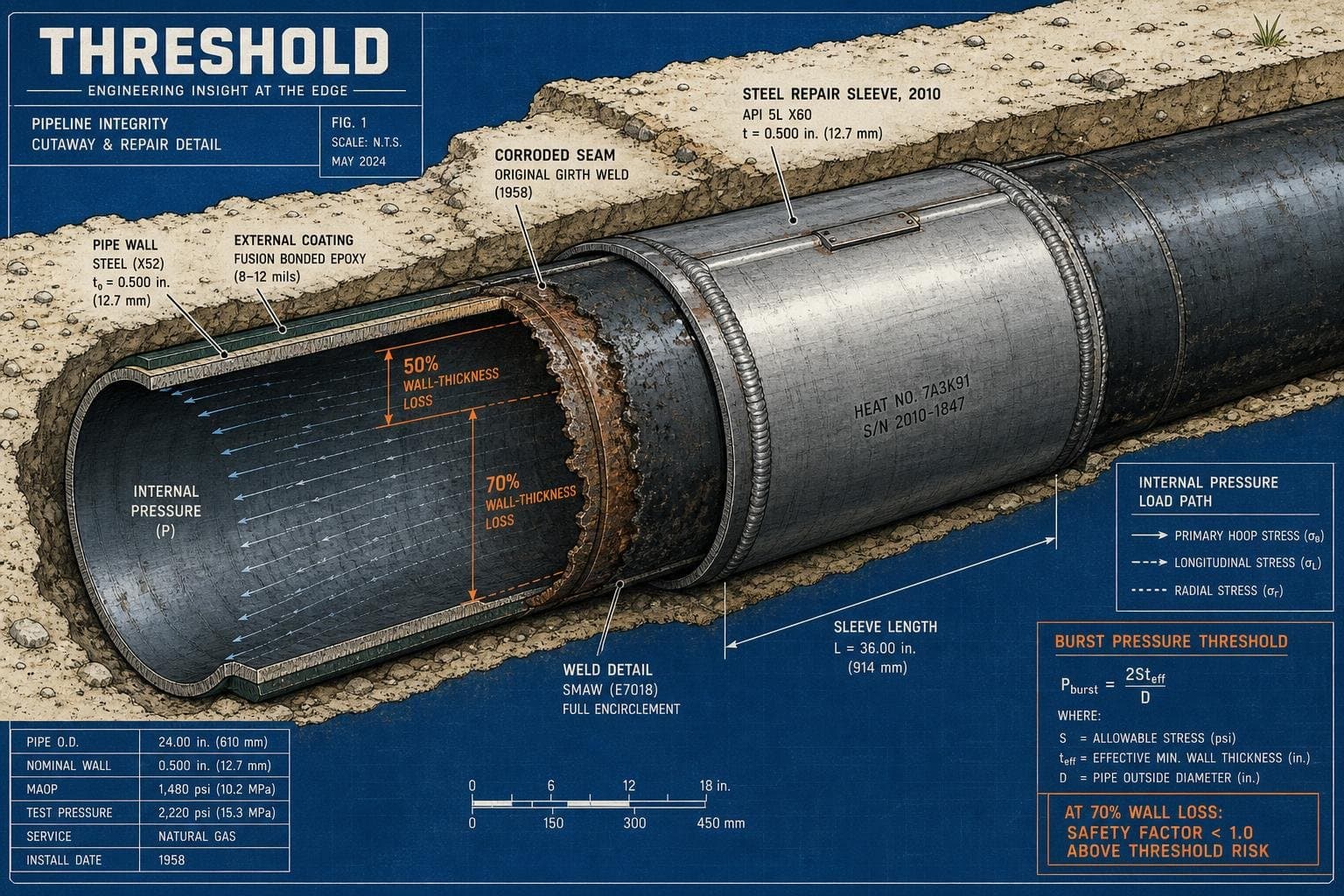

Pipeline operators in the U.S. currently have to fix a crack in a gas line once it eats through half the pipe wall. Under a rule PHMSA proposed on July 8, that threshold moves to 70% of wall thickness, giving operators more time before a repair becomes mandatory — a change the agency estimates will save industry about $390 million a year, according to Forbes. That's a real number with a real methodology behind it: PHMSA is shifting from flaw-depth triggers to burst-pressure calculations, on the theory that inspection tools and AI-assisted analysis have gotten good enough to justify the looser margin.
The problem, per that same Forbes reporting, is who's vouching for those tools. Most of the technical sources PHMSA cites to justify trusting the new inspection methods come from industry vendors and pipeline operators themselves, not independent peer-reviewed studies. Public comment on the proposal closed September 8, and the rule still has to clear PHMSA's advisory committees before becoming final. That's the actual state of play — not a finalized rule, a proposal in review, built on evidence the regulator didn't generate itself.
The Margin Question, Not Just the Threshold
An inspection-grade cutoff is a proxy for risk, not a measurement of it — the same distinction that applies to a D-rated bridge. Moving the repair trigger from 50% to 70% wall-thickness loss doesn't automatically mean more failures; it means the system is tolerating more measured degradation before intervention, on the assumption that the measurement itself is accurate. That assumption is exactly where the Forbes reporting raises its flag. If the crack-depth sensing and AI flaw-sizing tools PHMSA is leaning on carry industry-supplied error bars rather than independently verified ones, the actual safety margin at 70% wall loss is unknown, not merely larger. PHMSA hasn't published independent validation of that margin, and the rule hasn't been finalized — so any claim about what it means for failure risk has to stop there.
What Happens When the Paperwork Doesn't Exist at All
A measurement-based threshold only works if the repair that gets made is documented and inspectable later. A recent PHMSA investigation into a pipeline near Sterling Heights, Michigan found the opposite: a steel repair sleeve welded onto a 59-year-old, 130-mile line between Marysville, Michigan, and Toledo, Ohio in 2010 had no paperwork behind it at all, and the corroded seam underneath it leaked roughly 15 barrels of crude for an unknown period before a passerby noticed oil in a storm drain, per Energies Media. That's a liquid line, not a gas distribution main, so it doesn't speak directly to cast-iron gas infrastructure. But it's the same regulator, the same category of buried steel repair, and the same failure mode that any wall-thickness-based repair standard depends on avoiding: a patch that quietly fails below the surface, undetected by leak-detection systems built to catch sudden pressure drops rather than a slow seep. PHMSA issued a corrective order within three days of discovery, skipping the usual prior-notice process because of the risk involved, according to the same reporting.
The Enforcement Data Behind the Headlines
Day to day, PHMSA's actual enforcement workload looks less dramatic and more like steady accounting. In September 2026 alone, the agency issued four corrective action orders, two notices of amendment, one warning letter, and five notices of probable violation, totaling just under $1.95 million in proposed fines, according to compliance tracking firm RCP. That's the baseline churn of a regulator finding violations and assessing penalties — not a crisis, just the ordinary cost of oversight on a pipeline network that's aging in place. Separately, researchers at Oak Ridge National Lab have been applying machine learning to PHMSA's own incident dataset, which tracks more than 600 variables per event from 2010 through 2024 — infrastructure attributes, contributing factors, and incident characteristics. That dataset is the raw material any future case for tightening or loosening repair thresholds should be built on. Whether it will be is the open question.
What to Watch Next
The rule isn't final. PHMSA still has to take the July 8 proposal through its advisory committees before writing a final version, and the public comment window closed September 8 without resolving the industry-sourcing concern Forbes raised. Anyone tracking this should watch for whether the advisory committee review surfaces independent inspection-tool validation data, or whether the final rule goes out the door built on the same vendor-supplied evidence base it started with. The gap between a proposed threshold and a validated one is exactly where pipeline risk actually lives.