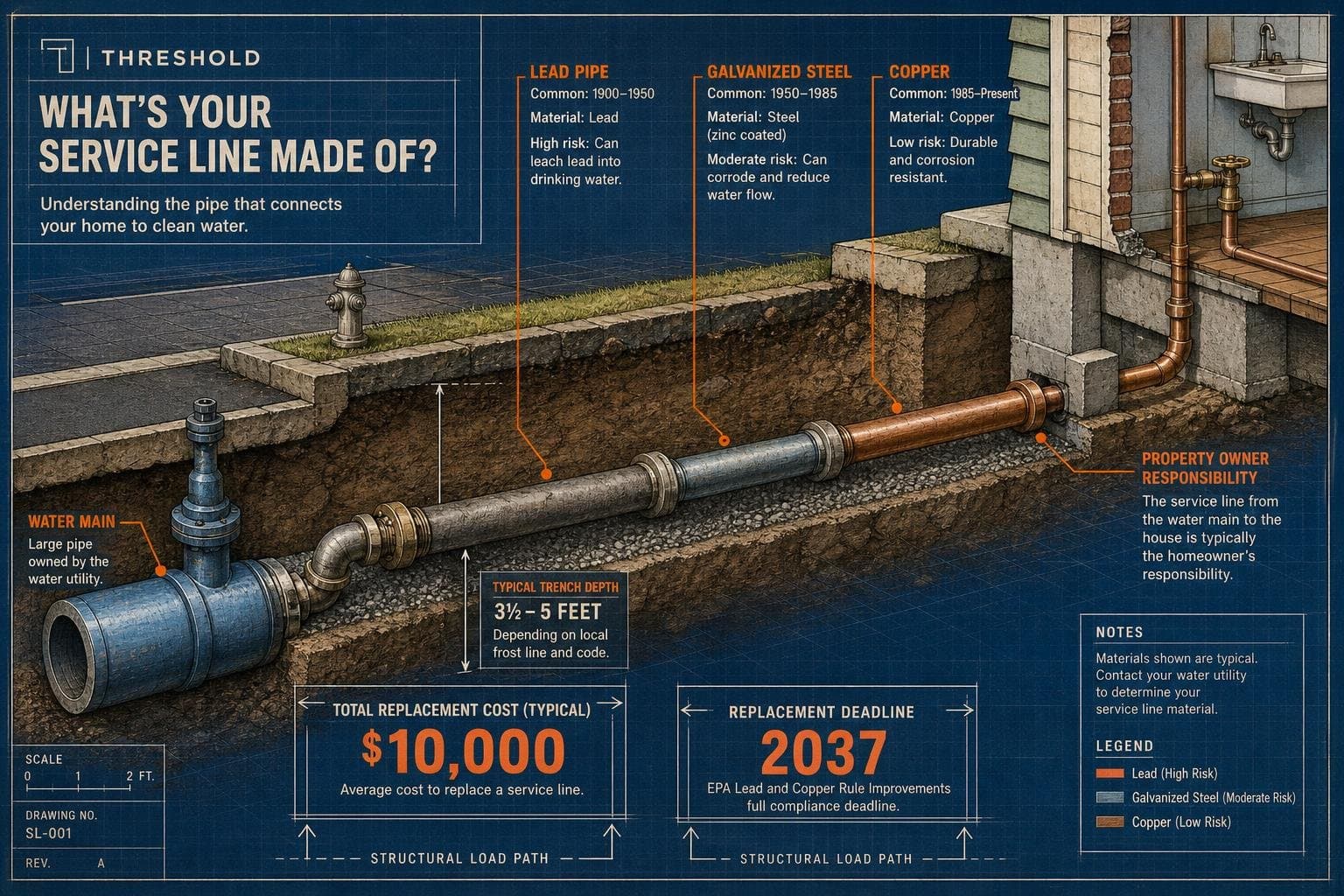

Barbara Deyounge-Ezell got a letter from New York City's Department of Environmental Protection in 2024 telling her the pipe carrying water into her Queens home was made of lead. Replacing it would cost more than $10,000 — money she doesn't have on a fixed retirement income, according to reporting from New York Focus (via Governing). Her situation captures the actual mechanics of the federal lead pipe mandate better than any policy summary: a hard national deadline, a patchwork of who pays, and a country that still doesn't fully know where its lead pipes are.
The Deadline Is Set. The Inventory Isn't Finished.
Under the 2024 federal rule, every lead service line in the country has to be gone by 2037 (Governing). Before utilities can replace anything, they had to count what they have — every water system was required to submit an initial inventory of lead, galvanized-requiring-replacement, and unknown-material lines to their state by October 16, 2024. Nearly two years past that deadline, roughly 6,300 water systems serving 3.8 million Americans still haven't submitted that inventory, and more than 1,300 systems have already been cited by EPA for missing it, according to an AP News analysis of EPA data reported by EHSLeaders. Most of the non-compliant systems serve populations under 500 — small utilities without the staff to dig through decades-old construction records, per the Environmental Policy Innovation Center.
This matters mechanically, not just administratively. EPA's Lead and Copper Rule Improvements set a 10-year replacement clock, and starting in November 2027, the number of "unknown" lines a system carries gets folded into its required 10% annual replacement rate — the more unknowns on the books, the more lines a utility has to physically replace each year to stay on pace, per EPIC's tracking of the rule (Environmental Policy Innovation Center). A system that hasn't finished counting its pipes is, by definition, underestimating its own workload. It's worth being precise here: an "unknown" service line is not a confirmed lead line. EPA's national estimate — about 4 million lead service lines total, with 3 million confirmed as lead or galvanized-requiring-replacement and roughly 1 million estimated among the unknowns — is a modeled projection, not a pipe-by-pipe count (EHSLeaders). Treating every unknown as a confirmed hazard overstates the problem; ignoring the unknowns understates the coming workload. Both errors have real cost consequences down the line.
Same Deadline, Wildly Different Bills Depending on Your ZIP Code
New York illustrates the funding math at state scale. EPA projects the state will need to replace roughly 385,000 lead service lines — the third-highest total of any state, behind Illinois and Ohio, according to Governing. So far New York has received $633 million in federal grants and loans, plus a matching $258 million in state money that services the loan portion. That funding flows to the state first, which then decides how much reaches each municipality — and the federal rule never required utilities to cover the full cost of replacing a private-property line, leaving states to fill that gap however they choose (Governing).
That gap-filling looks different city to city. New York State's latest round distributed $130 million across ten municipalities and water authorities, with Poughkeepsie receiving the largest single award at $14 million, New York City getting a matching $14 million for lines in Queens, Brooklyn, and Staten Island, and Port Jervis set to receive $13.4 million, per Hoodline. New York City separately reported receiving its fourth $24 million federal allotment, bringing its cumulative total past $143 million in combined grants, loans, and state funds — enough, the city says, to remove up to 7,000 lead lines on private property in low-income, highly polluted neighborhoods (Governing). Those figures are grant totals, not confirmed per-pipe replacement costs — the $10,000-plus bill Deyounge-Ezell faces is what happens to homeowners whose property simply isn't inside the funded footprint.
The Federal Piece That's About to Get Smaller
The engineering problem is straightforward — count the pipes, dig them up, replace them, verify the material. The financing problem is where the timeline gets shaky. Infrastructure Investment and Jobs Act funding has driven most of the LSL replacement work to date, and that money is winding down just as the 10-year regulatory clock keeps running, according to EPIC's policy tracking (Environmental Policy Innovation Center). EPIC is pushing Congress to authorize a dedicated $3 billion-a-year LSL replacement stream rather than folding it back into general drinking water revolving funds — a recommendation, not a funded commitment. Meanwhile, ASCE's 2025 infrastructure report card shows the broader system trending up, from a C- to a C overall, with several historically D-rated categories improving on the back of recent federal investment (ASCE). Lead pipe replacement sits underneath that average, not on top of it: a mandate with a hard date, a funding source that's contracting, and millions of pipes whose exact material is still, on paper, unknown.


