


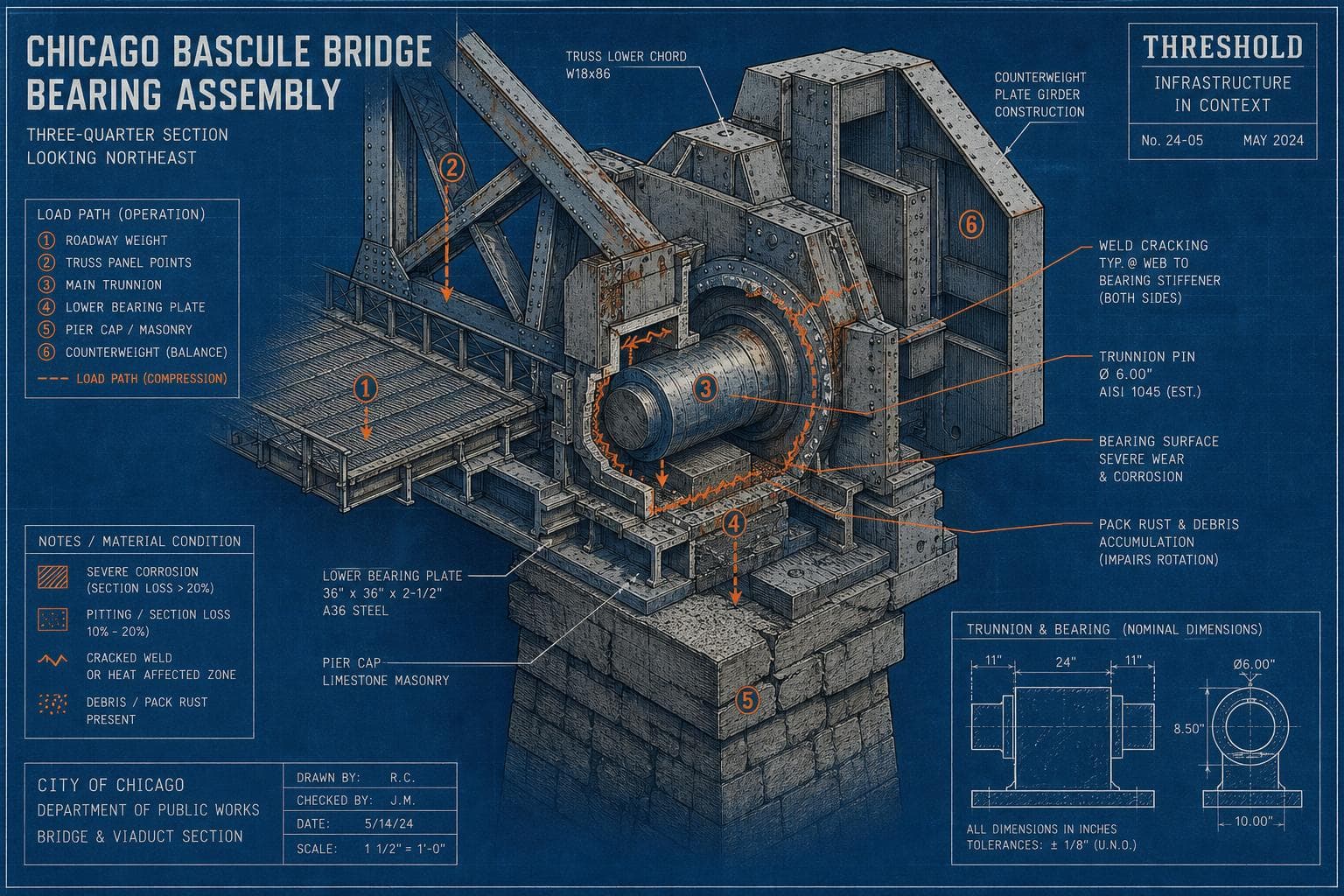

Chicago closed five river bridges simultaneously last year to catch up on deferred repairs. That's not a maintenance strategy — that's a system that ran out of runway.
The State Street Bridge shut down unexpectedly in April 2025, several months before engineers had planned to begin repairs. Emergency closure. Nearly a year of work. Traffic snarls across the Near North Side for most of 2025. When it finally reopened in March, it offered modest relief — because four other bridges on the same corridor remained closed.
That sequence is worth sitting with. The bridge didn't fail because no one was watching. It failed the schedule because the watching happened too late, and the repair queue was already full.
1 in 6 Is Not a Rounding Error
According to a Chicago Sun-Times analysis of federal bridge inspection records, 100 of Chicago's 601 bridges are currently rated "poor" — 16.6% of the city's bridge inventory. The national average sits at 6.7%. Chicago is running at roughly two and a half times that rate.
That's the backlog problem in its clearest form. The Grand Avenue Bridge over the North Branch of the Chicago River illustrates it precisely. University of Illinois Chicago engineering professor Farhad Ansari reviewed inspection records and identified it as a likely candidate for emergency closure — describing its superstructure and truss work as being "in critical condition." The bridge isn't closed yet. It's in the queue, somewhere, waiting for a funding slot that may arrive after the structure forces the issue.
What Deferred Assessment Actually Costs
The inspection backlog and the repair backlog are related but distinct problems. You can be current on inspections and still have a repair backlog — Chicago's situation. Or you can defer the inspections themselves, which means you don't know what you don't know.
Either way, the financial logic is punishing. A May 2026 analysis by Investortools drawing on audited financial statements from nearly 2,000 U.S. cities estimates a $1.03 trillion infrastructure replacement obligation sitting on municipal balance sheets — a figure that dwarfs most cities' bonded debt and unfunded pension liabilities combined. The report's core finding is structural: cities can defer maintenance without immediate accounting consequences, but prolonged deferral increases the likelihood of service disruptions, emergency repairs, and sudden fiscal stress.
That's exactly what Chicago experienced. Emergency closure of State Street cost the city a year of repair work on an accelerated, unplanned timeline. The five simultaneous closures that followed weren't a coordinated modernization program — they were the system trying to absorb a backlog that had grown faster than the budget could address it.
Minnesota's 2026 ASCE Infrastructure Report Card puts the same dynamic in starker terms: the state's two bonding bills over the past five years, the most recent measured in the millions, have not kept pace with a project backlog measured in the billions. Systems slip from "good" to "fair" — the condition range where repair costs escalate and failure risk increases — not because of sudden catastrophic events, but because the funding curve and the deterioration curve diverge quietly over years.
The Margin That Disappears
The concrete example here isn't abstract. Chicago's Near North Side currently has the Cortland Street, Chicago Avenue, Lake Street, and Halsted Street viaduct either closed or under repair — in addition to the Grand Avenue Bridge flagged for potential emergency action. That's a cluster of closures in a single corridor, each one individually manageable, collectively a significant rerouting burden for commuters and freight.
When inspection findings pile up faster than repair capacity, the system doesn't fail all at once. It fails in clusters — because deferred structures tend to reach critical condition around the same time, in the same neighborhoods, built in the same era with the same materials under the same load assumptions.
The math on Grand Avenue is the one to watch. If Ansari's assessment is right and the city moves to close it, the Near North Side loses another east-west link before the current closures are resolved. That's not a prediction — it's the logical output of a repair queue that's already oversubscribed.
Inspection grades tell you where the structure is. The backlog tells you how long it stays there.