



On April 28, the Iberian Peninsula went dark. Not a localized outage, not a rolling brownout — a cascading voltage collapse that swept across Spain and Portugal in minutes. European grid operators are now scrambling to understand what happened, and the early assessment from operators is striking: according to Reuters, a blackout caused by cascading voltage surges "had never happened before and was not something that operators were looking into before the Iberian outage."
That sentence should stop every grid engineer cold. Not because the failure was unimaginable — but because it wasn't, and they still weren't watching for it.
The Cascade Problem Is a Margin Problem
A cascading blackout doesn't start with a catastrophic failure. It starts with a margin that disappears faster than the system can respond.
Here's the basic physics: the grid operates at a precise frequency — 60 Hz in North America, 50 Hz in Europe. Every generator feeding the system has to stay synchronized to that frequency. When a large generator or transmission line trips offline, the remaining generators absorb the imbalance. If the imbalance is small and the response is fast, frequency dips and recovers. If the imbalance is large, or if the protective relays on neighboring equipment interpret the frequency deviation as a fault and disconnect their equipment, the cascade begins. Each disconnection increases the load on what remains. Each increase in load risks the next disconnection.
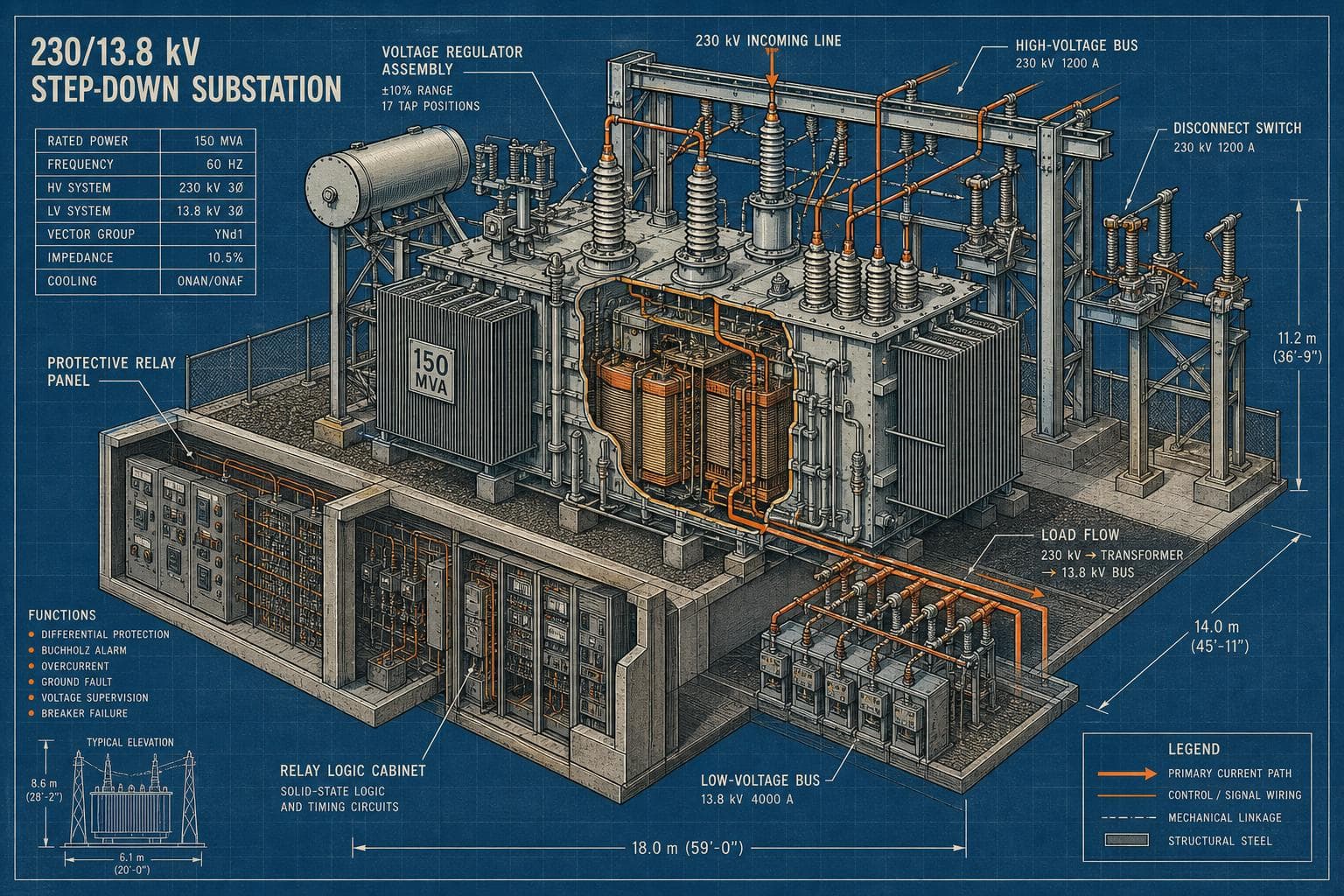
Substations are the control points in this sequence. They house the protective relays, the voltage regulators, and the switching equipment that can isolate a fault before it propagates. A well-configured substation acts as a firebreak. A poorly configured one — or one running aging relay firmware that wasn't designed for today's grid mix — can accelerate the cascade instead of stopping it.
The Iberian event appears to have involved voltage surges specifically, a mode that differs from classic frequency-driven cascades. That distinction matters because voltage stability and frequency stability are related but not identical problems, and protection systems optimized for one don't automatically handle the other.
The U.S. Grid Is Running the Same Calculation, With Less Margin
The DOE's July 2025 grid reliability report — released under the Speed to Power initiative — warned explicitly that absent new firm capacity and continued retirement of reliable generation, blackout frequency in the U.S. could increase by up to 100 times by 2030. That's not a rounding error. That's a structural shift in risk.
The driver isn't mysterious. The DOE's Office of Electricity describes a grid with more than 1 million megawatts of generating capacity connected to over 600,000 miles of transmission lines — infrastructure that is "aging and being pushed to do more than it was originally designed to do." AI data centers, EV charging loads, and the retirement of dispatchable coal and gas generation are all compressing the same margin that cascades exploit.
The DOE's response — a $1.9 billion SPARK funding opportunity announced in March 2026 — prioritizes transmission upgrades and advanced technologies including Phasor Measurement Units (PMUs). PMUs are the key tool here: they measure voltage angles across the grid in real time, giving operators a live picture of stability that traditional SCADA systems can't provide. The gap between "we have PMU data" and "our operators know how to act on it in under 30 seconds" is where cascades live.
What the Iberian Failure Actually Tells Us
The operators' own admission — that this failure mode wasn't on their radar — is the most important data point from the event. Not because European grid engineers are negligent, but because it confirms something the engineering literature has argued for years: the grid's failure modes are expanding faster than the protection paradigms designed to catch them.
Renewable-heavy grids have lower inertia than fossil-fuel grids. Synchronous generators spinning at 3,000 RPM carry kinetic energy that resists frequency changes; solar inverters don't. As the generation mix shifts, the grid's natural damping decreases, and the window between "anomaly detected" and "cascade initiated" shrinks.
The concrete lesson from Iberia: substation protection settings configured for a 2005 grid mix may be wrong for a 2026 grid mix — not because the hardware failed, but because the assumptions baked into the relay logic no longer match physical reality.
That's the audit every grid operator should be running right now. Not "are our substations maintained?" but "are our protection settings calibrated for the grid we actually have?"
The DOE's 100x blackout risk estimate assumes current trajectories hold. The Iberian event suggests the trajectories are already producing surprises. Watch for NERC's post-event analysis of the Iberian cascade — when it arrives, it will either confirm the voltage-surge mechanism or reveal something the operators haven't named yet. Either answer changes the math.