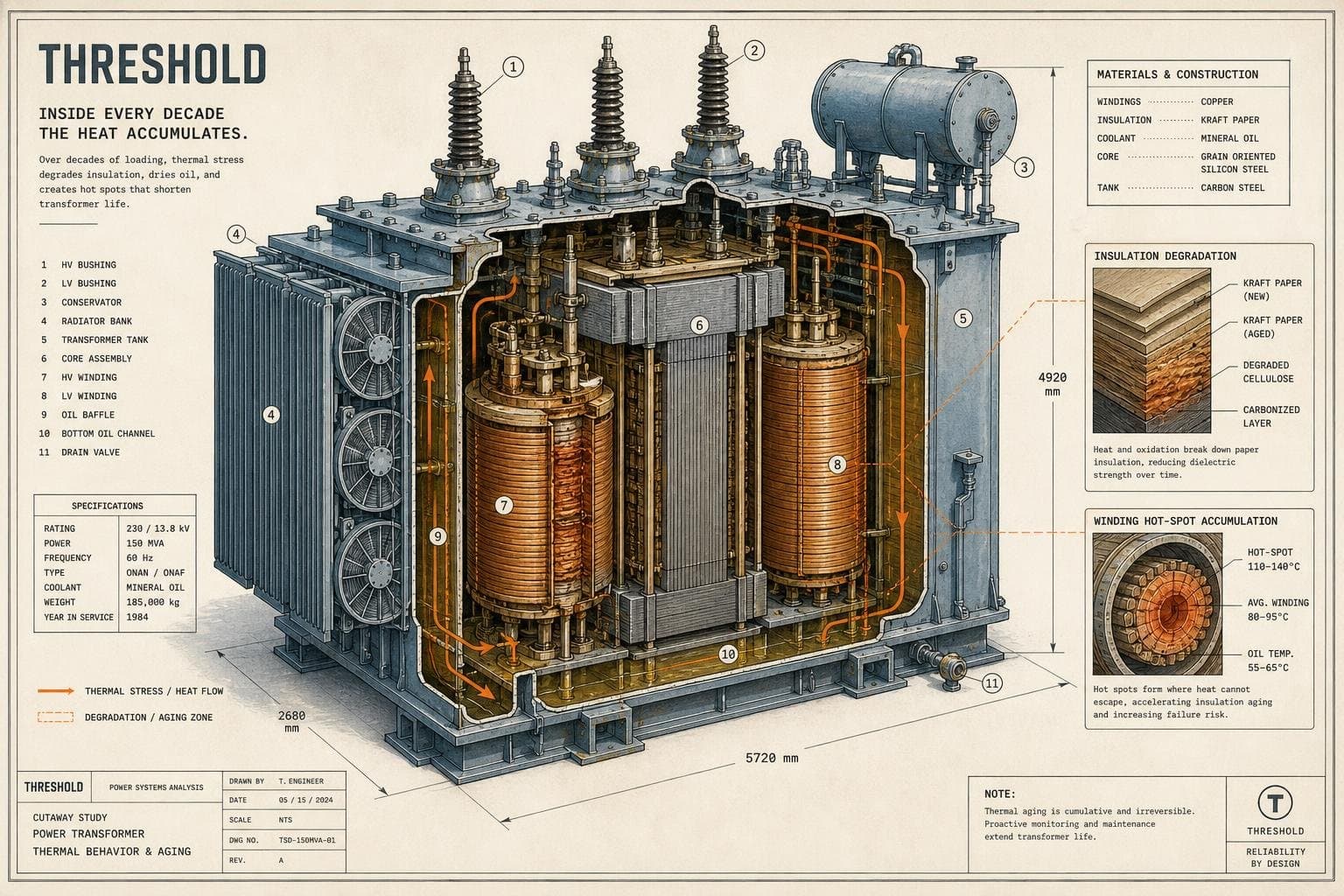

The grid's most vulnerable component doesn't trip a breaker or throw a fault code when it starts to fail. A substation transformer overheats slowly, insulation degrading degree by degree, until one day it doesn't come back online. By then, you're looking at a 12-to-18-month lead time for a replacement unit — and a section of the grid that's dark in the meantime.
That's the quiet math behind what's shaping up as the defining grid stress of the decade: aging transformer infrastructure colliding with a heat regime it was never rated to handle.
The Design Envelope Is Closing
For decades, transformer thermal ratings were calculated against nameplate assumptions — seasonal averages, historical peak temperatures, load curves that didn't include 50,000-square-foot data centers drawing power around the clock. Those assumptions are now obsolete.
Power Magazine reports that utilities are now rating transmission lines hour by hour against ambient temperature rather than against once-a-season nameplate values. The same article notes that high temperatures "threaten to accelerate wear on distribution and substation transformers, aging assets already in short supply and difficult to replace." That's not a warning about some future scenario — it's a description of operating conditions this summer.
The U.S. Energy Information Administration's May 2026 Short-Term Energy Outlook, cited in the same Power Magazine assessment, projects roughly 1,610 cooling degree days nationwide this year — 4% above 2025, with the third quarter running 8% above the same period last year and 5% above the ten-year average. Cooling degree days are the standard industry measure of air-conditioning demand. More CDDs means more load. More load means more heat generated inside transformer windings that are already running hot from ambient conditions. The thermal margin compresses from both ends simultaneously.
The North American Electric Reliability Corporation has flagged the overlap of early-summer heat with spring maintenance outages as a recurring concern, and named wide-area heat events as a primary reliability risk for summer 2026 — on par with generator outages and fuel supply, per Power Magazine's summary of NERC's 2026 Summer Reliability Assessment.
The Supply Problem Doesn't Resolve Quickly
I covered the transformer shortage in depth back in June. The core problem hasn't changed: large power transformers are custom-engineered, domestically scarce, and take over a year to procure even under normal conditions. What's changed is the demand side of that equation.
The Midwest construction boom illustrates the pressure. Engineering News-Record reports that data centers are "fundamentally reshaping" the regional construction market, with utilities and developers expanding solar, battery storage, and natural gas capacity simultaneously to meet load growth. Every new data center interconnection, every new generation facility, every grid expansion project pulls from the same constrained pool of transformer manufacturing capacity.
That's the compounding dynamic: demand for new transformers is rising at exactly the moment when aging installed units face accelerated wear from heat stress. The Department of Energy has active R&D efforts aimed at the transformer supply problem, per its Office of Electricity, but manufacturing lead times don't respond to R&D announcements on any short timeline. The gap between what the grid needs and what can be sourced remains the binding constraint.
What Resilience Actually Requires
The grid's 2025 performance was, by NERC's own accounting, reasonably strong — RTO Insider reported that NERC's 2026 State of Reliability report emphasized the system performed well despite challenges. That's worth acknowledging. A well-performing grid in 2025 doesn't mean the physical assets are in good shape; it means operators managed around the constraints successfully. Those are different statements.
The resilience tradeoff here is specific and measurable: utilities can extend transformer life through load management, dynamic line ratings, and demand response programs — all of which Power Magazine identifies as active adaptive measures. But each of those strategies has a ceiling. Dynamic ratings help when ambient temperatures are elevated but manageable. They don't help when a transformer's insulation has already accumulated years of thermal degradation and the unit simply fails during a peak event.
The engineering-honest version of grid resilience planning acknowledges that deferred replacement is a bet on operational management compensating for physical deterioration. That bet pays off until it doesn't — and the consequences of a large substation transformer failure aren't measured in hours. They're measured in the months it takes to source and install a replacement.
Watch for NERC's post-summer reliability assessment, typically released in the fall, which will include forced outage data and any transformer-related incidents from the 2026 peak season. That's where the theoretical stress analysis either gets confirmed or quietly filed away for another year.


