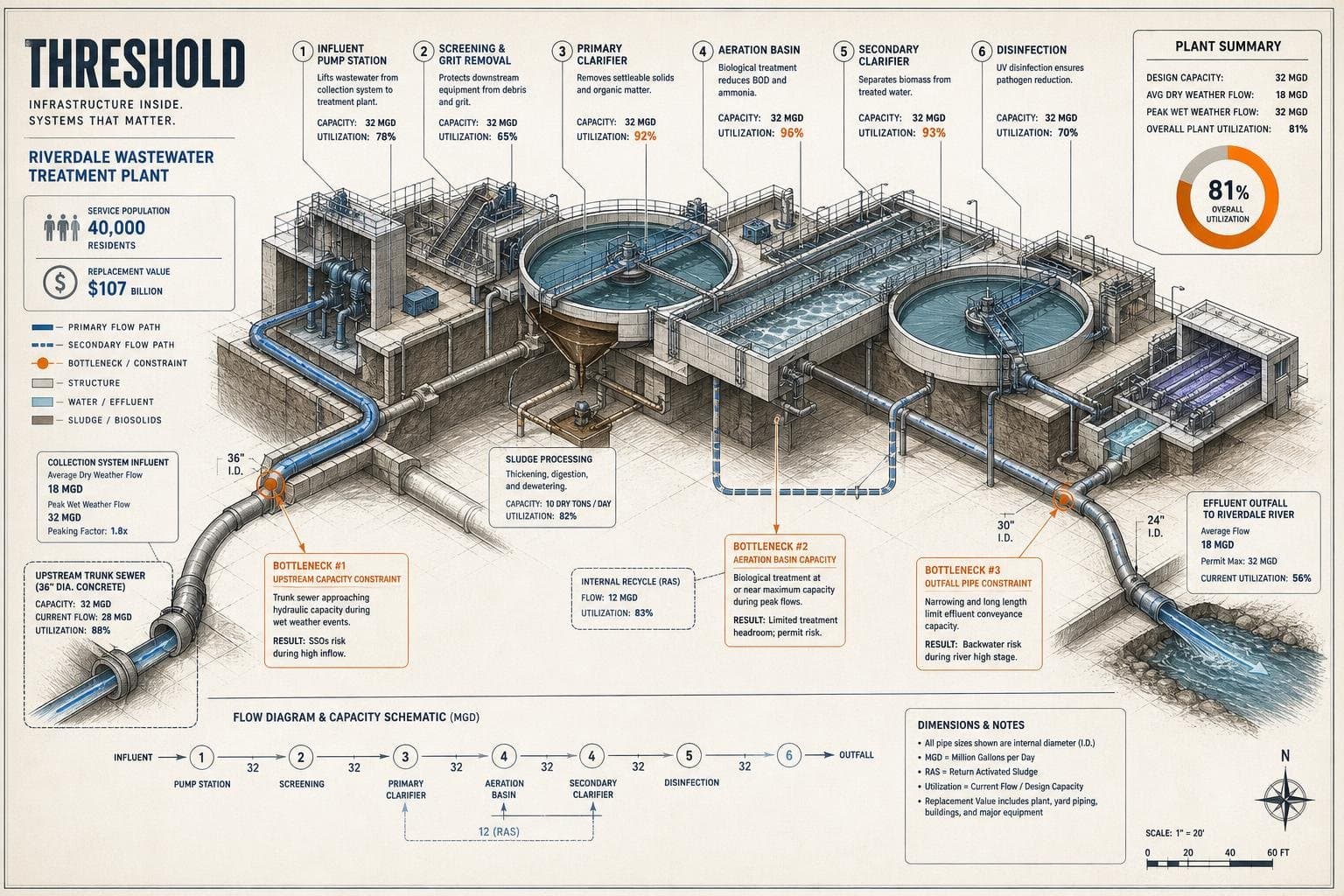

Winnipeg knows exactly how much room it has left. The city's North End Sewage Treatment Plant is mid-upgrade, but the existing system can absorb roughly 40,000 more residents before it hits capacity — and new industrial development could consume a portion of that headroom before residential growth does. The upgrade won't be complete in time to prevent a gap. That gap is approximately four years wide.
That's the infrastructure capacity problem stated with unusual precision. Most cities don't have numbers that clean. What they have is a version of the same constraint — aging treatment systems, pipes sized for populations that no longer match current demand, and a funding gap that keeps the math from closing.
The Constraint Isn't Hypothetical — It's Already Delaying Projects
The Winnipeg case is a useful illustration because it puts a number on something that usually stays abstract. But it's not an outlier. Across Canada, municipalities and developers are confronting wastewater plants nearing capacity, sewers that need expansion, and aging water systems requiring billions in investment — with the result that developments are being delayed, phased, or stopped even as provincial and federal governments push cities to approve housing faster. More than 11 percent of Canada's water and wastewater-related infrastructure was in poor or very poor condition in 2022, representing an estimated $107 billion in replacement value, according to the 2025 National Infrastructure Assessment (via the Financial Post).
The same dynamic is playing out in Austin, Texas, where a proposed 71-acre mixed-use development — White Rocks, which includes a 10,000-seat amphitheater, hotel, and 600 residences — ran directly into a water capacity dispute. Developers proposed serving the project's first phase through a 12-inch water main originally built for a single-family housing development. Austin Water concluded the system cannot accommodate the proposed demand without significant improvements. The pipe was adequate for what it was designed for. It was never designed for this.
That's the core pattern: infrastructure built for one load profile gets handed a different one, and the margin disappears. The pipe doesn't fail. The capacity just runs out.
The Federal Funding Picture Has a Capacity Problem of Its Own
The Infrastructure Investment and Jobs Act directed significant Clean Water State Revolving Fund money toward exactly these kinds of upgrades. But an August 2026 EPA Office of Inspector General review found that IIJA CWSRF grantees exhibited commonalities in their capacity to use the funds — meaning the bottleneck isn't only money. It's the institutional and technical capacity to absorb and deploy it. Funding arrives; the pipeline of shovel-ready projects, qualified staff, and procurement infrastructure to spend it efficiently does not always follow at the same pace.
This is a recurring finding in water infrastructure programs. The EPA's water infrastructure framework identifies needs, provides financing through the State Revolving Fund programs, and offers technical assistance — but the gap between identified need and completed project remains wide, particularly for smaller systems without dedicated grant-writing and project-management staff.
Meanwhile, the ASCE's 2025 Infrastructure Report Card moved the overall U.S. infrastructure grade from C- to C, with incremental improvements in several categories. But nine categories remain in the D range, and the report explicitly flags that sustained investment is necessary for long-term planning certainty. A grade improvement is real progress. It doesn't mean the capacity math has been solved.
The Timing Problem Is the Actual Problem
What makes water treatment capacity a harder constraint than most is the lead time. A bridge inspection can trigger a load restriction within weeks. A transformer can be ordered — slowly, but ordered. A wastewater treatment plant expansion takes years to plan, permit, finance, and build. The four-year gap in Winnipeg isn't a planning failure; it's what happens when a multibillion-dollar upgrade moves at the speed infrastructure projects actually move, while growth targets are set at the speed politicians prefer.
The Austin case illustrates the same timing asymmetry from the development side. A developer can propose a project, render it, pitch it, and submit a service extension request faster than a utility can assess whether the underlying system can support it — let alone upgrade it if it can't.
The honest read on water treatment capacity as a growth constraint is this: it's not a warning about some future ceiling. In a growing number of cities, the ceiling is already visible in the existing pipe inventory, the treatment plant utilization rates, and the upgrade timelines already on the books. The question for city planners and developers isn't whether water infrastructure will limit growth — it's whether the projects being approved today have accounted for where their water is actually coming from, and when the system serving them will run out of room.
Watch for how municipalities handle the gap between housing approval timelines and infrastructure delivery timelines — that's where the next round of project delays, phasing disputes, and utility-developer conflicts will surface.


