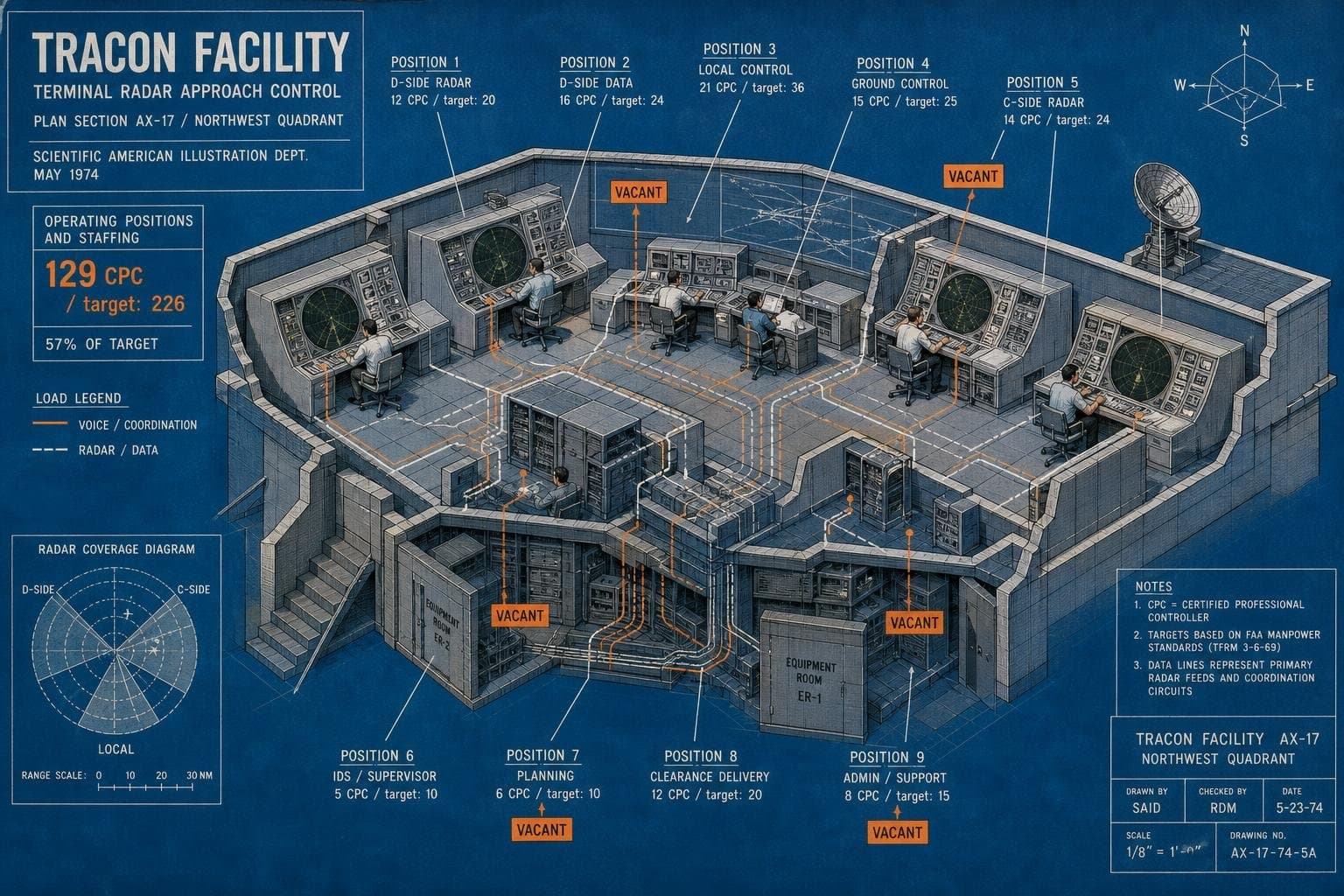

Newark Liberty is running at 57 percent of its controller staffing target. Not 57 percent of some aspirational stretch goal — 57 percent of the number the FAA itself says it needs to operate safely. The New York TRACON has 129 certified professional controllers against a target of 226, and the agency doesn't expect to reach even 70 percent of that target before 2028.
That's the number to hold in your head when you read the FAA's May 2026 workforce plan, which announced a "bold" strategy to erase the staffing shortage. Because the plan contains a detail that didn't make the press release headline: the FAA quietly reduced its full-staffing target from 14,633 certified professional controllers to 12,563. The agency is now running roughly 11,000 CPCs across more than 300 facilities — and even after lowering the bar by more than 2,000 positions, it's still 1,500 to 2,500 controllers short of the new, easier target.
Moving the goalposts isn't a staffing solution. It's an accounting maneuver.
The Gap Between Hiring Plans and Net Additions
The workforce plan commits to hiring 2,200 controllers in FY2026, 2,300 in FY2027, and 2,400 in FY2028 — numbers that appear in both the FAA's own documents and the agency's public statements. On paper, that's nearly 7,000 new hires over three years. In practice, the pipeline has been the binding constraint for a decade, not application volume.
A January 2026 Government Accountability Office report found that the FAA was receiving hundreds of thousands of applications. The bottleneck was the academy, the on-the-job training queue at each facility, and the multi-year path to full certification. Net additions get consumed by retirements and washouts. Even in years when the agency exceeds its hiring number, the system claws back most of the gain.
The Las Vegas TRACON illustrates the math at the local level. Its 2026 staffing target is 46 controllers; as of October 2024 it had 37, with an attrition forecast of 10 departures within three years. If those 10 departures materialize before replacements complete training — a process that takes up to two years — the facility could be operating at roughly 60 percent of target. That's not a projection from a critics' report. That's the FAA's own attrition forecast applied to the FAA's own staffing numbers.
Fatigue Is Now the Operating Model
The staffing shortfall has a human cost that shows up in the workload data. As of early 2026, more than 41 percent of certified professional controllers were reportedly working 10-hour days, six days a week. The National Air Traffic Controllers Association has been explicit about what sustained fatigue means for cognitive performance in a job where one missed instruction can put two aircraft in the same piece of sky.
This isn't abstract. The FAA extended operating restrictions at Newark through October 2027 and granted schedule relief at JFK, LaGuardia, and Reagan National — not because those airports are underperforming, but because the agency is formally acknowledging that the system cannot safely handle its scheduled traffic load. Newark's arrival on-time performance sits at 75 percent under the current limits. That's with the caps in place.
Nashville's situation adds another data point. The airport's tower is operating below federally recommended staffing levels, with fewer controllers today than 20 years ago — while passenger volume has more than doubled over the same period. In May alone, two staffing-related ground stops occurred within weeks of each other, with three additional ground freezes the month before.
The Technology Bet Carries Real Risk
The FAA's answer to the staffing gap includes a significant technology component: a recently awarded $875 million contract to Boston-based Air Space Intelligence for cloud-based software that will give airlines and controllers a shared view of the airspace, using AI to predict traffic flows and identify conflicts before they occur. Congress provided $12.5 billion for the broader ATC overhaul, with advocates arguing at least another $19 billion is needed to fully fund it.
The technology investment is defensible as a long-term thesis. Shared data, predictive traffic management, and better scheduling tools can genuinely reduce workload. But software doesn't certify controllers, and it doesn't replace the judgment of an experienced human managing a complex airspace sector at peak demand. The new "modern staffing model" — the justification for lowering the controller target by 2,000 positions — is explicitly a bet that automation can absorb workload that was previously absorbed by people. That bet may prove correct in 2030. It is a dangerous assumption to operationalize in 2026, when the tools are still being deployed and the controllers running the system are already working six-day weeks.
Watch for the FAA's FY2026 hiring actuals when they're published this fall. The gap between the 2,200-hire target and the net CPC count after retirements will tell you whether the workforce plan is closing the shortage or just describing it in more optimistic terms.


