


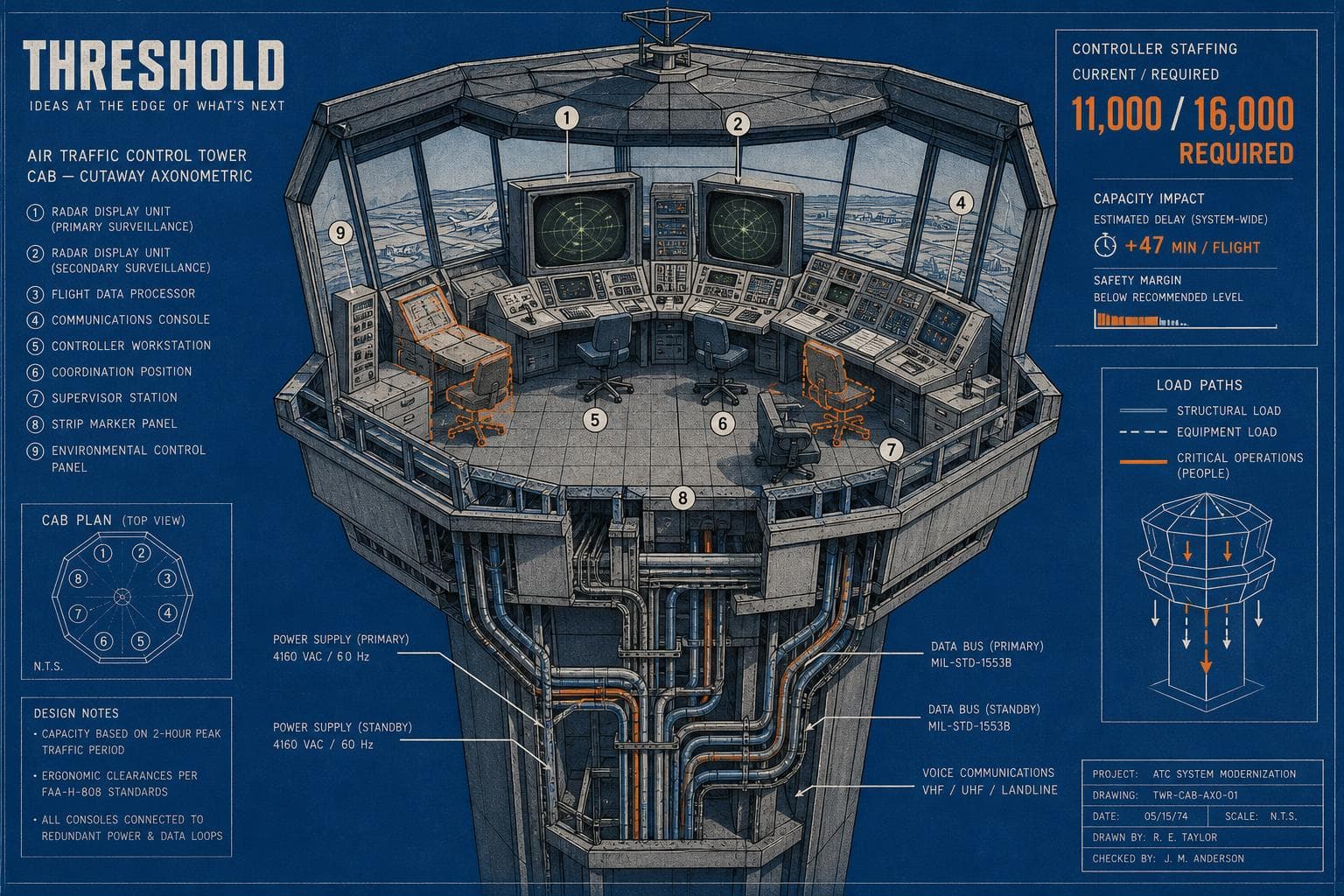

The hiring window opened at midnight on April 17. Within 12 hours, 6,000 applications had arrived. That sounds like a success story. It isn't — or at least, not yet. Because the pipeline from application to certified controller runs three to five years, and the system operating right now is running at roughly 70% of stated staffing requirements.
That gap is the number that explains your delays.
The Workforce Equation Doesn't Close Easily
Here's the baseline: before the November 2025 government shutdown, 11,000 fully certified controllers were working in the U.S. air traffic control system, per prior USA Today reporting. The government's own stated requirement is roughly 30% higher than that — meaning the system is operating with a structural deficit of several thousand controllers on any given day.
That deficit didn't appear suddenly. The controller workforce fell 6% between 2015 and 2025, according to a December 2025 GAO report — while the number of flights relying on ATC systems increased 10% over the same period. Load went up. Capacity went down. The margin compressed.
The consequences are predictable from a systems standpoint: when you run a network near its staffing ceiling, any perturbation — weather, equipment issues, a single facility going short-handed — cascades. Controllers who were already logging 10-hour days, six days a week before the shutdown have limited surge capacity. There's no slack in the system to absorb spikes.
What the Pipeline Actually Produces
The FAA's new recruitment campaign — targeting gamers on YouTube and Roblox, advertising a $155,000 salary after three years — is a genuine attempt to expand the applicant pool. The logic isn't frivolous: spatial reasoning, multitasking, and fast pattern recognition are real prerequisites for the job, and gaming does develop some of those skills.
But the pipeline math is sobering. From 2017 to 2022, 106,500 people with prior ATC experience applied for controller positions. About 4,000 were hired. Roughly 2,300 completed training and became fully certified. That's a yield rate under 3% from application to certification — and that cohort had prior experience. New applicants with gaming backgrounds face the full training gauntlet: the Air Traffic Skills Assessment, medical and security clearances, FAA Academy in Oklahoma City, then one to three years of on-the-job training before earning Certified Professional Controller status.
The 6,000 applications in 12 hours is a demand signal, not a staffing solution. Even with aggressive hiring, the controllers certified from this cohort won't be working live traffic until 2029 at the earliest.
The Structural Problem Behind the Staffing Problem
I'd argue the deeper issue isn't recruitment — it's that the system has been running a deferred maintenance cycle on its human capital for a decade, and there's no fast-forward button on the fix.
The LaGuardia incident in April — an Air Canada jet striking a fire truck on landing, killing two people — put the staffing shortage in sharp public focus. Investigators are examining coordination between air traffic and ground control personnel. One controller's words on the recording were stark: "I messed up." Whether staffing pressure contributed to that specific failure is still under investigation. But the broader pattern is documented: a workforce stretched thin, with limited redundancy, handling more traffic than it was sized for.
The FAA's hiring push, the $155,000 salary advertisement, the Roblox outreach — these are the right moves given the constraints. But watch the certification numbers, not the application numbers. The metric that matters is how many controllers reach Certified Professional Controller status in 2027 and 2028, and whether attrition from the existing workforce outpaces new entries. If the FAA can certify 1,800 to 2,000 new controllers per year while holding retirements steady, the gap starts closing by the end of the decade. If attrition accelerates — and an overworked workforce is a retention risk — the math gets worse before it gets better.
The 6,000 applications are a start. The system needs about 5,000 certified controllers. Those are not the same number.