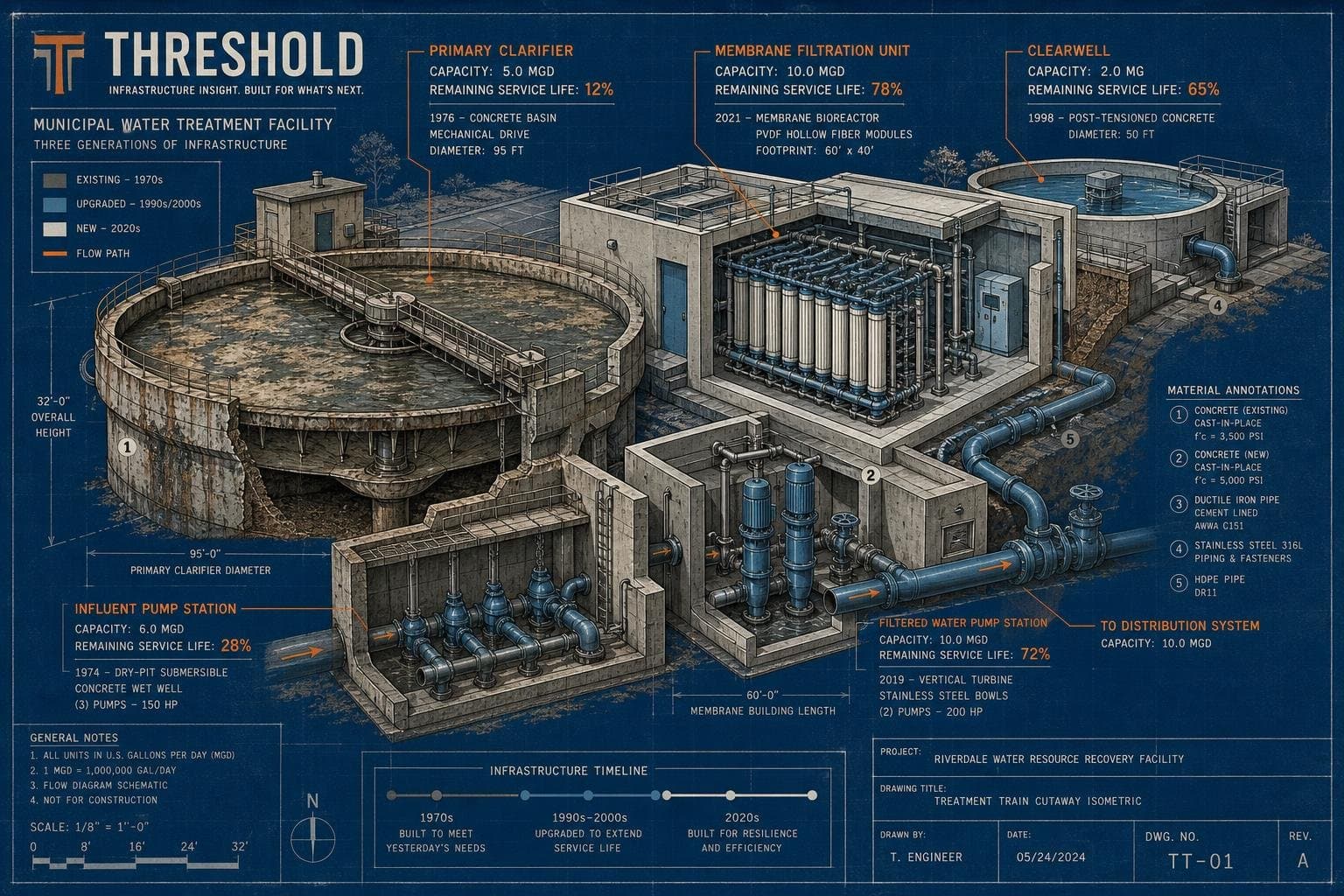

A city can approve ten thousand new housing units. It can rezone industrial corridors, fast-track permits, and cut ribbon after ribbon. What it cannot do is conjure treatment capacity that doesn't exist. At some point, the pipes become the answer — and right now, across much of the country, the answer is no.
The math is stark. ASCE's national drinking water assessment puts the 20-year infrastructure need at $625 billion — up more than $150 billion from EPA's 2018 estimate. That gap didn't widen because engineers revised their methodology. It widened because deferred maintenance compounds, populations grew into systems designed for smaller loads, and emerging contaminants like PFAS created treatment requirements that 1970s-era plants were never built to handle.
The 2021 Infrastructure Investment and Jobs Act committed more than $30 billion for drinking water capital improvements, lead service line removal, and PFAS remediation. That's real money. It's also roughly five cents on the dollar against the identified need.
The Asset Management Gap Is Where Capacity Problems Hide
The $625 billion figure captures replacement and repair costs. What it doesn't fully capture is the operational blind spot that lets systems deteriorate past the point where incremental maintenance is sufficient.
ASCE reports that only about 30% of utilities have fully implemented an asset management plan — the systematic process of tracking what you own, what condition it's in, and when it will fail. Just under half are in the process of implementing one. That means roughly one in five utilities is operating without a clear picture of their own infrastructure's remaining service life.
For a water treatment plant, that's not an administrative gap — it's a capacity planning gap. You cannot schedule a membrane filtration upgrade, a pump station expansion, or a clearwell enlargement if you don't know when your existing equipment will reach the end of its useful life. And you certainly can't tell a city planner whether the system can absorb fifty thousand new residents if you're still working from paper records and institutional memory.
EPA's new systemic issues checklist, released for state partners, explicitly flags "demand in source water nearing capacity" as a systemic issue — the kind of problem that could eventually lead to a disruption of water services if a failure occurs. The Association of State Drinking Water Administrators, quoted in the same EPA release, called the checklist "a practical resource that will help drinking water primacy agencies and public water systems identify and address challenges before they become risks to service reliability or public health." A checklist doesn't build capacity; it identifies where capacity is running out.
Arizona Is the Stress Test in Real Time
The clearest current case study is Arizona, where population growth and extreme heat are colliding with infrastructure that earned a C from ASCE's 2025 state report card. The state ranked third in population growth in 2019, and the pressure hasn't let up.
Axios Phoenix reported on August 11 that Arizona's C grade — unchanged from 2020 — drew a pointed response from ASCE Arizona section president Frederick Tack: "While this grade is ahead of many states around the country, an average grade of C is not acceptable." Roads earned a D+ and face a projected funding gap of $162 billion by 2050. Drinking water sits in the C-range — adequate for now, but not sized for the growth trajectory the state is on.
The structural problem is that water treatment capacity is a long-lead-time constraint. A new treatment plant takes years to permit, design, and build. A major expansion of distribution infrastructure takes longer. Growth, by contrast, can happen in months — a subdivision approved, a data center announced, a semiconductor fab breaking ground. The infrastructure timeline and the development timeline are not synchronized, and nobody in the permitting chain is required to reconcile them. Arizona's 2020 ASCE report card flagged this directly: the state's rapid population growth "stands to strain our systems if we don't plan ahead."
Small Systems Face the Same Math With a Fraction of the Resources
The capacity problem isn't limited to fast-growing metros. The nation's drinking water infrastructure comprises more than 2 million miles of underground pipes operated by nearly 150,000 public water systems — and half of those systems serve communities of fewer than 500 people, according to ASCE. These small utilities lack the rate base to finance major capital projects through bonds, and they often lack the technical staff to navigate federal grant programs.
EPA's recent $30 million Real Water Technical Assistance grant announcement targets exactly this gap — providing training and technical, managerial, and financial support to small and rural systems. Since 2012, the program has provided over $200 million to technical assistance providers. That's meaningful support for operational capacity. It doesn't, however, fund the physical infrastructure expansions that would allow these communities to absorb growth.
The constraint is real and it's structural. Meanwhile, FEMA's Building Resilient Infrastructure and Communities program — which funds hazard mitigation work including utility hardening and pump station securing — had its FY2024-25 application window close in July 2026. For small systems trying to layer resilience onto already-strained capacity, the gap between available grant cycles and actual capital need is its own kind of bottleneck.
The through-line here is the same one that runs through every deferred-maintenance story: the cost of inaction is not zero, it just arrives later and arrives larger. A treatment plant that's adequate today but has no expansion plan is a growth ceiling that will become visible at the worst possible moment — after the permits are approved, after the units are built, after the residents move in.
Watch for EPA's PFAS treatment compliance deadlines and state-level capacity assessment requirements as the next forcing function. Those regulatory timelines don't flex for funding gaps, and they will accelerate the reckoning for systems that have been running on margin.


