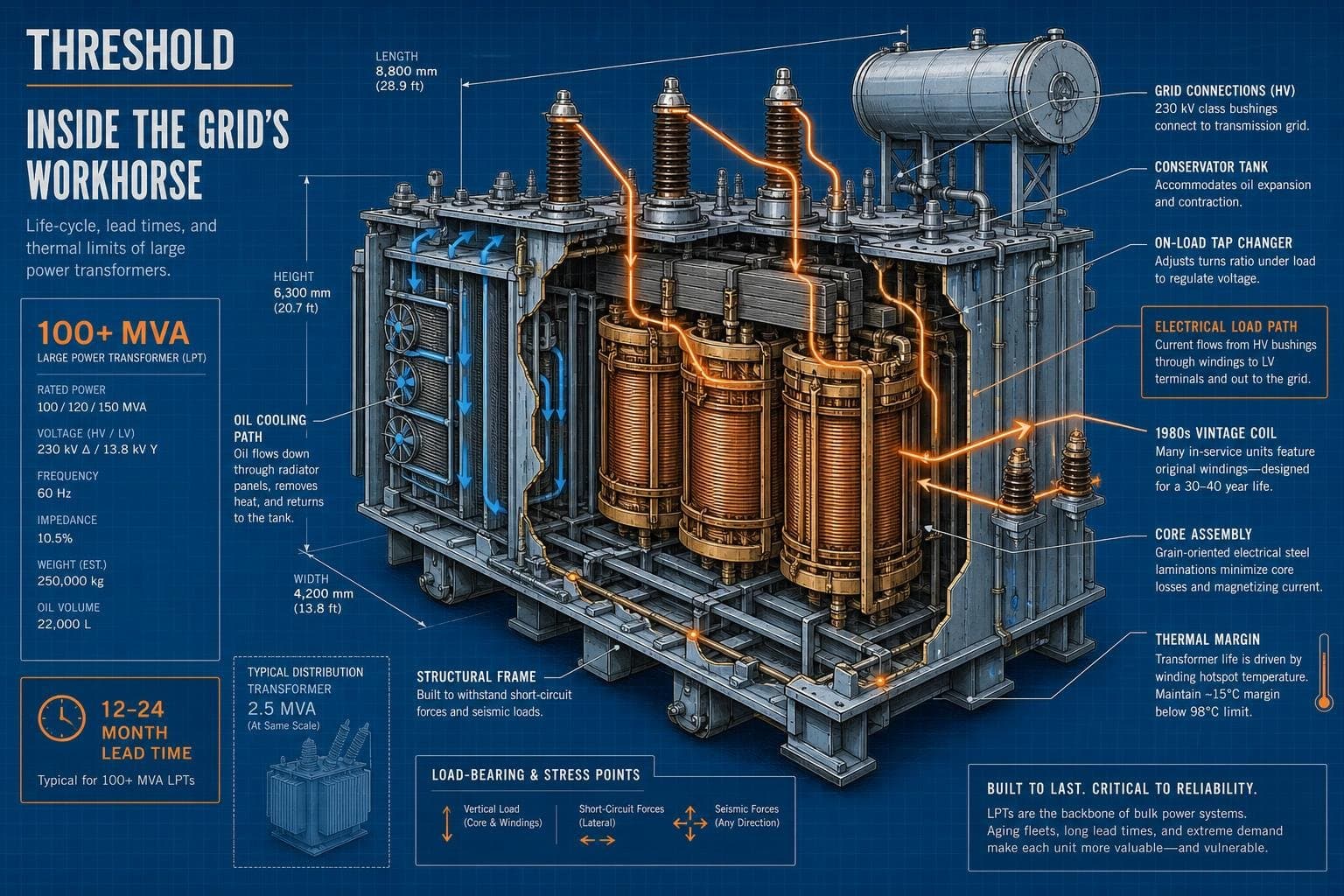

The most-cited statistic in American grid coverage has a stranger origin than almost anyone quoting it realizes. The claim that the average U.S. transformer is more than 40 years old traces back to a 2012 DOE report on large power transformers — equipment rated 100 MVA or higher, transmission-class gear — and a 2014 update that softened the figure to 38–40 years. That estimate, as Reliable Media's sourcing guide documents, rests on figures offered by equipment manufacturers during a 2011 antidumping trade dispute, not a unit-level federal inventory. DOE published it as an approximation and has been citing it ever since.
That's not a reason to dismiss the aging concern. It's a reason to be precise about what the concern actually is.
The Statistic Describes a Sliver — the Most Dangerous Sliver
The DOE's large power transformer (LPT) category covers transmission-class equipment: the massive, custom-wound units that step voltage up and down at the backbone of the grid. The distribution transformer fleet — the smaller units on utility poles and in neighborhood substations — runs to 60 to 80 million units, and DOE explicitly excluded it from the aging assessment because domestic manufacturing capacity and backup supplies exist for that size range.
The LPT fleet is the problem. These are not off-the-shelf items. Lead times for large power transformers have historically run 12 to 24 months under normal conditions, longer when demand spikes. There is no meaningful domestic stockpile. When one fails, the replacement timeline is measured in seasons, not weeks — and the grid segment it serves goes without its primary protection during that window.
So the 40-year figure, imprecise as it is, points at the right equipment class. The issue is that it gets applied indiscriminately to every transformer conversation, which obscures where the actual exposure sits.
What's Narrowing the Margin Right Now
The aging fleet would be a manageable slow-burn problem if load were stable. It isn't. NERC's 2026 State of Reliability report, released June 24, found that conventional generator forced-outage rates hit 9.2 percent in 2025 — above the historical 7–8 percent norm — while data centers produced two customer-initiated load reductions exceeding 1,000 MW during the year. A 1,000 MW load departure is the same disturbance magnitude as losing a large generating unit, arriving from the demand side where no interconnection studies, ride-through obligations, or performance standards yet apply.
The compounding is the story. Thermal generation is delivering less reserve capacity at exactly the moment demand is becoming less predictable. Aging transmission infrastructure sits in the middle of that squeeze.
DOE's July 2026 draft National Transmission Needs Study frames the challenge directly: transmission operators are confronting accelerating load growth and aging infrastructure simultaneously, with data center construction driving demand curves that existing grid models weren't built to anticipate. The study identifies transmission capacity constraints and congestion as present and expected harms to consumers — not hypothetical future risks.
The Regulatory Clock Is Now Running
The policy response is moving faster than the infrastructure response. On July 16, FERC ordered NERC to file modified reliability standards addressing computational loads — data centers and large IT infrastructure — by December 31, 2026, with a workplan for additional standards due by March 1, 2027. NERC had documented multiple grid disturbances in which computational loads caused or contributed to bulk power system instability; FERC concluded that NERC's voluntary timeline wasn't adequate.
That's a meaningful deadline. Standards filed by year-end would establish registration requirements and reliability obligations for large computational loads — the demand-side variable that NERC's own report identified as a new source of grid stress. Whether those standards can be implemented fast enough to matter is a separate question, but the regulatory framework is at least catching up to the operational reality.
On the supply side, the engineering consulting market is signaling where the investment is flowing. Arcadis recently acquired Spanish power design specialist Satel, positioning itself for Spain's roughly $22 billion grid modernization program through 2030 — a program that includes high-voltage transmission and substation work at scale. The acquisition logic reflects a broader pattern: grid modernization work is becoming a premium engineering service, and firms are consolidating to capture it.
The Number to Watch Isn't Age — It's Replacement Rate
The 40-year average will keep circulating in congressional testimony and investor decks. It's not wrong, exactly, but it's not the right metric for assessing near-term risk. The questions that matter operationally are: What is the current replacement rate for transmission-class transformers? How does that rate compare to the retirement curve of units installed in the 1980s and 1990s? And what does the lead-time picture look like when multiple utilities are competing for the same limited manufacturing capacity during a demand surge?
Those figures aren't in the DOE's approximation. They're in utility capital plans, FERC filings, and the order books of the handful of manufacturers that build this equipment. Watch NERC's December 2026 standards filing — it will force those numbers into the open for the first time under a mandatory reliability framework.


