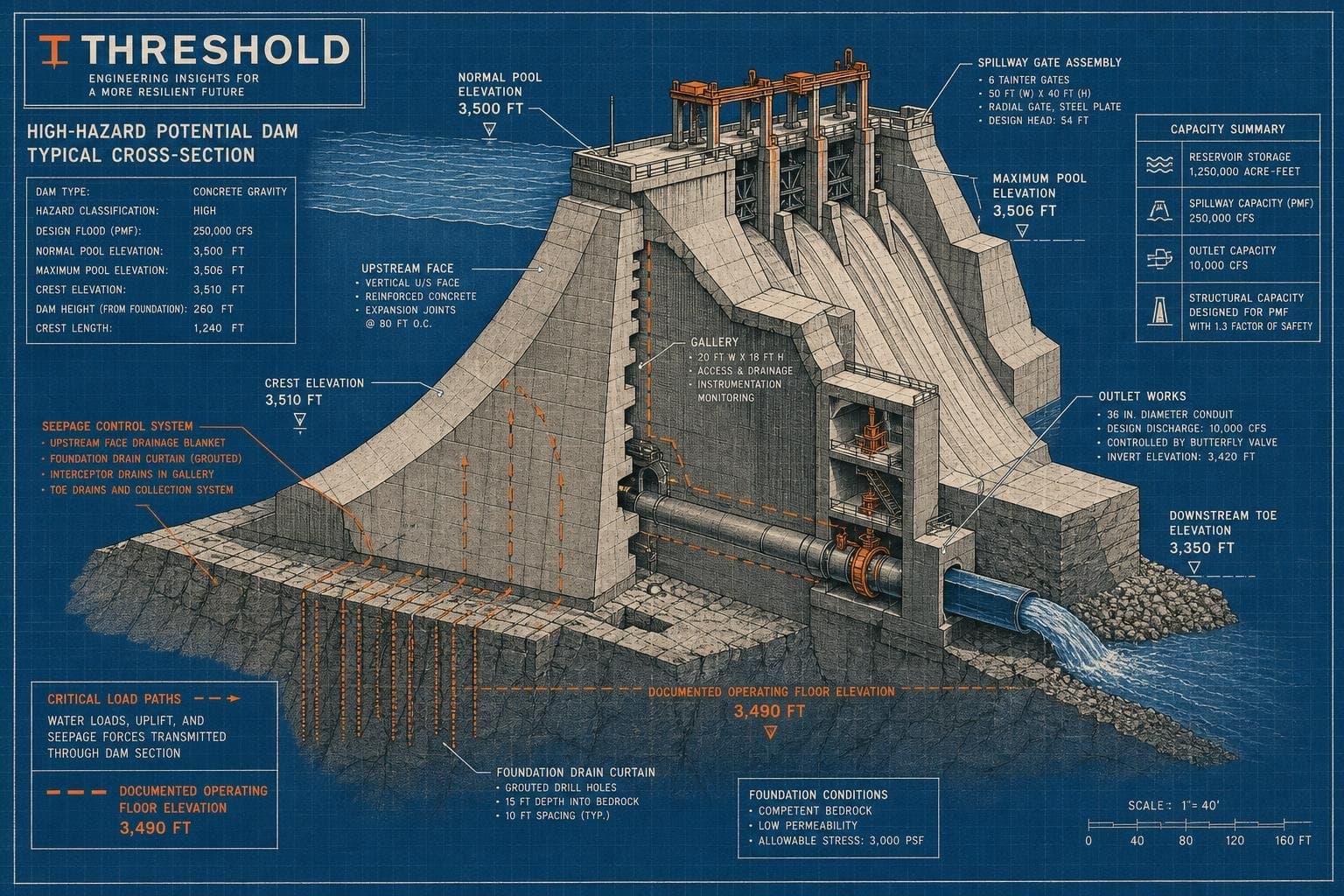

The math on dam safety has never been complicated. Preventive maintenance on a high-hazard dam costs a fraction of emergency repair after a failure — and emergency repair costs nothing compared to the downstream consequences of a breach. Yet the federal funding structure that governs most of the nation's 94,000 dams consistently underweights the preventive side of that equation.
Two federal grant programs are open right now that illustrate the gap precisely.
The Rehabilitation Ceiling Is Too Low to Move the Needle
FEMA's Rehabilitation of High Hazard Potential Dams grant program is offering $11.4 million for fiscal year 2026 to support rehabilitation, repair, or removal projects at non-federal high-hazard dams. The State Assistance Grant Program, running concurrently, has an estimated $7.4 million available to strengthen state dam safety programs broadly — inspections, emergency action planning, equipment.
Combined, that's roughly $18.8 million in federal dam safety funding for a single fiscal year, spread across eligible states and territories competing for the same pool.
To put that in context: California alone has authorized up to $228 million through its Dam Safety and Climate Resilience Local Assistance Program — a single state program, funded through the California Budget Act of 2025, targeting repairs, rehabilitation, and enhancements at state jurisdictional dams. That's more than twelve times the federal rehabilitation allocation, for one state's inventory.
The disproportion isn't an accident of this particular budget cycle. It reflects a structural reality: federal dam safety funding has historically been sized for program administration and state capacity-building, not for closing the actual rehabilitation backlog. The high-hazard classification — reserved for dams whose failure would cause loss of human life and significant property destruction — should concentrate funding urgency. Instead, it concentrates competition.
The Colorado River Case: Engineering Constraints as Budget Drivers
The Bureau of Reclamation's post-2026 Colorado River operating framework, finalized in a July 31 Environmental Impact Statement, makes the cost tradeoff concrete in a way that abstract budget comparisons don't. According to Engineering News-Record, the preferred framework prioritizes maintaining Lake Powell above 3,500 feet elevation specifically because Glen Canyon Dam's river outlet works were not designed for sustained low-elevation operation — and hydropower generation ceases entirely below 3,490 feet.
That's a maintenance and design constraint, not a drought constraint. The dam's outlet infrastructure has a documented operating floor, and the entire post-2026 operational framework for the Colorado River — affecting water deliveries across seven states — is being shaped around it. Arizona, California, and Nevada pushed during the environmental review for Reclamation to evaluate physical modifications to Glen Canyon Dam rather than treating the outlet-works limitation as a fixed constraint. Reclamation declined, leaving potential infrastructure modifications to separate engineering and environmental review.
The cost of that deferred evaluation is now embedded in the operating rules: coordinated releases from upstream reservoirs triggered when Lake Powell approaches the critical threshold, managed through anticipated two-year incremental updates through 2036. That's an operational workaround for an infrastructure problem — and operational workarounds accumulate their own costs over time.
Prevention Doesn't Win Budget Fights — Failure Does
Arizona's 2026 ASCE infrastructure report card gives the state's dams a grade of C, part of an overall infrastructure GPA that has held flat at C since 2020 despite the state's rapid population growth and the compounding effects of drought, wildfire, and more intense storm events. The report notes that funding shortfalls persist across dam, levee, bridge, and water sectors — and that the Infrastructure Investment and Jobs Act helped close some pre-2021 gaps, but state transportation revenues alone face a projected shortfall exceeding $162 billion by 2050.
The pattern is consistent across states: infrastructure grades hold steady or decline slowly, funding gaps widen, and the federal programs designed to address the highest-risk assets are capitalized at levels that can fund a handful of projects per cycle rather than systematic rehabilitation.
The FEMA High Hazard Potential Dam program's application window for FY2026 closed August 31. States that applied are now waiting to learn whether their highest-risk dams made the cut for a share of $11.4 million. The ones that didn't will manage those dams on state budgets, local maintenance programs, and whatever inspection cycles their dam safety offices can sustain — until the next funding cycle, or until something forces the issue faster.
The engineering case for preventive maintenance over emergency repair is airtight. The budget case, apparently, still needs to be made.
Watch for FEMA's FY2026 HHPD award announcements, which will show which states secured rehabilitation funding and which high-hazard dams remain unfunded heading into the next inspection cycle. California's DSCR program solicitation period, following the close of its August comment window, will be an early indicator of whether state-level funding can compensate for the federal gap — or whether it's simply addressing a different tier of the same backlog.


