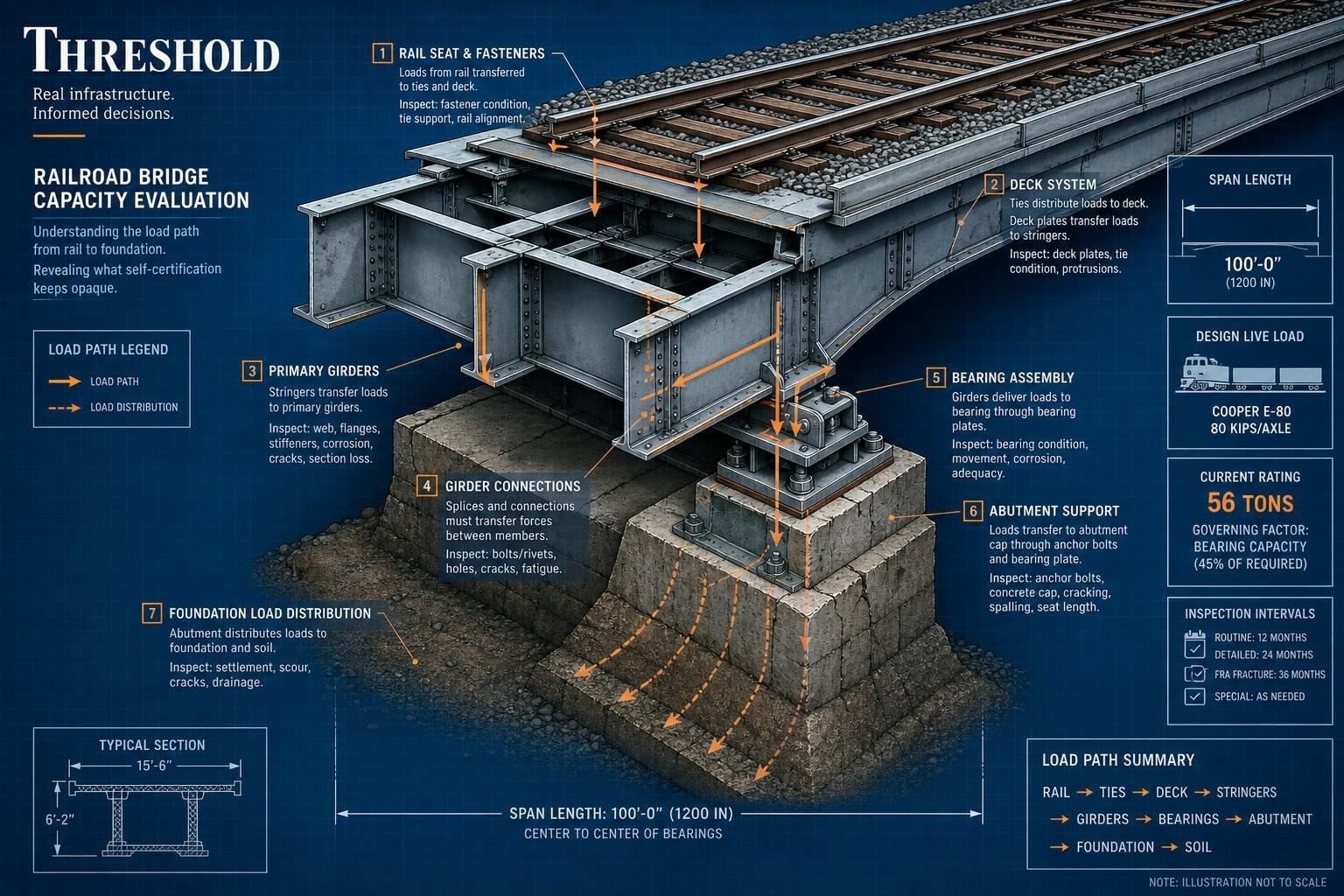

Drive across a D-rated highway bridge and you can look up exactly why it's rated that way — a state DOT inspection report, a federal sufficiency rating, a number that feeds into the next ASCE report card. Cross a railroad bridge on an Amtrak route or next to a grade crossing, and there's no equivalent public score to check. That's not an oversight failure in the sense of neglect — it's a structural difference in how the two systems are regulated, and it's worth understanding before anyone draws a straight-line comparison between rail and highway bridge safety.
Two Different Regulatory Philosophies
Highway bridges are inspected under a federally mandated framework that produces condition ratings state DOTs publish and ASCE aggregates into its report cards. Railroad bridges operate under a different model entirely. The Federal Railroad Administration doesn't run its own national inspection and grading program the way the National Bridge Inventory does for highways. Instead, under 49 CFR Part 237, each railroad is required to maintain its own bridge management program — covering inspection (Subpart E), capacity determination (Subpart D), repair and modification (Subpart F), and documentation and audits (Subpart G) — and FRA's role is to review, audit, and provide technical oversight of those programs rather than issue its own condition grades.
That's a self-certification model layered under federal audit, not a public report card. FRA bridge staff do participate in accident investigations and bridge management program reviews, per the agency's own description of its bridge and structures office, but the output of that oversight doesn't surface as a number a rider or a city council member can pull up the way a highway bridge's NBI rating does. The regulation itself dates to 2010 — Part 237 has been in effect since July 2010 — so this isn't a new gap. It's a long-standing structural asymmetry between how the two modes are held accountable to the public.
The Rulebook Just Got Lighter, Not Heavier
What is new is a regulatory move in the opposite direction. FRA finalized a rule, published in the Federal Register on April 28, 2026, repealing certain bridge load capacity evaluation requirements under Part 237. That rule traces back to a proposed version FRA floated in July 2025, meaning this went through roughly nine months of notice-and-comment before finalizing. The published record doesn't specify in the available text exactly which load capacity evaluation provisions were struck or what triggered the change, and I'm not going to guess at specifics the source doesn't give me. What's confirmed is the direction: FRA is removing, not adding, requirements in the capacity-evaluation subpart of its bridge safety rule, at the same moment highway bridge inspection and reporting obligations remain intact and increasingly visible through ASCE's publication cycle.
The Visibility Mismatch Is the Story, Not the Safety Record
None of this means railroad bridges are less safe than highway bridges — there's no dataset here that supports that comparison, and I'm not going to manufacture one. What the sources do support is a visibility mismatch. ASCE's 2025 national report card gave rail an improved grade and pushed the country's overall infrastructure score to a C, while specific state bridge categories — Texas at B-, California at C- — get itemized, published, and explained with methodology behind them, per ASCE's state report card coverage and the national 2025 report card analysis from Engineering News-Record. Rail shows up in that cycle as a sector grade — an improvement signal — but nothing comparable to an individual bridge's sufficiency rating exists in the public record for the freight or passenger bridges underneath it. California's own infrastructure breakdown assigns bridges a C- and rail improved separately, per ASCE's California report, but that's a statewide rail sector score, not a structure-by-structure condition rating anyone outside FRA and the railroad itself can audit independently.
The question worth tracking isn't whether FRA's self-certification model is adequate — that requires inspection outcome data this pool doesn't contain. It's whether a federal agency can simultaneously loosen load-capacity evaluation requirements and maintain the audit capacity to catch what individual railroads self-report. FRA's own Subpart G audit provisions are the mechanism that's supposed to do that. Whether audit frequency and staffing keep pace with a lighter rulebook is the number that deserves a public answer, and right now there isn't one.


